
City of the Taj
Where the Mughal Empire built its most enduring monument to love
City of the Taj
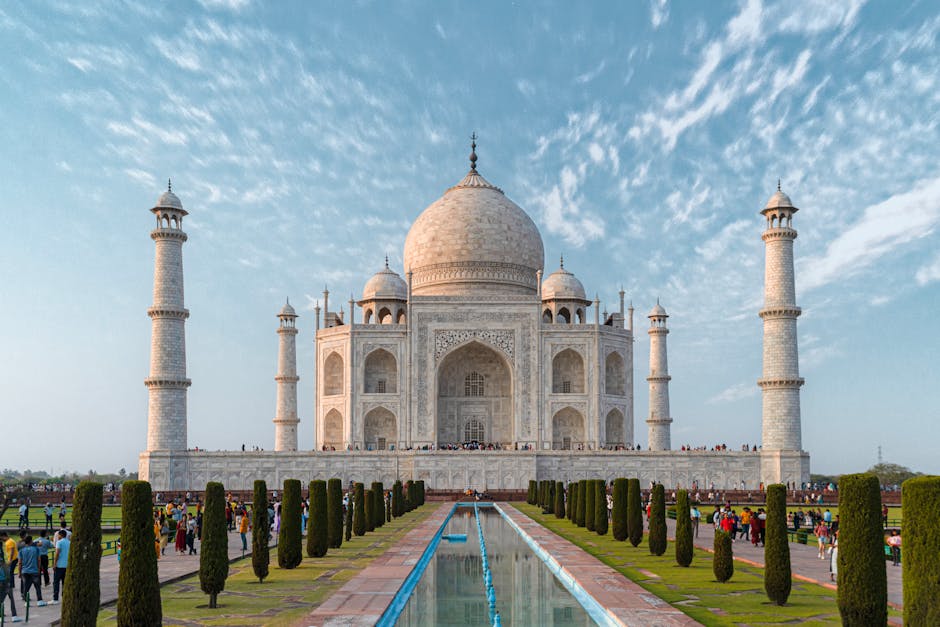
Agra needs no introduction — the city of the Taj Mahal has drawn travelers for nearly four centuries. But beyond its marble icon, this former Mughal capital rewards the curious with imposing red sandstone fortresses, exquisite tombs described as the 'Baby Taj,' and narrow lanes where artisans still practice the same pietra dura marble inlay technique that adorns the Taj itself. The old city vibrates with life: sweet shops pile pyramids of the famous petha, kebab stalls fire up at dusk, and the call to prayer echoes from centuries-old mosques.
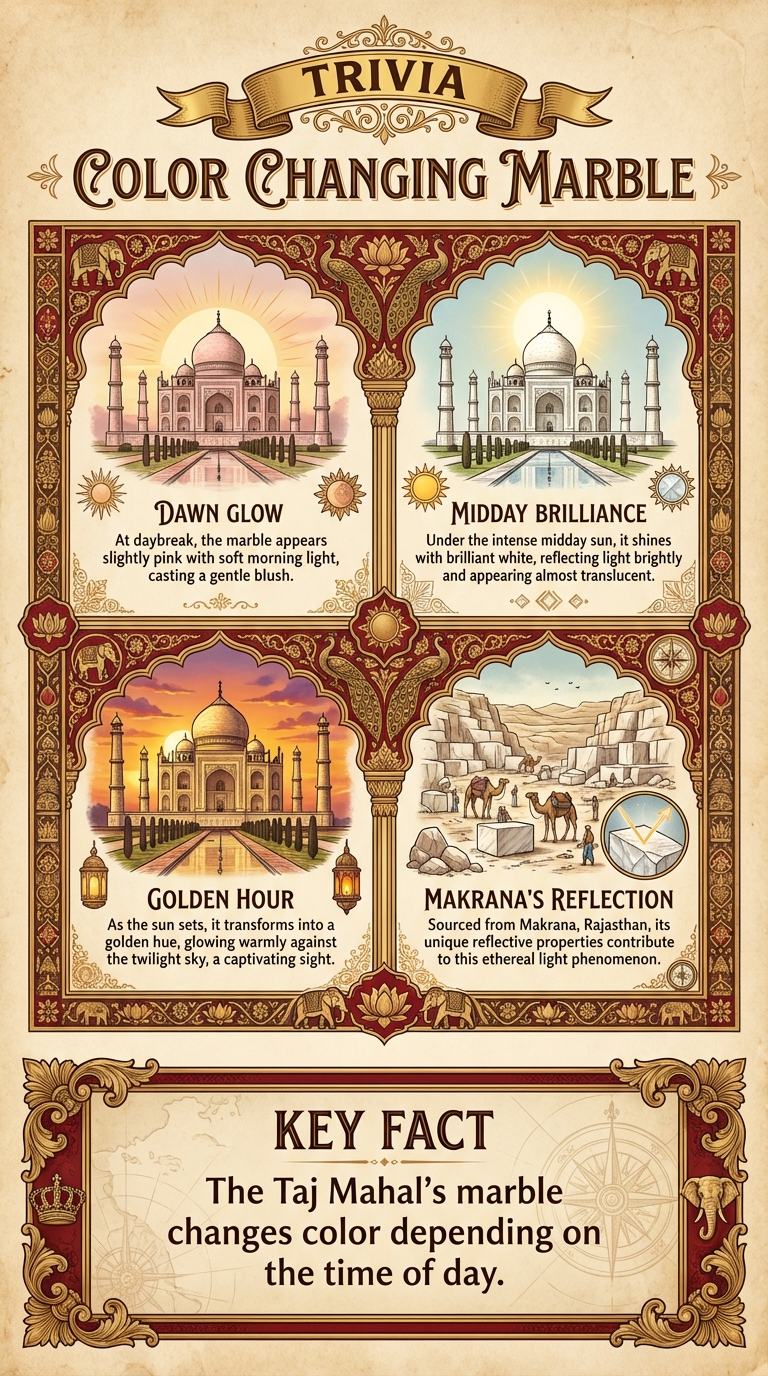
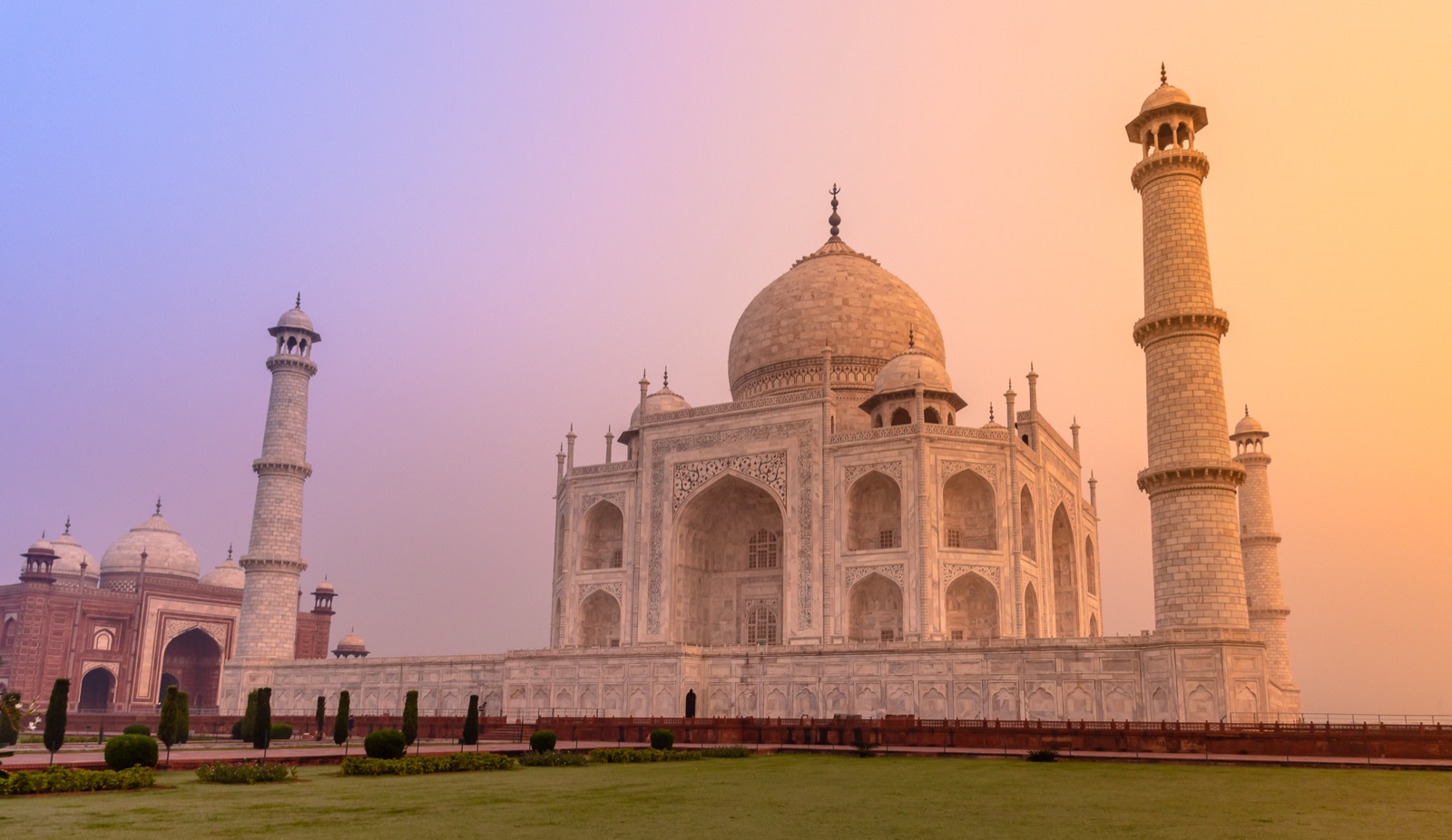
The best strategy for Agra is to arrive early and stay late. The sunrise at the Taj is unmissable — the white marble shifts from pale pink to blazing gold as the sun clears the Yamuna. Spend afternoons exploring Agra Fort's labyrinthine corridors and the romantic Mehtab Bagh across the river. And don't rush through: the magic of Agra lies in its quieter moments — watching the light change on marble, sipping chai with a shopkeeper, or discovering a hidden Mughal garden that most tourists never find.
Agra
The Yamuna River city of Agra served as the Mughal capital during the 16th and 17th centuries, producing some of the world's greatest architectural masterpieces. Today it's a bustling north Indian city where ancient monuments sit alongside chaotic bazaars. Most visitors come for the Taj, but the city deserves at least two full days.
The essential sights and experiences
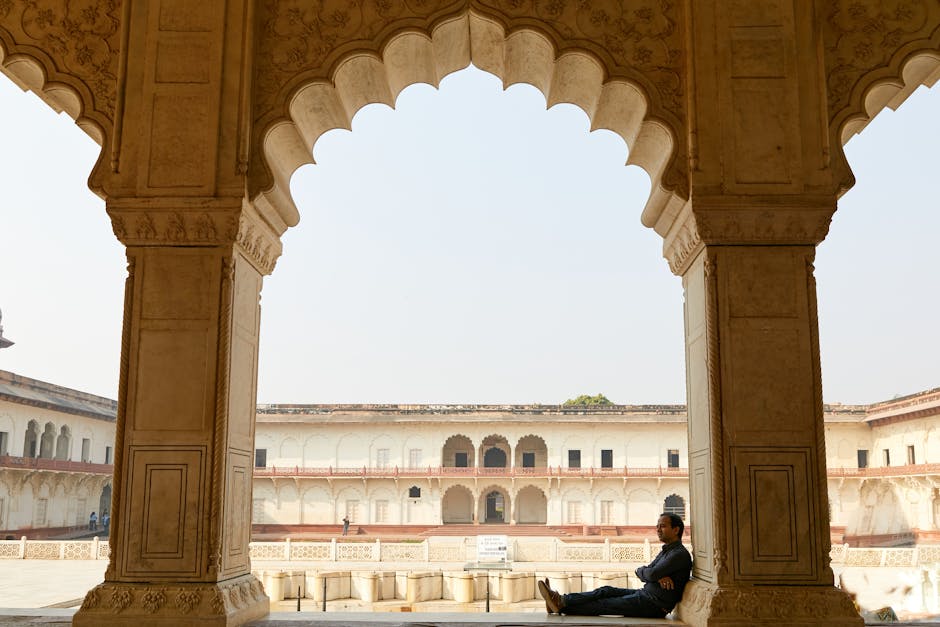
Dharmapuri, Forest Colony | ₹50/₹1,100
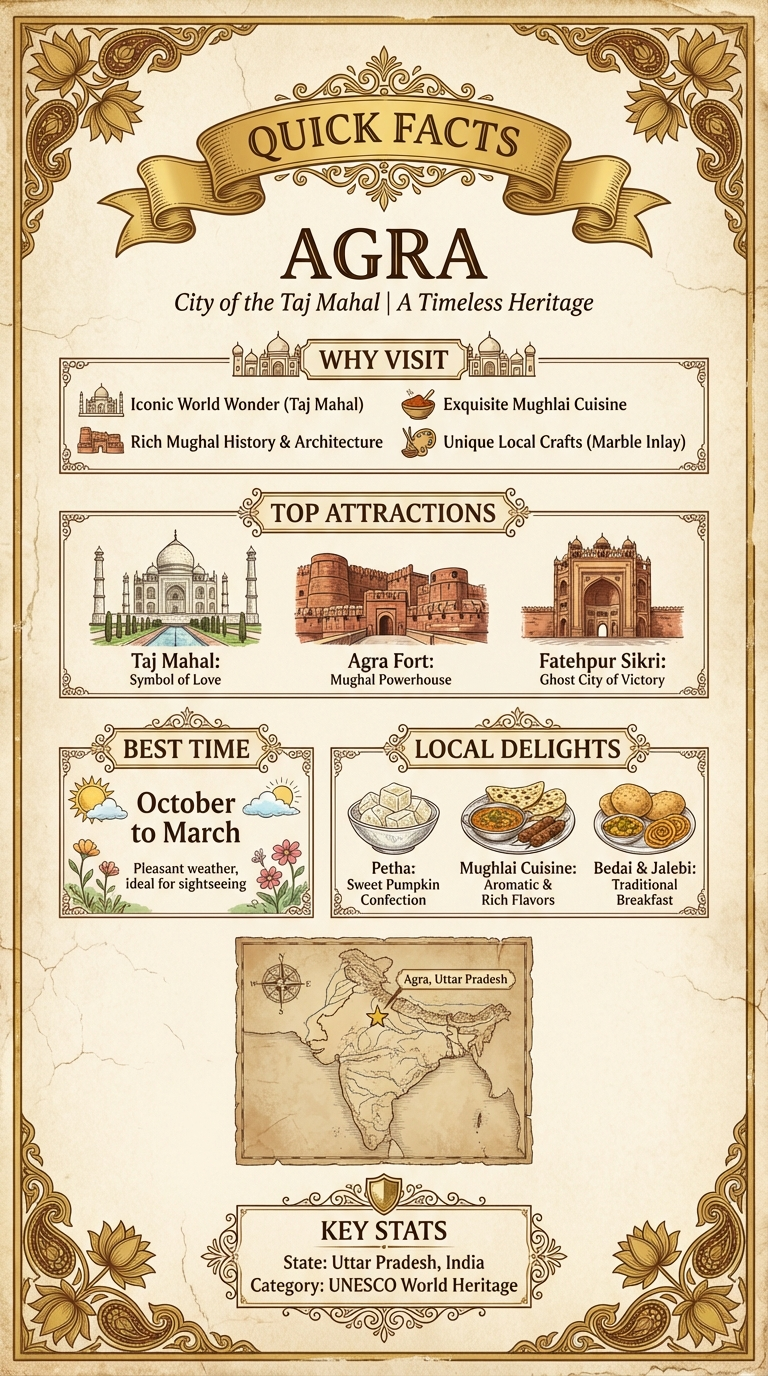
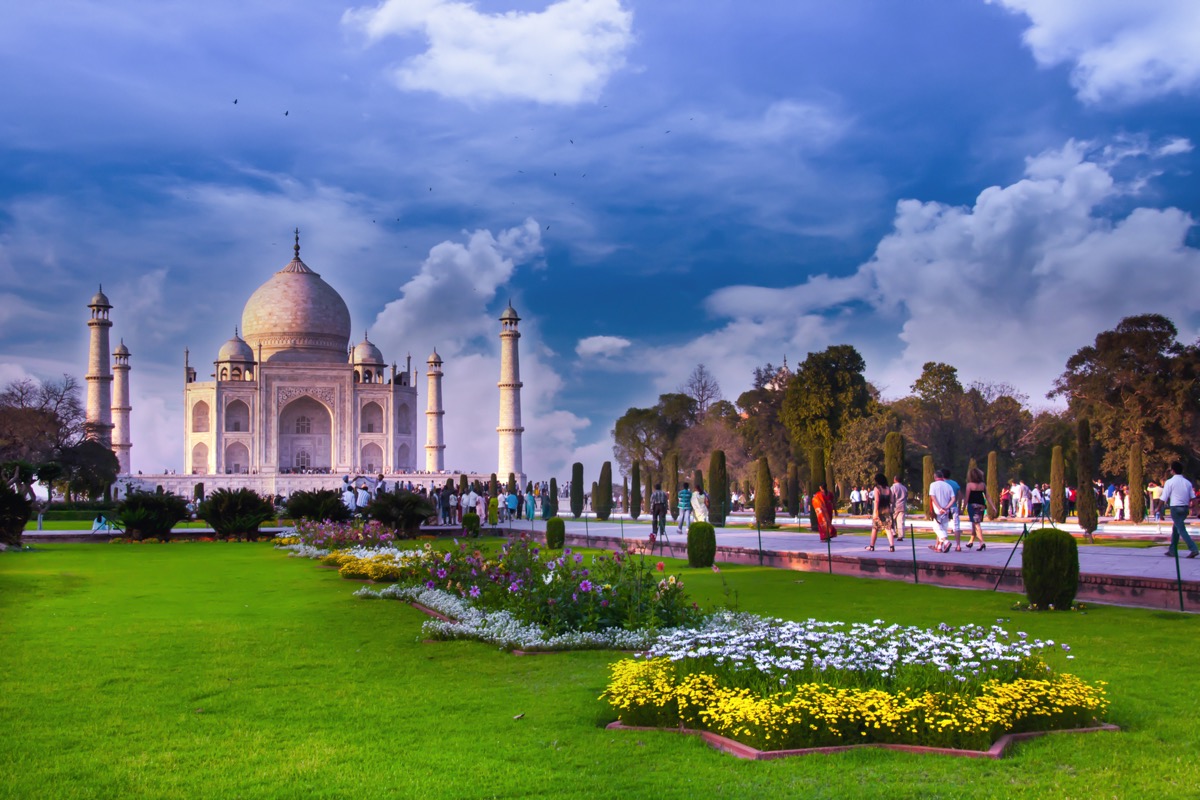
UNESCO masterpiece built 1632–1653 by Shah Jahan. Arrive at sunrise for magical light on the white marble.
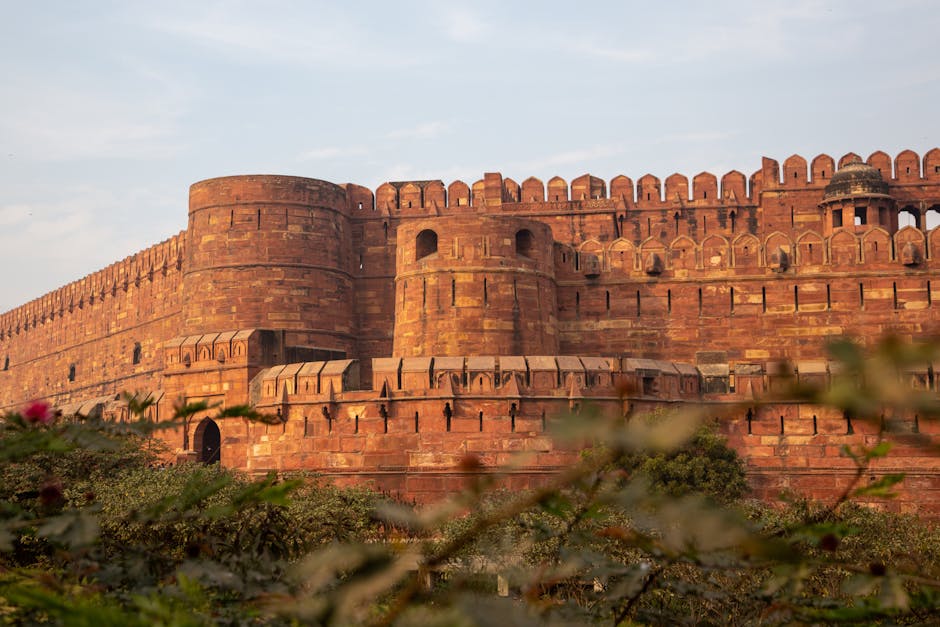
Rakabganj | ₹40/₹550
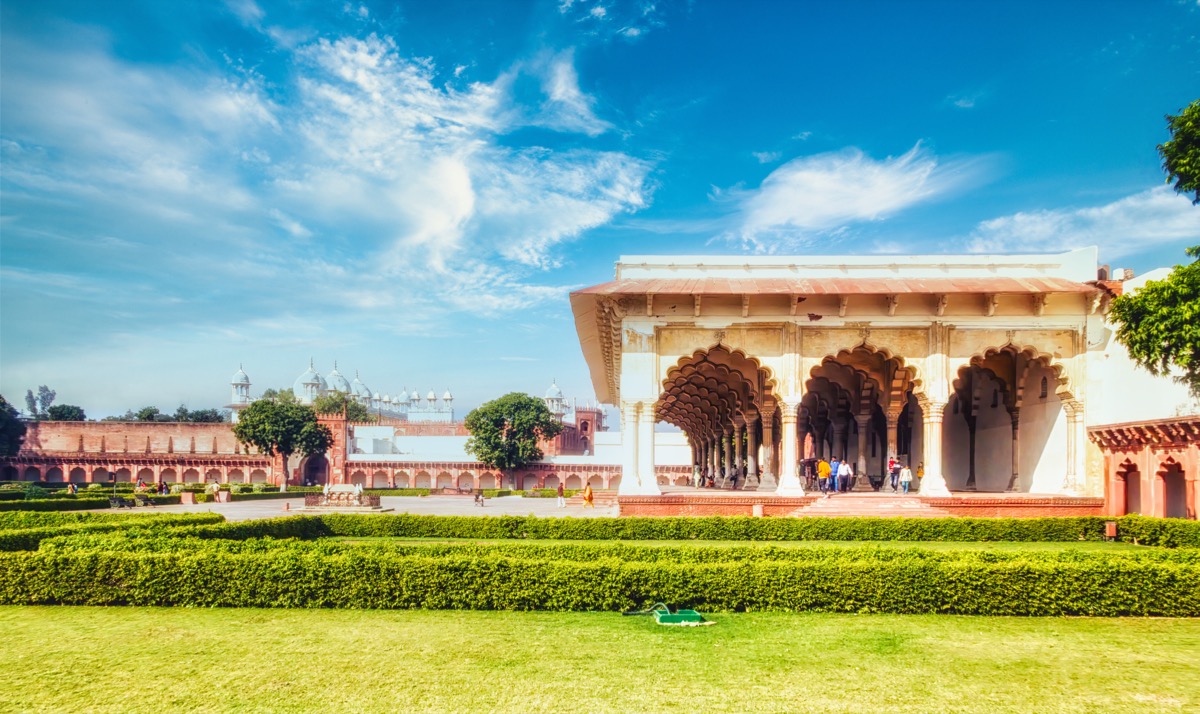
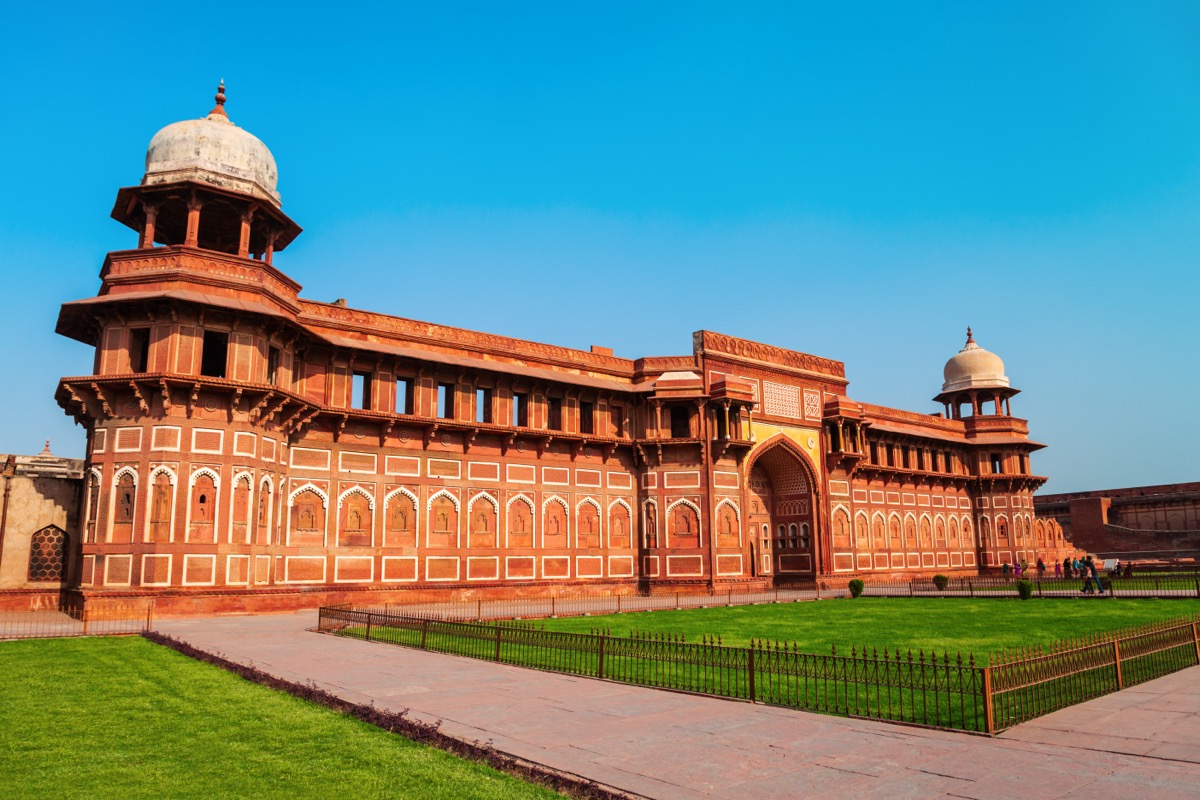
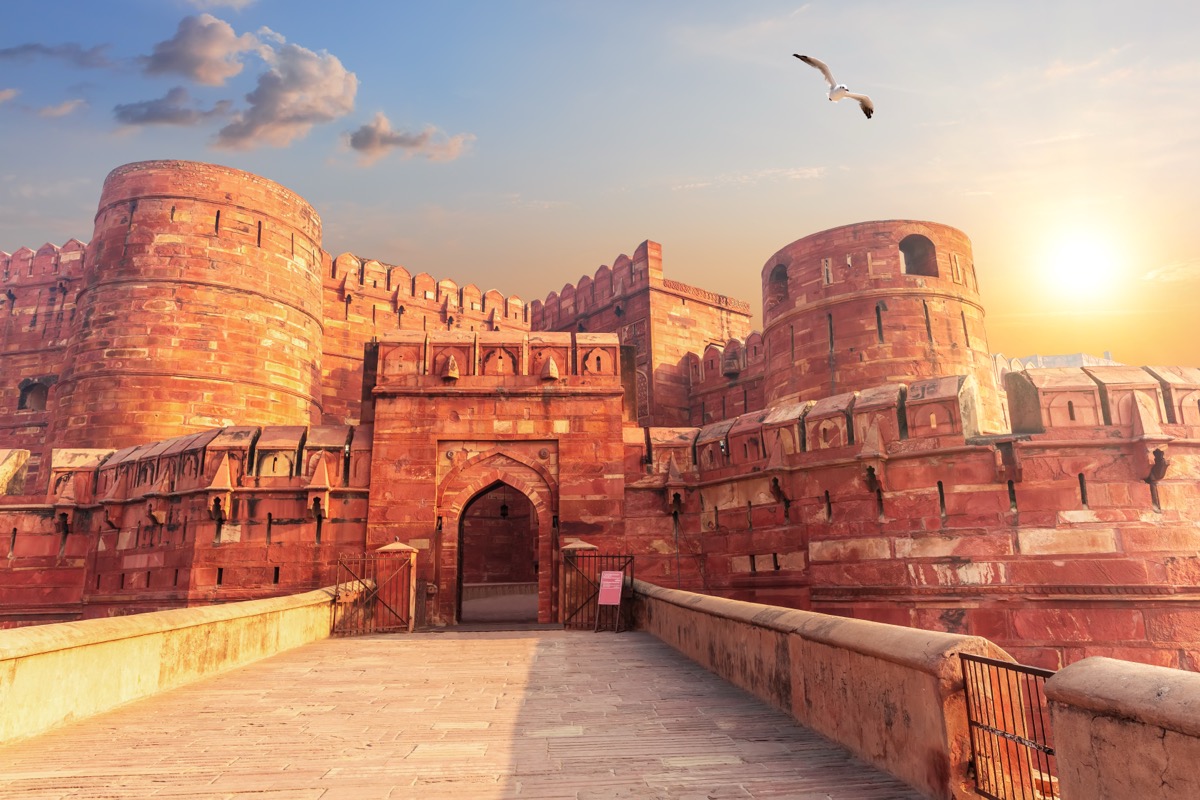
Massive red sandstone fortress with palaces, mosques, and the room where Shah Jahan gazed at the Taj as a prisoner.
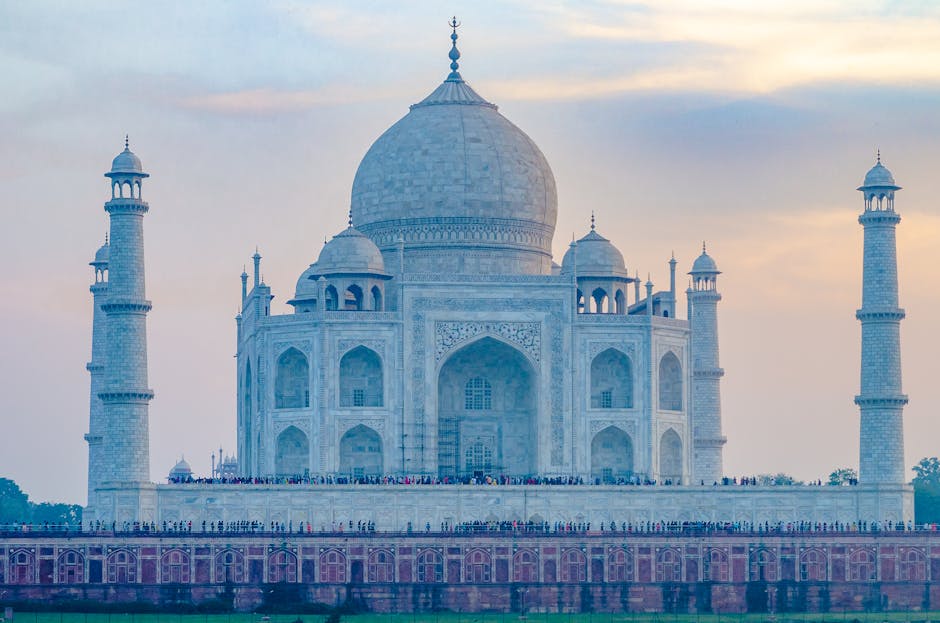
Moti Bagh | ₹30/₹310
The 'Baby Taj' — an exquisite marble tomb predating the Taj Mahal, with stunning pietra dura inlay work.
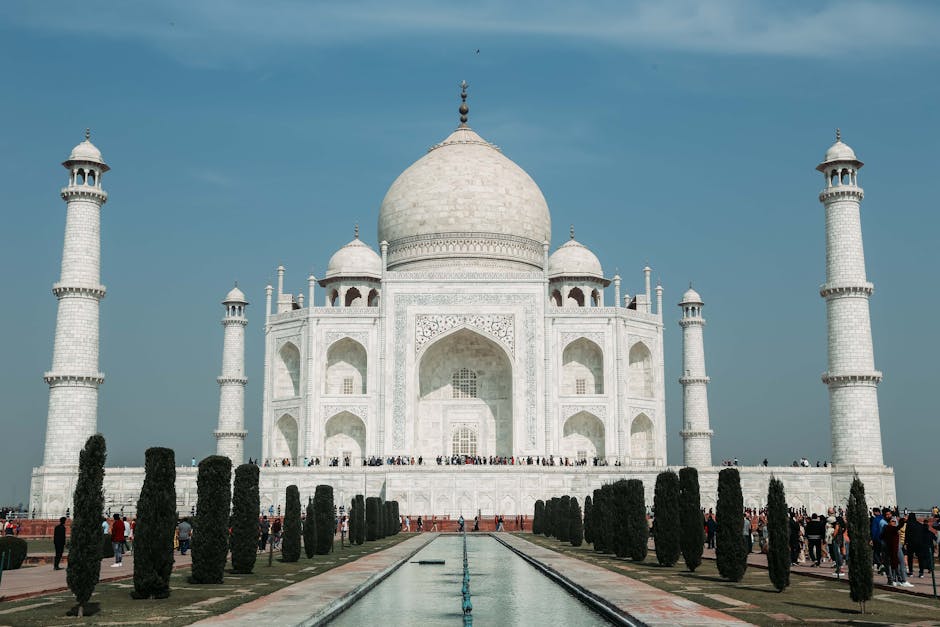
Nagla Devjit | ₹30/₹310
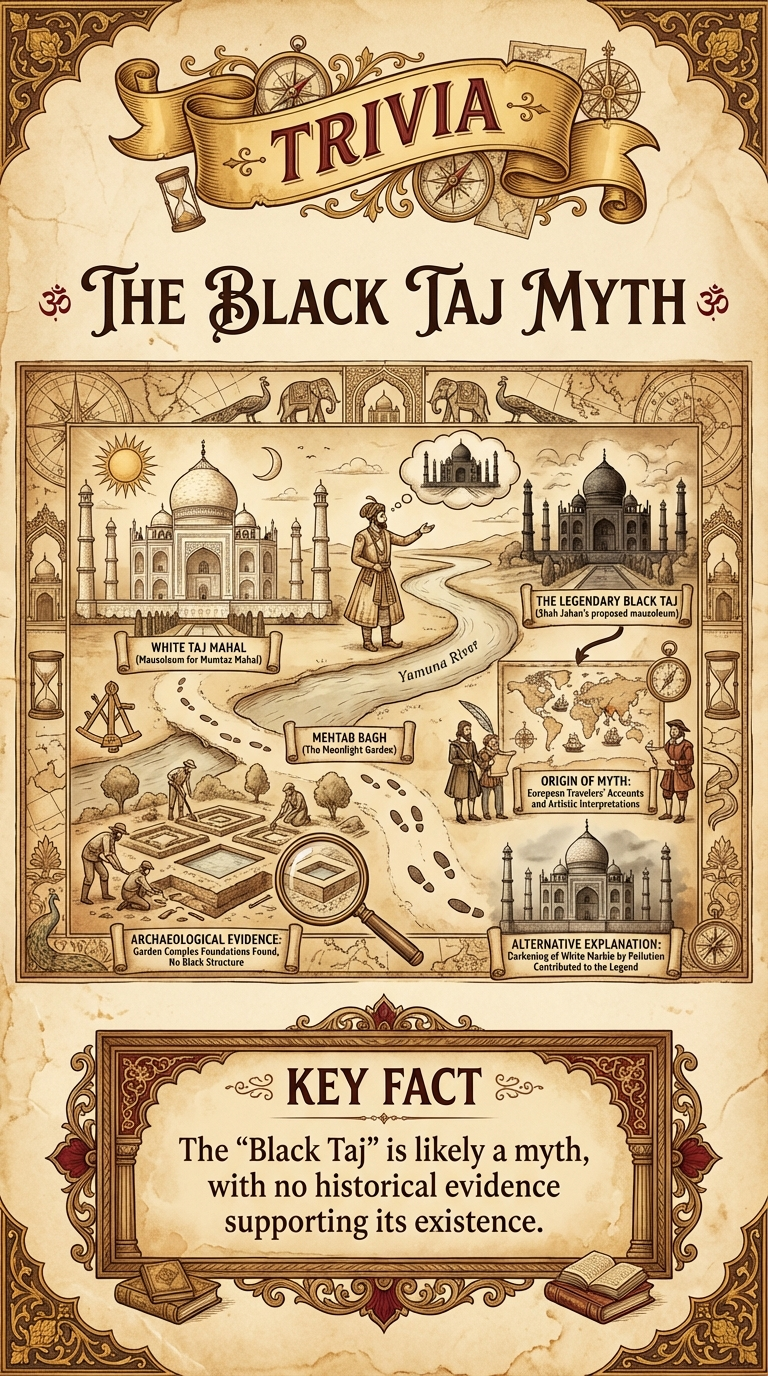
Moonlight Garden across the Yamuna with the most stunning sunset views of the Taj Mahal.
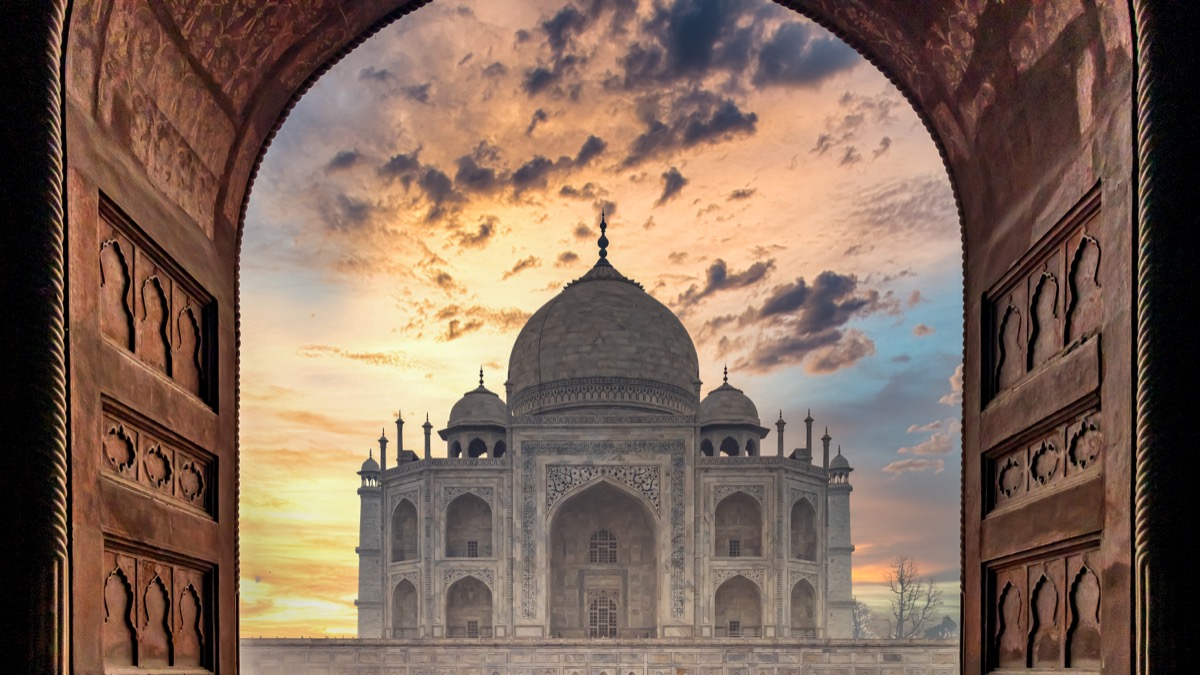
37 km west of Agra | ₹50/₹610
Akbar's abandoned ghost city (1571–1585), a UNESCO site with the towering Buland Darwaza.
Old Agra | Free
Chaotic and colorful market near Jama Masjid selling everything from spices to marble souvenirs.
Near Agra Fort | Free
India's largest mosque courtyard, built by Shah Jahan's daughter Jahanara Begum in 1648.
Sikandra, 10 km north | ₹35/₹310
Grand mausoleum of Emperor Akbar set in a peaceful walled garden with deer and monkeys.
East bank of Yamuna | Free
Persian-style glazed tile tomb of Allama Afzal Khan Mullah, a Mughal prime minister.
Inside Agra Fort | Included with fort
Geometric Mughal grape garden within Agra Fort, with stunning white marble pavilions.
North Agra | ₹25/₹300
India's oldest Mughal garden (1528), laid out by Babur before the Taj was imagined.
Near Sikandra | ₹25
Peaceful tomb of Akbar's wife set among gardens, rarely visited by tourists.
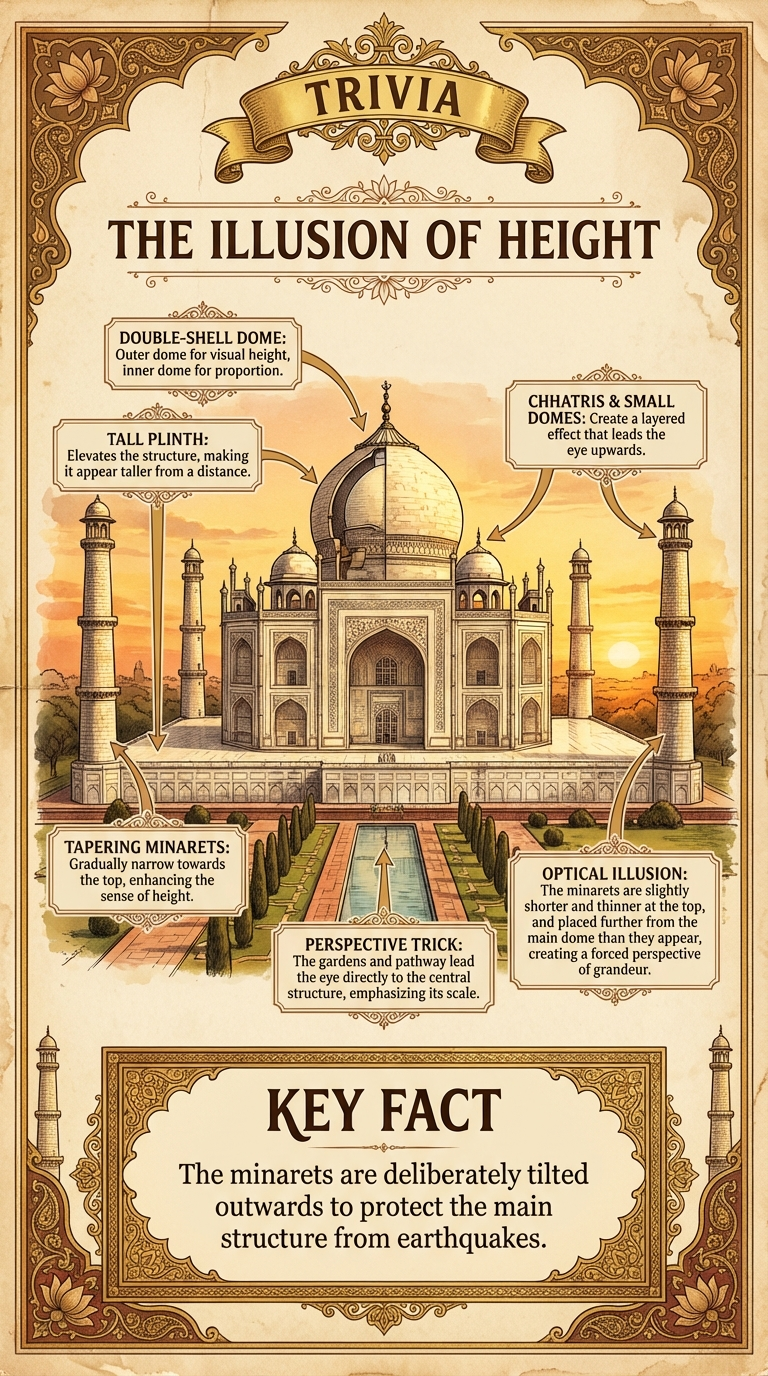
Inside Taj complex | Included
Small museum inside the Taj grounds with original architectural drawings and Mughal artifacts.
Sikandra Road | Free
Important Sikh gurdwara with a vast holy tank, built to commemorate Guru Tegh Bahadur.
15 km north | Free
Ongoing marble masterpiece under construction since 1904, showcasing incredible modern inlay work.
Old Agra | Free
Ancient Shiva temple believed to have been established by Lord Shiva himself.
Old Agra lanes | ₹500–1,000 guided
Two-hour walk through the old city visiting workshops, havelis, and hidden monuments.
20 km south | ₹50
Bird sanctuary and lake perfect for a half-day escape from the city.
19. Sheroes Hangout Café (Near Taj East Gate, ₹200–400): Inspirational café run by acid attack survivors. Pay what you wish. Great coffee.
20. Yamuna Boat Ride at Sunset (Mehtab Bagh ghat, ₹100–200/person): Wooden boat ride on the Yamuna with unbeatable Taj views as the sun sets.
Essential practical information
ATMs are widely available. Most monuments only accept cash. UPI (Google Pay, PhonePe) works at many shops and restaurants.
Agra is generally safe for tourists. Be firm with touts near the Taj. Avoid auto-rickshaw drivers who insist on taking you to marble shops.
No dress code for the Taj, but cover shoulders and knees for mosques. Remove shoes at religious sites.
Photography is free at most monuments. Tripods are banned inside the Taj complex. Drone photography is strictly prohibited.
Navigate the city like a local
Agra Airport (AGR) is 12 km from the city center (₹400–600 by prepaid taxi, 30 min). Most travelers arrive by train from Delhi.
The primary way to get around. Always negotiate the fare before getting in. Cost: ₹10–20/km
Good for short distances in the old city. Slower but atmospheric. Cost: ₹20–50/ride
Available and reliable. AC comfort. Book through the app for fair pricing. Cost: ₹8–12/km
Shared electric rickshaws on fixed routes. Cheap and common. Cost: ₹10–20/person
Available at railway stations and airport. Fixed rates displayed on boards. Cost: ₹150–300 within city
When to go and what to expect
Perfect weather (20–28°C). Clear skies for Taj photos. Taj Mahotsav festival in February. Peak tourist season — book ahead.
Cold mornings (5–15°C) with magical fog around the Taj. Christmas and New Year bring crowds. Carry warm layers for sunrise visits.
Increasingly hot (30–45°C). Fewer tourists and lower hotel prices. Visit monuments early morning or late afternoon only.
Monsoon season. Hot and humid. Occasional dramatic rain shots of the Taj. Lowest prices. Green gardens around monuments.
Agra — best experienced in October–MarchMake the most of your time
Extended stays and themed routes
Add Mathura and Vrindavan (58 km north) for Krishna temples, plus the Keetham Lake bird sanctuary and a cooking class learning Mughlai cuisine.
Combine Agra with the Golden Triangle — add Delhi (3 hrs by Gatimaan Express) and Jaipur (4 hrs by train) for the classic North India circuit.
Kids love the Agra Bear Rescue (₹250), the elephant and deer at Akbar's Tomb, and boat rides on the Yamuna. Stay at ITC Mughal for pool time between sights.
Book a street food walk through Kinari Bazaar, take a Mughlai cooking class, try petha at Panchhi Petha (since 1912), and end with a thali at Dasaprakash.
Where budget travelers meet the Taj at dawn
The Taj's Doorstep
Taj Ganj is the vibrant neighbourhood immediately south of the Taj Mahal, a labyrinth of narrow lanes packed with budget guesthouses, rooftop cafes with Taj views, and souvenir shops. The area comes alive before dawn as visitors stream toward the South Gate, chai wallahs doing brisk business. After the Taj, wander the back lanes to find marble inlay workshops where fourth-generation artisans chip away at intricate designs using techniques unchanged since Shah Jahan's time.
The rooftop restaurants are the area's greatest charm — sip a lassi while gazing at the Taj from Saniya Palace or Joney's Place. By evening, the lanes quiet down and you can hear the call to prayer from the neighbourhood's small mosques. Budget travelers base themselves here for ₹500–1,500/night guesthouses just minutes from the monument.
Where to eat in Taj Ganj
Joney's Place (₹150–300): Backpacker institution since the 1980s. Rooftop Taj views and banana pancakes.
Stuff Makers (₹200–400): North Indian thalis and fresh juice with a Taj backdrop.
Sheroes Hangout Café (₹150–300): Inspiring café run by acid attack survivors. Pay-what-you-wish model.
Shopping: Marble inlay boxes (₹200–5,000), miniature Taj replicas, pashmina shawls. Always bargain — start at 40% of the asking price.


Agra's real heartbeat — where locals shop, eat, and celebrate
The Commercial Heart
Sadar Bazaar is Agra's bustling commercial district, stretching along MG Road with shops, restaurants, and the city's best street food. This is where locals eat, shop, and socialize. The area around Sadar Bazaar railway crossing is particularly vibrant at dusk, with chaat stalls, bedai-jalebi vendors, and the sweet smell of freshly made petha wafting from legendary shops like Panchhi Petha (established 1912) and Bhagat Halwai.
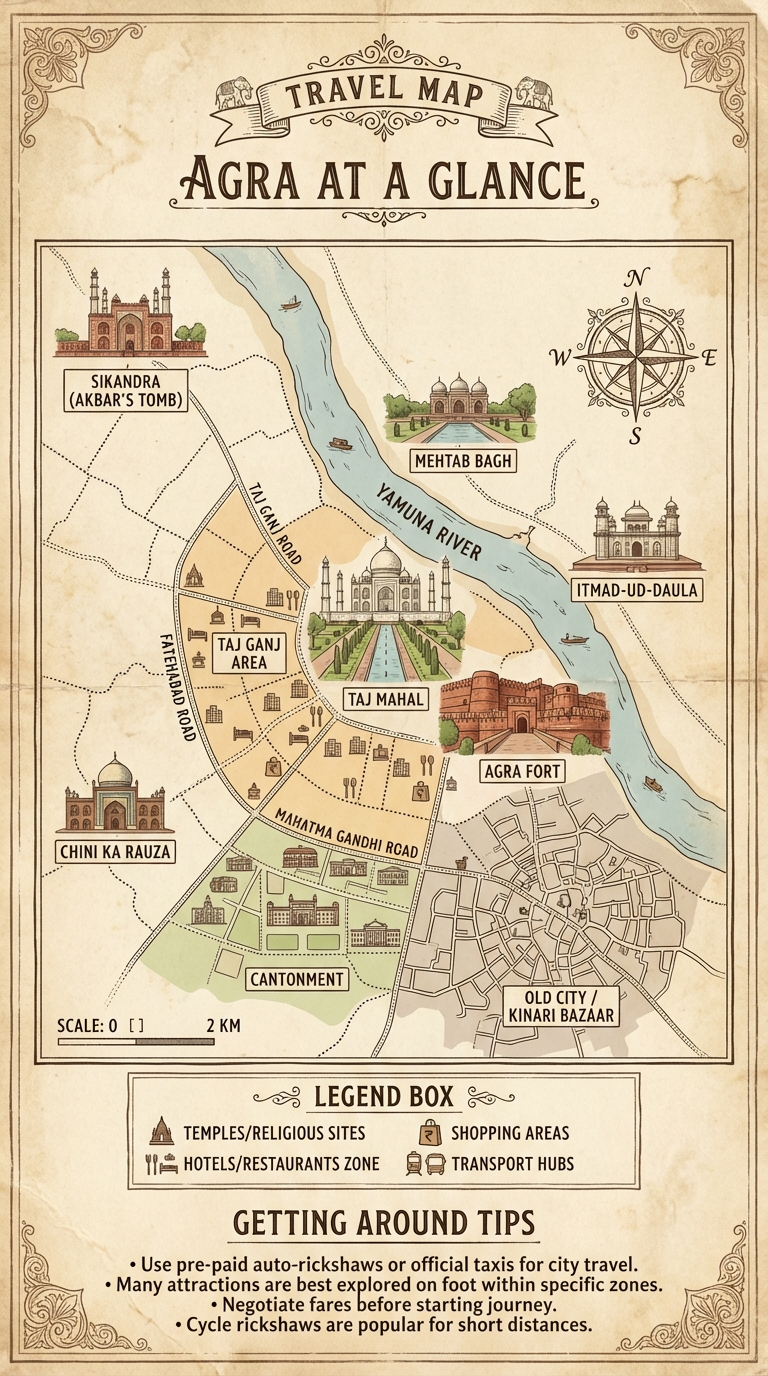
Civil Lines, the colonial-era cantonment area north of Sadar, is where you'll find Agra's better hotels, restaurants, and the leafy cantonment. Fatehabad Road, connecting the Taj to Sadar, is lined with mid-range and luxury hotels including ITC Mughal and the Oberoi Amarvilas. This is the best area for comfortable dining — try Pinch of Spice for North Indian, Bon Barbecue for grills, or Dasaprakash for South Indian.
Where to eat in Sadar Bazaar & Civil Lines
Panchhi Petha: The most famous petha shop in Agra (since 1912). Try the Angoori petha.
Pinch of Spice (₹400–800): Upscale North Indian with reliable quality.
Mama Chicken (₹200–400): Local favourite for butter chicken and kebabs.
Dasaprakash (₹200–400): South Indian thalis and ice cream sundaes.
Street Food Trail: Start at the bedai stalls (₹30), move to chaat vendors (₹40–60), try Agra's famous dalmoth namkeen (₹100/packet), and finish with petha from Panchhi.


Where Mughal gardens whisper their stories to those patient enough to listen
The Quiet Mughal Gardens
North Agra is a different world from the Taj crowds — quieter, greener, and home to some of the city's most underrated monuments. The star attraction is Akbar's Tomb at Sikandra, a grand mausoleum set in a walled garden where spotted deer and grey langur monkeys roam freely among geometric pathways. Unlike the Taj, you might have the entire place to yourself in the afternoon.
Further north, the remarkable Dayal Bagh Temple has been under construction since 1904 and showcases marble inlay work that rivals the Taj in detail and surpasses it in intricacy. The artisans here work full-time and welcome visitors to watch. Nearby, the historic Guru Ka Tal gurdwara has one of India's largest holy tanks. This area rewards those willing to venture beyond the standard tourist circuit.
Where to eat in Sikandra & North Agra
Dining options are limited in this area. Grab a thali at one of the roadside dhabas near Sikandra (₹80–150) or pack a picnic lunch from Sadar Bazaar.
Chameleon Restaurant at Clarks Shiraz hotel (₹500–900): The best restaurant in north Agra with a varied menu.


What to eat and where to find it
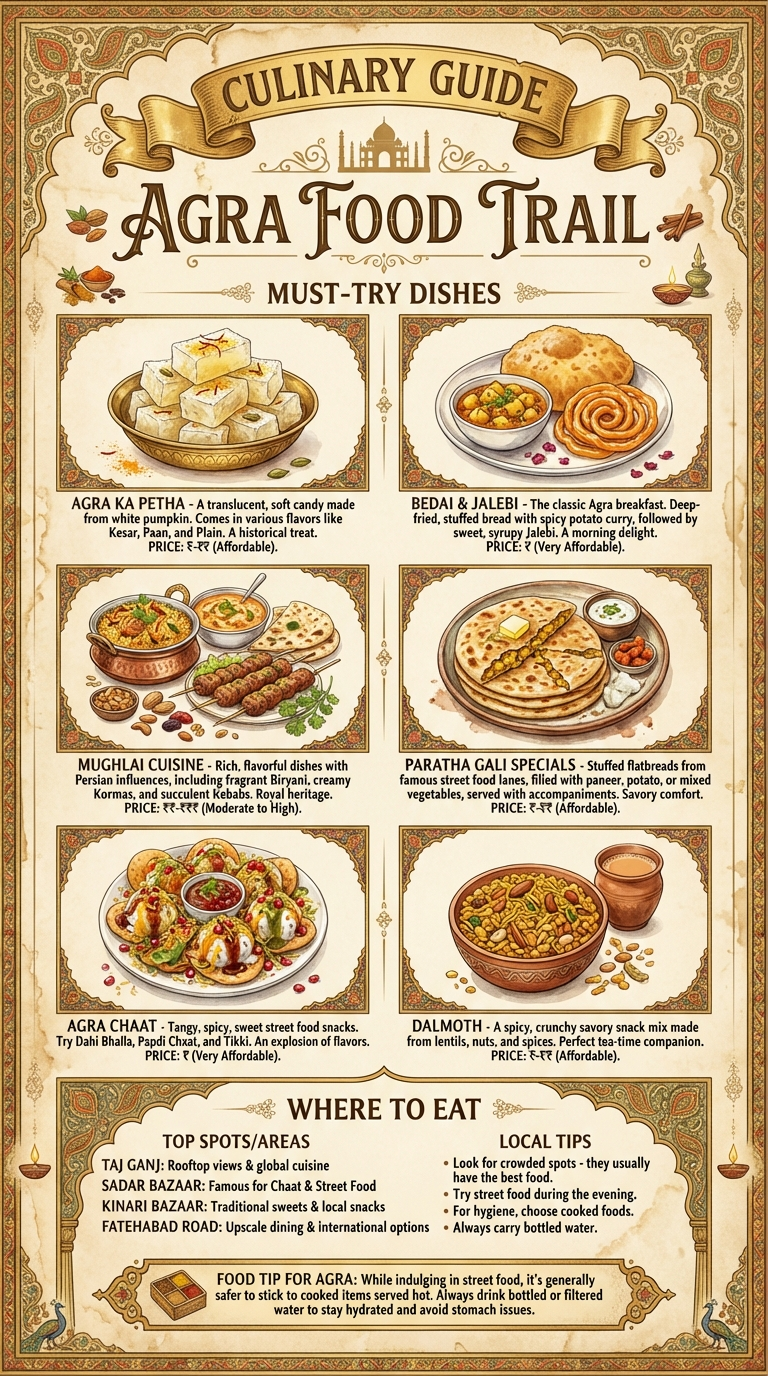
Agra's culinary identity is shaped by centuries of Mughal influence blended with UP street food traditions. The city is famous for its petha (crystallized pumpkin sweet), bedai-jalebi breakfast, Mughlai kebabs, and an emerging café scene near the Taj. Don't expect fine dining — Agra's best food is found at street stalls, railway station vendors, and unpretentious family restaurants where recipes have been passed down for generations.
Petha (₹100–300/kg): Agra's signature sweet — translucent crystallized pumpkin in varieties from plain to Angoori (grape-sized) to paan-flavored.
Bedai & Jalebi (₹30–60): The quintessential Agra breakfast: deep-fried bread with spicy dal, always paired with hot, syrupy jalebis.
Mughlai Parantha (₹50–80): Stuffed flatbread with minced meat, egg, or paneer — a Mughal-era recipe perfected in Agra's lanes.
Dalmoth (₹100–200/packet): Agra's famous spicy lentil snack mix. The best comes from Panchi Petha shops.
Gajak & Rewri (₹80–150/box): Sesame and jaggery sweets, especially popular in winter months (Nov–Feb).
Kebabs (₹100–300): Galawati (melt-in-mouth) and seekh kebabs at stalls near Jama Masjid and Kinari Bazaar.
Chaat (₹40–80): Agra's chaat stalls serve papdi chaat, golgappa, and aloo tikki with fiery green chutney.
Tandoori Chicken (₹200–400): Best at Mama Chicken on Gwalior Road or any of the Kinari Bazaar grill stalls.
Best restaurants, markets, and street food
Peshawri, ITC Mughal (₹2,000–3,500): Legendary North Indian restaurant. The dal Peshawri alone is worth the trip.
Esphahan, Oberoi Amarvilas (₹3,000–5,000): Fine dining Mughlai with Taj views. Dress smart.
Pinch of Spice (₹400–800): Agra's most popular mid-range restaurant. Reliable North Indian and Chinese.
Bon Barbecue (₹500–900): Buffet grill restaurant popular with families.
Sadar Bazaar street stalls: The epicenter of Agra street food. Don't miss the bedai-jalebi vendors at the railway crossing (₹30–50).
Kinari Bazaar: Evening kebab stalls and chaat vendors near Jama Masjid.
Panchhi Petha (since 1912): Buy petha from the original shop on Hospital Road — they ship worldwide.


Understanding the story of Agra
Agra rose to prominence in 1504 when Sultan Sikandar Lodi moved his capital here from Delhi. But it was the Mughals who transformed it into one of the world's great cities. Babur, the first Mughal emperor, laid out the Ram Bagh gardens in 1528. His grandson Akbar made Agra his capital, building the massive Agra Fort (1565) and the short-lived dream city of Fatehpur Sikri (1571–1585). Shah Jahan, the greatest Mughal builder, gave the world the Taj Mahal (1632–1653) and the Pearl Mosque inside Agra Fort. The city reached its zenith under his reign, with a population exceeding one million.
The decline began when Aurangzeb shifted the capital to Delhi in 1648, and Agra suffered invasions by Marathas, Jats, and finally the British, who took control in 1803. The Jat rulers of Bharatpur famously stripped gold and silver from the Taj and Agra Fort. Under the British Raj, Agra became an administrative center and the Taj was restored (Lord Curzon led the effort in 1908). After independence in 1947, Agra developed as a tourism city, and the Taj Mahal was declared a UNESCO World Heritage Site in 1983, cementing its status as India's most visited monument.
Agra's culture is a living museum of Mughal traditions blended with modern UP (Uttar Pradesh) life. The pietra dura marble inlay craft, brought by Persian artisans in the 17th century, still thrives in family workshops around Taj Ganj. The city celebrates Eid with particular fervor — the Jama Masjid and smaller neighbourhood mosques overflow with worshippers, and the streets fill with the aroma of biryani and sewaiyan (vermicelli pudding). The annual Taj Mahotsav (February) is a 10-day arts and crafts festival held near the Taj, featuring artisans from across India.
Excursions from Agra
Agra sits at the crossroads of northern India's greatest heritage sites, making it an ideal base for exploring the region.
Akbar's magnificent abandoned capital (1571–1585). Don't miss the Buland Darwaza, the world's tallest gateway at 54 meters. Entry: ₹50/₹610
Birthplace of Lord Krishna. The Krishna Janmabhoomi temple and the chaotic Holi celebrations are unforgettable. Entry: Free (temples)
Keoladeo National Park — a UNESCO site hosting 350+ bird species. Best visited Oct–Feb for migratory birds. Entry: ₹75/₹500
One of India's deepest and most photogenic stepwells, with 3,500 steps descending 13 stories. Often combined with a Jaipur trip. Entry: ₹25/₹200

Practical information from A to Z
Available at licensed restaurants and hotel bars. Wine shops (called "thekas") sell beer and spirits. No public drinking.
HDFC, SBI, and ICICI ATMs are common along MG Road, Fatehabad Road, and near Sadar Bazaar. Carry cash for monuments.
Pushpanjali Hospital (Fatehabad Road) and SN Medical College for emergencies. Travel insurance recommended.
220V/50Hz with Type C/D/M plugs. Power cuts are frequent; most hotels have generators.
Free Wi-Fi at most hotels and cafes. Jio/Airtel 4G SIMs available at phone shops (₹200–300 with passport copy).
India decriminalized homosexuality in 2018. Agra is conservative — public displays of affection (any orientation) draw attention.
India Post main office on The Mall Road. DHL and FedEx offices on Fatehabad Road for international parcels.
Taj Mahal: sunrise to sunset, closed Fridays. Agra Fort: sunrise–sunset daily. Most shops: 10am–8pm. Banks: 10am–4pm Mon–Fri.
Air quality can be poor Nov–Jan. Vehicles are banned within 500m of the Taj to reduce pollution.
Always negotiate before boarding. Carry small change (₹10/₹20 notes). Be firm about your destination.
GST of 5–18% applies. Most restaurants include taxes in menu prices. Hotels charge 12–18% GST.
Western toilets at hotels, restaurants, and the Taj Mahal complex. Carry tissue paper — it's not always provided.
Never drink tap water. Bottled water costs ₹20. Check the seal is unbroken.
Getting to and around Agra
From Delhi: Gatimaan Express (1h40m, ₹750, 8:10am from Hazrat Nizamuddin) is the fastest option. Shatabdi Express (2h, ₹600) is another good choice. By road, the Yamuna Expressway takes 3–3.5 hours.
From Jaipur: Direct trains take 3.5–4 hours (₹200–500). By road via NH-21, it's about 4 hours.
Within Agra: Auto-rickshaws are the standard transport. Download Ola/Uber for fair pricing. The city is too spread out for walking between major sights.
| Mode | Details | Cost |
|---|---|---|
| Auto-Rickshaw | The primary way to get around. Always negotiate the fare before getting in. | ₹10–20/km |
| Cycle Rickshaw | Good for short distances in the old city. Slower but atmospheric. | ₹20–50/ride |
| Ola/Uber | Available and reliable. AC comfort. Book through the app for fair pricing. | ₹8–12/km |
| E-Rickshaw | Shared electric rickshaws on fixed routes. Cheap and common. | ₹10–20/person |
| Prepaid Taxi | Available at railway stations and airport. Fixed rates displayed on boards. | ₹150–300 within city |
Essential phrases for travelers
Hindi is the primary language in Agra, with Urdu widely understood. English is spoken at hotels and tourist sites, but a few Hindi phrases will earn you warm smiles and better prices.
| English | Hindi |
|---|---|
| Hello / Greetings | Namaste |
| Thank you | Dhanyavaad |
| Yes / No | Haan / Nahin |
| How much? | Kitna hai? |
| Too expensive | Bahut mehnga hai |
| Water | Paani |
| Food | Khana |
| Where is...? | ...kahan hai? |
| Help | Madad |
| Good | Accha |
| Beautiful | Sundar |
| Please | Kripya |
| I don't understand | Mujhe samajh nahin aaya |
| Taxi/auto | Auto-rickshaw |
| How far? | Kitni door hai? |
Our favourite experiences in Agra
Taj Mahal at Dawn
Nothing compares to watching the marble glow pink as the sun rises
Mehtab Bagh
The classic Taj-across-the-Yamuna view in golden evening light
Panchhi Petha
Agra's iconic sweet shop since 1912 — try the Angoori variety
Sadar Bazaar Bedai Stalls
The ₹30 bedai-jalebi breakfast is an Agra institution
Oberoi Amarvilas
Every room has a Taj Mahal view — India's most romantic hotel
Fatehpur Sikri
Akbar's ghost city is India's best-preserved Mughal complex
Dayal Bagh Temple
Modern marble inlay that rivals the Taj — and it's still being built
Yamuna Boat Ride
A ₹100 wooden boat ride delivers unbeatable Taj perspectives
Subhash Emporium
Watch artisans create pietra dura inlay before your eyes
Kinari Bazaar Walk
Lose yourself in Agra's most atmospheric market lanes
Everything you need for Agra
Travorea creates comprehensive, beautifully designed travel guides that combine insider knowledge with practical information. Our guides are crafted to help you experience destinations like a local, not just a tourist.
This premium guide to Agra was researched and written to give you everything you need for an unforgettable trip. All prices and information were verified at the time of writing (2026) but may change — always confirm locally.
All photographs in this guide are sourced from free-to-use image libraries (Pexels, Unsplash) and original Travorea photography. Infographics are original Travorea creations.
Visit us at www.travorea.com for more destinations, interactive trip planners, and the latest travel tips.
Explore More Guides
Visit www.travorea.com/ebooks for premium guides to 50+ destinations worldwide.
City of the Taj