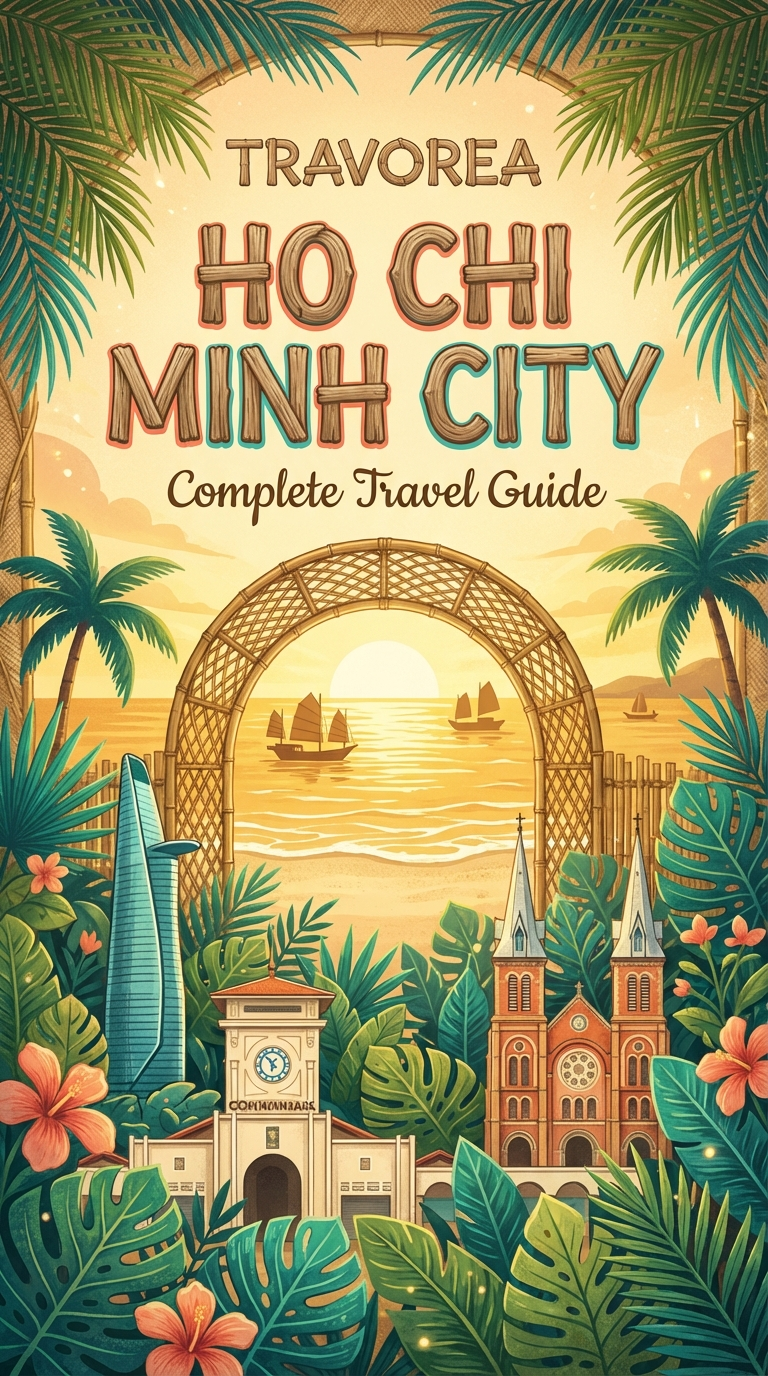

Ho Chi Minh City
The Pearl of the Far East
War HistoryStreet Food CapitalFrench Colonial ArchitectureMotorbike CultureMekong Delta Gateway
80
Pages2026 Edition
The Pearl of the Far East

 Ho Chi Minh City
Ho Chi Minh City sprawls across the low-lying plains of southern Vietnam where the Saigon River meets the Mekong Delta. The tropical climate is hot year-round, with a pronounced wet season from May to November. Three days covers the city’s highlights; a week lets you explore the Mekong Delta, Cu Chi Tunnels, and the city’s incredible food scene in depth.
The essential sights and experiences

Vietnam’s most powerful museum, documenting the American War through photographs, military hardware, and first-hand accounts. The Agent Orange exhibit is harrowing and essential.

Vast underground tunnel network used by Viet Cong guerrillas during the war. Crawl through sections of the tunnels and understand the ingenuity and suffering of the conflict.

Stunning French colonial cathedral built 1863–1880 with red brick imported from Marseille. The twin bell towers dominate the city’s skyline.

Saigon’s iconic central market since 1912. Hundreds of stalls selling everything from lacquerware and silk to fresh produce and street food. Haggle hard — start at 40% of the asking price.

The former Presidential Palace where a North Vietnamese tank crashed through the gates on April 30, 1975, ending the Vietnam War. The 1960s time-capsule interior is extraordinary.

Magnificent French colonial building designed by Gustave Eiffel’s firm in 1891. The soaring arched interior with painted maps of old Saigon is one of the city’s most photogenic spaces.
Saigon’s most iconic skyscraper with a 49th-floor observation deck offering 360-degree views over the city and river. The helipad design is inspired by a lotus bud.
The most atmospheric temple in Saigon, built by the Cantonese community in 1909. Smoke-filled halls, intricate wood carvings, and tortoise ponds create a mystical atmosphere.

Saigon’s sprawling Chinatown with Cantonese temples, herbal medicine shops, wholesale markets, and some of the best Chinese-Vietnamese food in the country.
Beautiful yellow colonial building housing Vietnamese art from ancient Cham sculpture to contemporary works. The building’s tiled floors and spiral staircase are art in themselves.
Saigon’s grand pedestrian boulevard, once a canal, now a wide promenade flanked by the People’s Committee Building. Best at night when families stroll and street performers appear.
Evening dinner cruise along the Saigon River past illuminated skyscrapers and the historic wharves. Multiple operators offer cruises with traditional music and Vietnamese cuisine.

Stunning 18th-century Chinese temple dedicated to the sea goddess. Enormous incense coils hang from the ceiling, burning for weeks. The ceramic roof decorations are exquisite.
Saigon’s famous backpacker street comes alive at night with bars, street food, live music, and an electric atmosphere. Controlled chaos in the best possible way.
The bustling backpacker district surrounding Bui Vien, packed with budget hostels, travel agencies, tailor shops, and cheap street food. The starting point for most travellers.
Hidden coffee shops inside old apartment blocks (42 Nguyen Hue and 14 Ton That Dam are the most famous). Climb dingy stairwells to find beautifully designed cafés with city views.
Central green space where locals practise tai chi at dawn, play badminton, and gather at the morning bird-singing club. The best place to see everyday Saigon life.
Fascinating museum of traditional Vietnamese medicine housed in a beautiful colonial building. Learn about herbal remedies, acupuncture, and centuries-old healing practices.
19. Landmark 81 (Binh Thanh District, 200,000–350,000 VND (Skydeck)): Southeast Asia’s tallest building at 461 metres. The 79th-floor observation deck offers panoramic views stretching to the Mekong Delta on clear days.
20. An Dong Market (District 5, Free entry): Massive wholesale market in Chinatown specialising in fabric, clothing, and accessories. Less touristy than Ben Thanh and better for serious shopping at local prices.
When to go and what to expect
Dry season, coolest months (25–32°C). Clear skies, low humidity. The most comfortable time to visit. Tet (Lunar New Year, Jan/Feb) is festive but many businesses close for a week.
Hot and dry (28–36°C). Temperatures peak in April. Fewer tourists. Good for sightseeing if you start early and rest during midday heat.
Wet season (26–34°C). Daily afternoon downpours, usually lasting 1–2 hours. Mornings are often clear. Lower hotel prices and fewer crowds. The city is lush and green.
 Ho Chi Minh City — best experienced in December–April (dry season)

District 1 is where everything begins in Ho Chi Minh City. This is the commercial, historical, and cultural core of Saigon — a compact district where French colonial grandeur collides with Vietnamese street life at every turn. The Notre-Dame Cathedral, Central Post Office, Independence Palace, and War Remnants Museum are all here, connected by tree-lined boulevards that still echo with the architectural ambitions of French Indochina. Dong Khoi Street, once the infamous Rue Catinat of Graham Greene’s The Quiet American, now glitters with luxury boutiques and five-star hotels.
Start at the Notre-Dame Cathedral and Post Office cluster, then walk down Dong Khoi Street to the Saigon River waterfront. Ben Thanh Market is the city’s bustling heart — explore the interior during the day, then the surrounding night market after dark. The hidden apartment cafés on Nguyen Hue and Ton That Dam are Saigon’s best-kept secret: climb dingy stairwells to find beautifully designed coffee shops with stunning views. At night, Bui Vien Walking Street erupts into backpacker mayhem, while the rooftop bars of Dong Khoi offer a more refined experience.


Cho Lon — literally “Big Market” — is one of the largest Chinatowns in the world and Saigon’s most atmospheric neighbourhood. Established by Cantonese, Teochew, Hokkien, and Hainanese immigrants over 300 years ago, this district is a labyrinth of ornate Chinese temples, wholesale markets, herbal medicine shops, and some of the best food in the city. The air smells of incense, dried herbs, and sizzling woks. Cho Lon feels like a city within a city, operating to its own rhythms and traditions.
Begin at Thien Hau Temple, where enormous incense coils hang from the ceiling like smouldering chandeliers. Walk through the herbal medicine streets where shops display dried seahorses, ginseng roots, and mysterious powders. Binh Tay Market is Cho Lon’s main wholesale market — bigger, cheaper, and more authentic than Ben Thanh. The food here is extraordinary: dim sum at breakfast, Cantonese roast duck for lunch, and late-night congee at pavement stalls. The Ha Chuong and Ong Bon temples are smaller but equally beautiful.


Thao Dien in District 2 is where Saigon takes a breath. Across the Saigon River from the downtown chaos, this tree-lined neighbourhood has become the city’s expatriate hub — a village of international restaurants, artisan bakeries, yoga studios, and boutique shops that feels more like a tropical suburb than a Vietnamese city. The pace is slower, the streets are wider, and there’s a community atmosphere rare in a megacity. International schools, organic markets, and riverside dining have made Thao Dien Saigon’s most liveable quarter.
Cross the river via the Thu Thiem Bridge for a completely different Saigon experience. Browse The Factory Contemporary Arts Centre — the city’s best gallery space in a converted warehouse. Walk along Xuan Thuy and Thao Dien streets for brunch at one of the many cafés, then explore the weekend Thao Dien Market for artisan goods and organic produce. The Deck and Villa Royale offer stunning riverside dining with views back across to District 1’s skyline.


District 3 is where Saigonese actually live — and where visitors discover the city’s most authentic character. The tree-lined streets, crumbling French villas, local coffee shops, and neighbourhood markets create an atmosphere that feels unhurried and deeply Vietnamese. While District 1 buzzes with tourism, District 3 hums with daily life: students on motorbikes, grandmothers selling fruit from shoulder poles, and the aroma of drip coffee drifting from every corner. The War Remnants Museum and many of the city’s best eateries are here.
Walk the shaded streets around Vo Van Tan and Tran Quoc Thao, where French colonial villas now house cafés and boutiques. The War Remnants Museum deserves a full morning. Lunch at one of the neighbourhood’s incredible local restaurants, then explore Xa Loi Pagoda (historically significant for the Buddhist crisis of 1963) and the Le Van Tam Park. District 3’s coffee culture is unrivalled — the pavement cafés here are where Saigon’s creative class gathers.


Binh Thanh is the district of extremes — home to both Landmark 81, Southeast Asia’s tallest building at 461 metres, and the teeming alleyways of a traditional Vietnamese neighbourhood. This inner-city district sits along the Saigon River’s eastern bank and has transformed rapidly, with luxury condominiums and shopping malls rising alongside decades-old markets and street-food alleys. The Vinhomes Central Park development around Landmark 81 is a showcase of modern Vietnamese ambition.
Visit Landmark 81’s Skydeck for the most spectacular panoramic views of Ho Chi Minh City — on clear days you can see all the way to the Mekong Delta. The Vinhomes Central Park area below has gardens, a riverside promenade, and family-friendly facilities. For contrast, explore the neighbourhood around Bui Huu Nghia Street, where old Saigon survives in narrow alleys filled with noodle stalls, motorbike repair shops, and community life. The Thanh Da islet in the Saigon River is a rural pocket within the city.


Phu My Hung in District 7 is Saigon’s answer to Singapore — a meticulously planned new town built on reclaimed marshland south of the city centre. Wide boulevards, manicured parks, international schools, and modern shopping malls create an environment completely different from the chaotic energy of central Saigon. A large Korean and Japanese expatriate community has established excellent East Asian restaurants, and the Crescent Lake area offers peaceful waterside dining and walking.
Stroll around Crescent Lake in the evening when the fountains are illuminated and families gather along the waterfront promenade. The SC VivoCity mall has international brands and a cinema. For food, explore the Korean restaurants along Pham Thai Buong Street or the Japanese izakayas near the Crescent. The Starlight Bridge is a pedestrian bridge with LED light shows at night. District 7 is best experienced as a contrast to the intensity of central Saigon — and perfect for families seeking a quieter base.


District 4 is a compact, working-class neighbourhood squeezed between District 1 and the Saigon River that has quietly become Saigon’s greatest street-food destination. The narrow alleys (hếm) are lined with plastic-stool restaurants serving some of the cheapest and most delicious food in the city. Historically home to dockworkers and river communities, District 4 retains a raw, authentic energy that tourist-heavy District 1 has lost. It’s just a short bridge crossing from Ben Thanh Market, yet few visitors venture here.
Cross the Ong Lanh Bridge from District 1 into a completely different Saigon. Vinh Khanh Street is the district’s food spine — hundreds of metres of seafood restaurants, noodle shops, and grilled-meat stalls that come alive from late afternoon. Try hủ tiếu (southern Vietnamese pork noodle soup), ốc (snails cooked a dozen different ways), and bánh tráng trộn (mixed rice paper — a uniquely Saigonese snack). The atmosphere is boisterous and local — cold Saigon beer, tiny plastic chairs, and the roar of a neighbourhood at dinner.


District 5 overlaps with and extends beyond Cho Lon, forming the historic core of Saigon’s Chinese community. While Cho Lon’s temples get the tourists, District 5’s back streets reveal the living, trading heart of Chinese-Vietnamese culture. Wholesale fabric markets, gold shops, traditional Chinese pharmacies, and clan association halls line streets that have changed little in a century. The architecture is a unique blend of Chinese shophouse and French colonial — ornate facades with shuttered windows and tile roofs.
Explore beyond the main temples into the wholesale district around An Dong Market — one of the largest indoor markets in Vietnam, specialising in fabric, clothing, and accessories at rock-bottom wholesale prices. Walk Hai Thuong Lan Ong Street, the traditional Chinese medicine street, where hundreds of shops display dried herbs, roots, and mysterious remedies. The Cha Tam Church, where President Diem was captured in 1963, is a poignant historical site. End with Chinese-Vietnamese pastries at a traditional bakery.


Phu Nhuan sits between District 1 and Tan Son Nhat Airport, a densely populated inner-city district that most tourists pass through without stopping. That’s a mistake. Phu Nhuan has some of Saigon’s best local food, vibrant street markets, and a community atmosphere that reveals the real rhythms of Vietnamese urban life. The Phan Xich Long area has emerged as a trendy dining and nightlife strip, with craft breweries, Japanese restaurants, and hipster coffee shops drawing young Saigonese.
Explore the Phan Xich Long food strip in the evening — this street has transformed into one of Saigon’s hottest dining and drinking destinations, with everything from craft beer taprooms to Japanese ramen shops and Vietnamese barbecue joints. During the day, wander the neighbourhood markets where vendors sell everything from live eels to fresh tropical fruits. The Phu Nhuan’s Vietnamese coffee scene is excellent — tiny pavement shops serving perfect cà phê sữa đá for 15,000 VND.


Go Vap is a sprawling northern district known for two things: an extraordinary concentration of Buddhist temples and pagodas, and some of the most authentic local food in the city. This is deep, residential Saigon where tourists rarely venture — and where Vietnamese daily life unfolds at its most unfiltered. The Gia Lao and Phan Van Tri areas have clusters of ornate pagodas, while the wet markets and noodle stalls serve food that predates Saigon’s tourist-restaurant boom by decades.
Hire a GrabBike to temple-hop through Go Vap’s pagoda district. The Vinh Nghiem Pagoda is one of the largest in Saigon, with a seven-storey tower and peaceful gardens. Phap Hoa Pagoda and Giac Lam Pagoda (technically in Tan Binh but on Go Vap’s border) are stunning. Between temples, eat at the neighbourhood’s noodle shops: bún mắm (fermented fish noodle soup) and bún mọc (pork-ball vermicelli) are local specialities. The morning markets along Nguyen Oanh and Quang Trung are vibrant and untouristy.


Tan Binh is the district surrounding Tan Son Nhat Airport and home to some of Saigon’s most rewarding local experiences. Beyond the airport, this densely populated district has vibrant wholesale markets, the historic Giac Lam Pagoda — the oldest temple in Ho Chi Minh City, dating to 1744 — and a thriving local food scene untouched by tourism. The Tan Binh Market is one of the city’s largest wholesale clothing markets, and the streets around it are filled with fabric shops, tailors, and garment workshops.
Visit Giac Lam Pagoda early in the morning when monks chant and incense fills the ancient wooden halls. This is the oldest temple in the city, and its warren of altars, ancestral tablets, and prayer wheels creates a deeply atmospheric experience. Explore the Tan Binh Market for wholesale clothing bargains, then walk through the surrounding streets where tailors can copy any garment in 24 hours at a fraction of international prices. The local food around Hoang Hoa Tham Street is excellent and incredibly cheap.


Thu Duc City — officially Vietnam’s first “city within a city,” carved from three eastern districts in 2021 — is the engine of Saigon’s future. The Saigon Hi-Tech Park hosts Samsung’s largest smartphone factory outside Korea, while the Vietnam National University campus brings 100,000 students to the area. The Suoi Tien Theme Park (a gloriously bizarre Buddhist-mythology waterpark) and the Mekong Delta-style canals of the Saigon River’s eastern bank offer experiences found nowhere else in the city.
Take Metro Line 1 from Ben Thanh to Thu Duc — the journey itself showcases modern Saigon’s transformation. Suoi Tien Theme Park is a wonderfully surreal experience: Buddhist hell gardens, dragon-shaped roller coasters, and a crocodile kingdom. The university district has cheap, lively food courts and a youthful energy. For nature, explore the Saigon River’s eastern bank, where fruit orchards and fish farms persist amid the development. The Can Gio mangrove biosphere is accessible from Thu Duc by boat.


Cu Chi District, 70 kilometres northwest of central Saigon, is home to the most visited historical site in southern Vietnam: the Cu Chi Tunnels. This vast underground network — stretching over 250 kilometres at its peak — was the nerve centre of Viet Cong operations during the American War. Guerrilla fighters lived, fought, ate, and slept underground for years, building an astonishing subterranean city with hospitals, kitchens, weapons factories, and command centres. The tunnels are a testament to human resilience and ingenuity.
Choose between the Ben Dinh site (more polished, closer to the city) and Ben Duoc (larger, more authentic, further out). Both offer guided tours through restored tunnel sections, displays of ingenious booby traps, and the chance to crawl through widened tunnels. The experience is physically challenging and emotionally powerful. Above ground, the Cu Chi area is lush farmland: rubber plantations, fruit orchards, and rice paddies. Many tours combine the tunnels with a visit to a local village for a traditional lunch.


The Pearl of the Far East