
Manali
Travorea

Manali

Valley of the Gods

Rohtang PassOld ManaliSolang ValleyHadimba TempleRiver Rafting
46
Pages
2026 Edition

Contents

Plan Your Trip

Welcome to Manali4
Manali at a Glance5
Top 20 Experiences7
Need to Know13
Month by Month15

Itineraries

3-Day Itinerary16
Extended Itineraries17

Explore Manali

Old Manali18
Mall Road & Main Town22
Vashisht & Beyond26

Special Sections

Food Guide31
Day Trips36
History & Culture34

Survival Guide

Directory A–Z38
Transport40
Language41

Quick Reference

Top 10 Picks43
Packing List44
Credits45
2
Manali

Manali

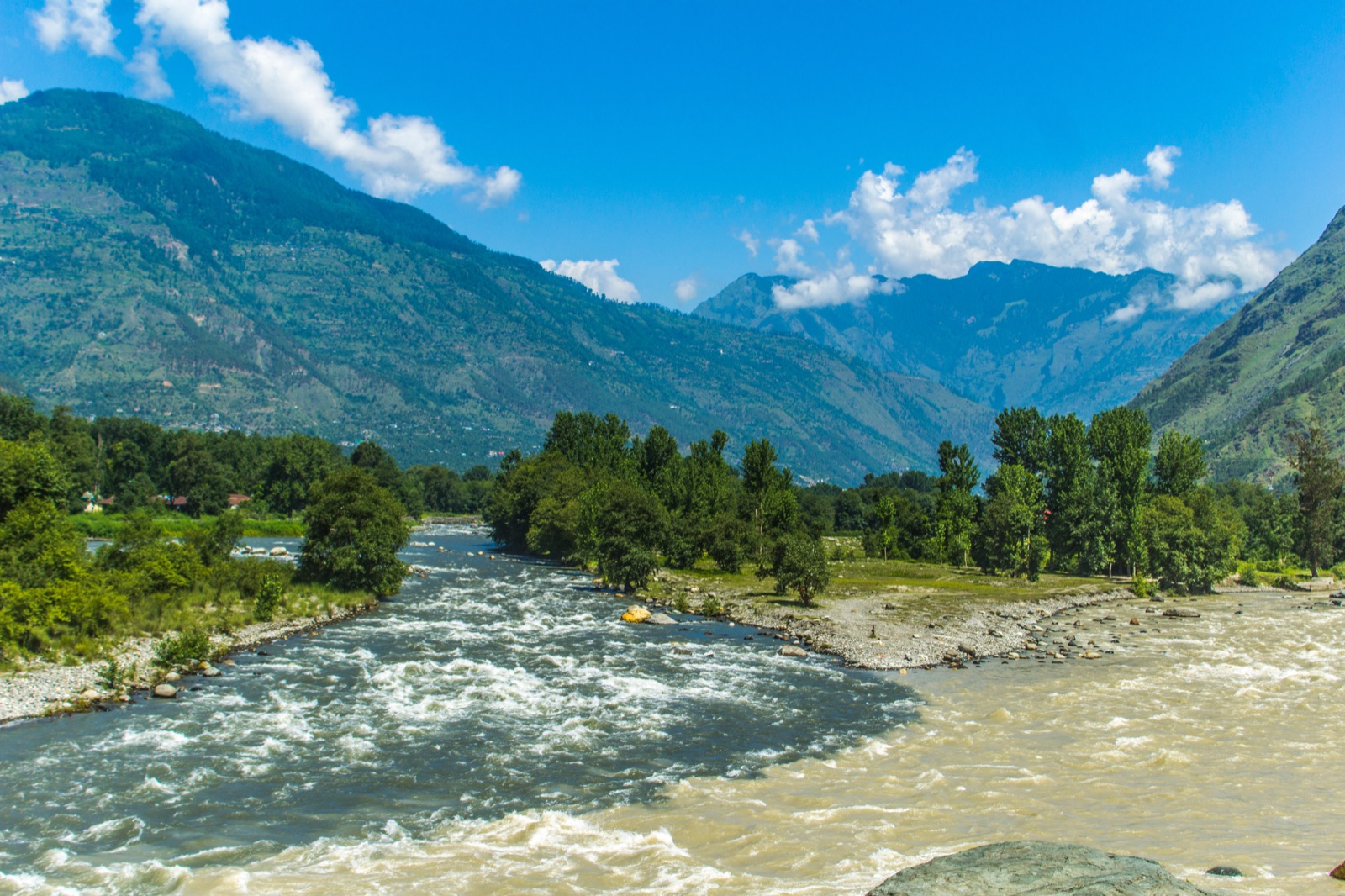
Where the Beas River carves through cedar forests at the edge of the high Himalayas

3

Welcome to Manali

Valley of the Gods

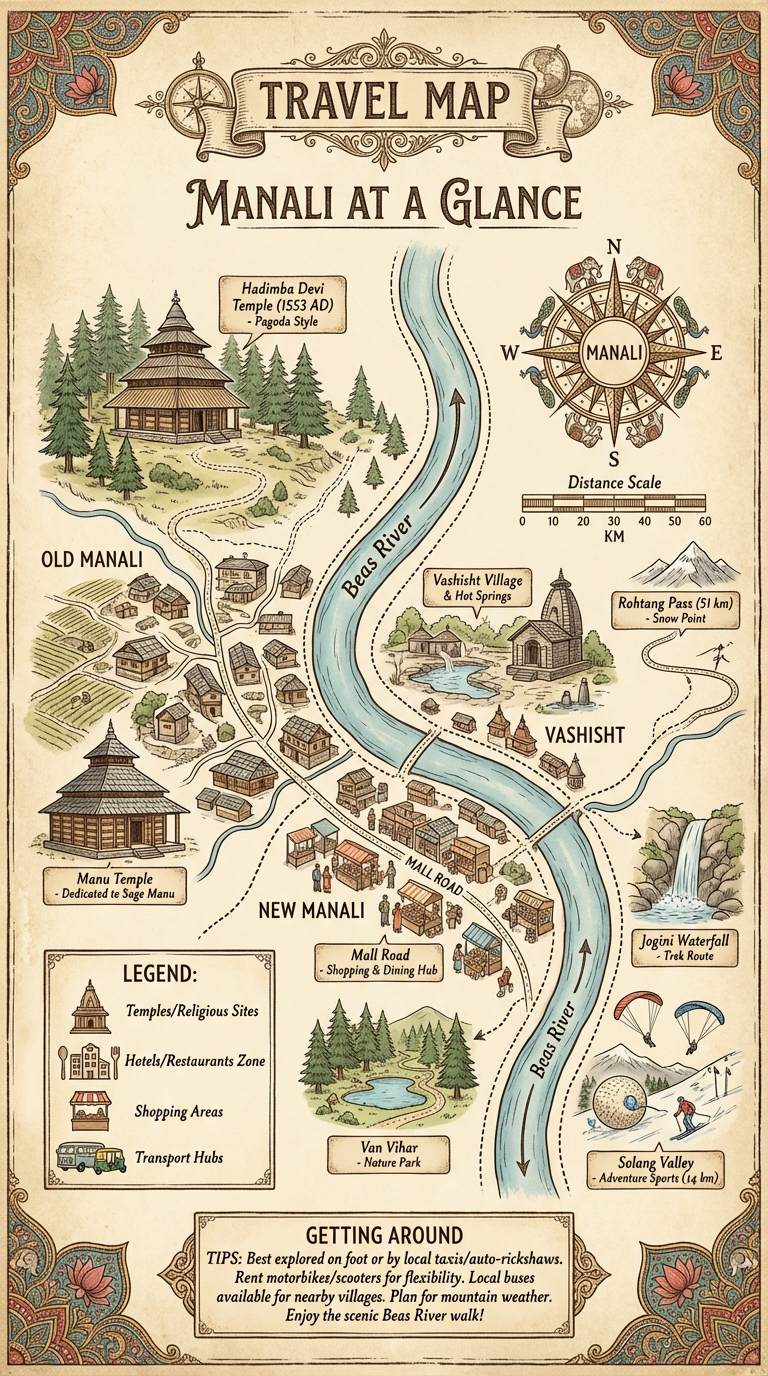
Manali sits at 2,050 metres in the Kullu Valley, cradled between deodar-covered slopes and the rushing Beas River, with the snow-dusted peaks of the Pir Panjal range towering behind. For decades it has been the gateway to Ladakh, the launching pad for high-altitude passes, and the mountain retreat where India's young come to breathe. Old Manali — a cluster of stone houses, backpacker cafes, and apple orchards on the hillside above the main town — feels like a different country from the bustling Mall Road below.

But Manali is far more than a transit point. The ancient Hadimba Temple, built in 1553 from carved deodar wood, sits in a sacred forest clearing. The hot springs at Vashisht have been soothing travelers for centuries. And the high-altitude adventures — Rohtang Pass at 3,978m, Solang Valley's paragliding and skiing, the Atal Tunnel to Lahaul — make this one of India's most thrilling destinations. Whether you seek adrenaline or stillness, Manali delivers both, often on the same day.

WHY I LOVE MANALI
Base yourself in Old Manali for the best cafes and quieter atmosphere. The main town (Mall Road) is more convenient for buses and services. The two are connected by a 20-minute walk or ₹50 auto ride.
4

Manali at a Glance

Population8,100
Area116 km²
LanguageHindi, Pahari, Kullu
Currency₹ (INR)
Time ZoneUTC+5:30
Best TimeOctober–June
Visae-Visa available
Emergency112
Manali Manali

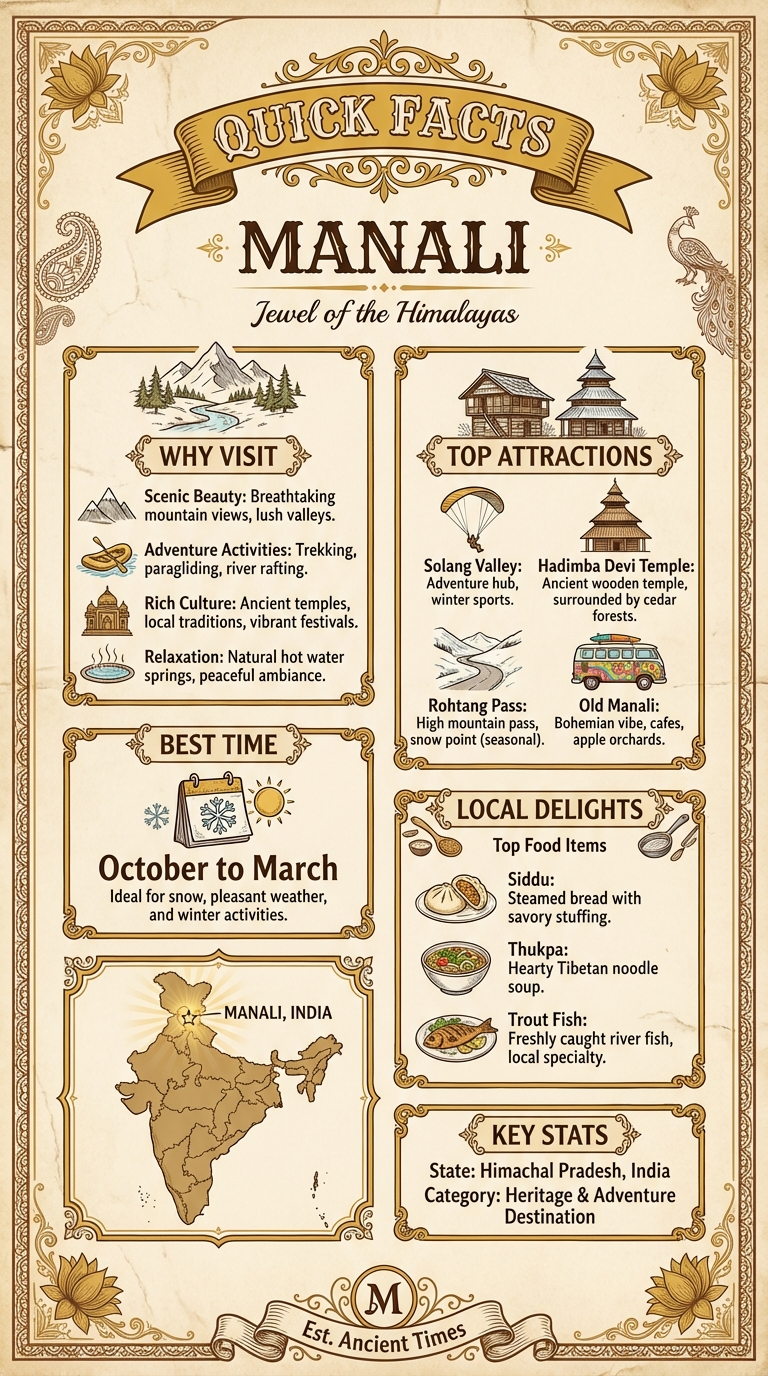
Nestled at 2,050m in the Kullu Valley of Himachal Pradesh, Manali is one of India's most popular hill stations and the traditional gateway to Ladakh via the Rohtang Pass. The town combines ancient temples, hippie-era backpacker culture, and world-class adventure sports against a backdrop of snow-capped Himalayan peaks.
Money-Saving Tips
Manali is budget-friendly. Old Manali guesthouses cost ₹500–1,500/night. Café meals ₹150–350. River rafting ₹500–1,000. ATMs are available on Mall Road but carry cash for Rohtang and Solang.
5
Quick Facts
6
01

Top 20 Experiences

The essential sights and experiences

Hadimba Temple

1. Hadimba Temple

Dhungri Forest | Free

Ancient deodar wood temple (1553) dedicated to Hadimba, wife of Bhima from the Mahabharata. Set in a sacred cedar grove.
Rohtang Pass

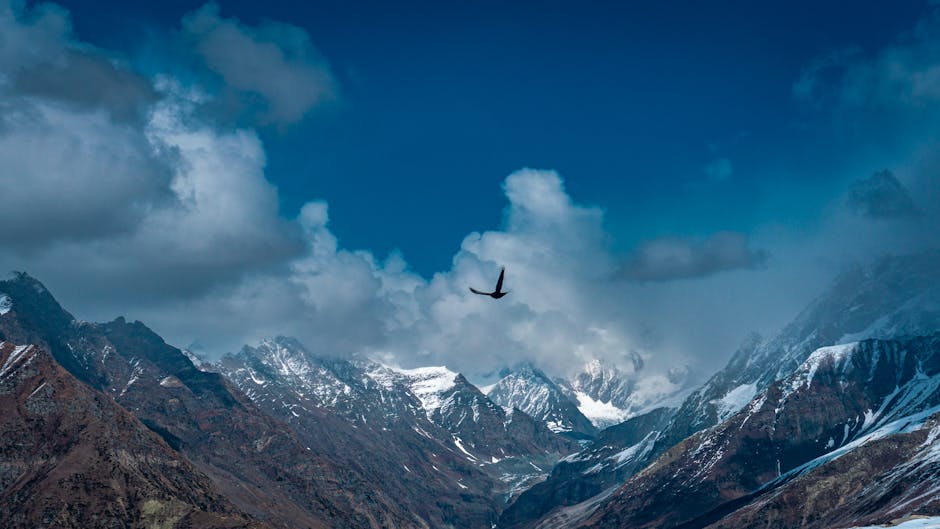
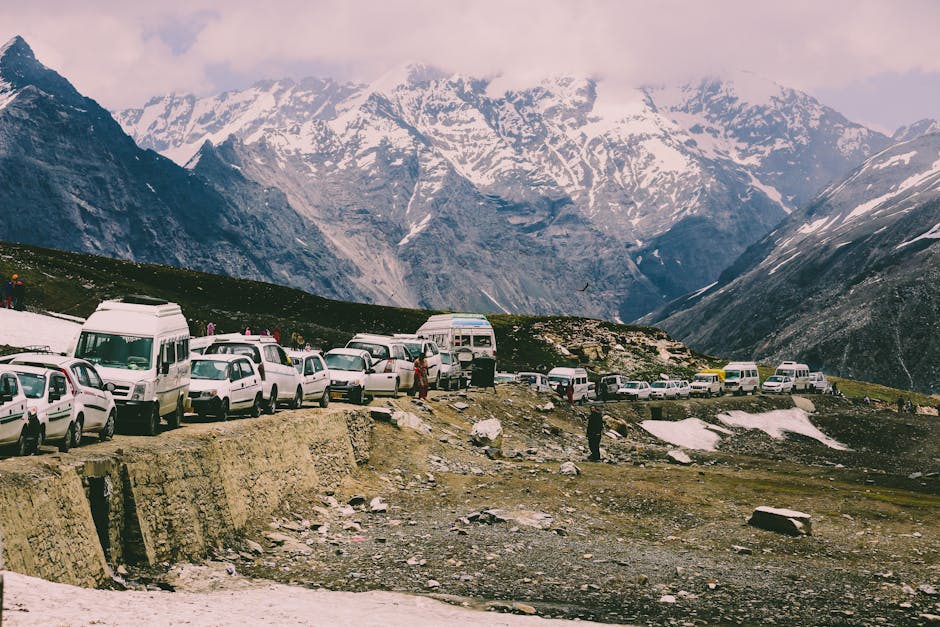
2. Rohtang Pass

51 km from Manali | ₹550 permit

Legendary 3,978m pass connecting Kullu Valley to Lahaul-Spiti. Snow year-round. Permits required and limited. Open Jun–Nov.
Solang Valley

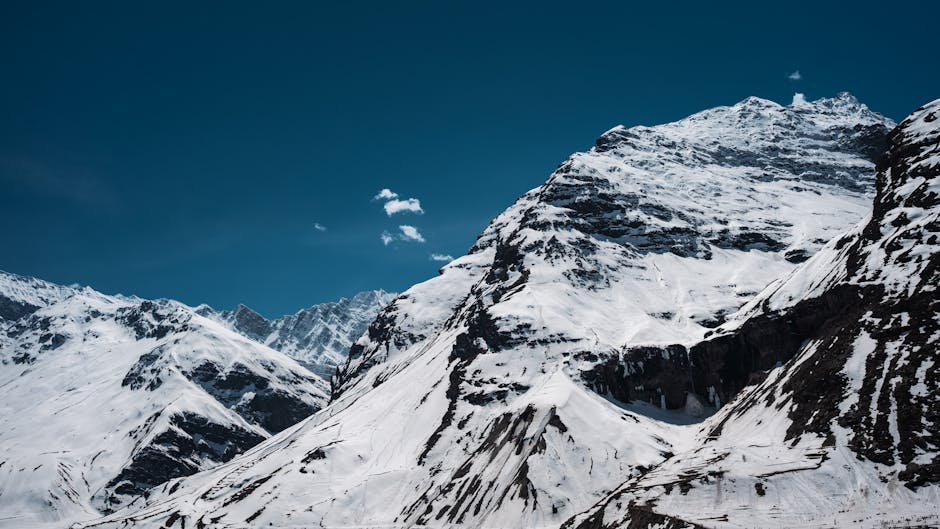
3. Solang Valley

14 km from Manali | ₹300–2,500 (activities)

Adventure hub with paragliding (₹2,000–3,500), zorbing (₹500), and skiing in winter. Gondola to 3,000m for panoramic views.
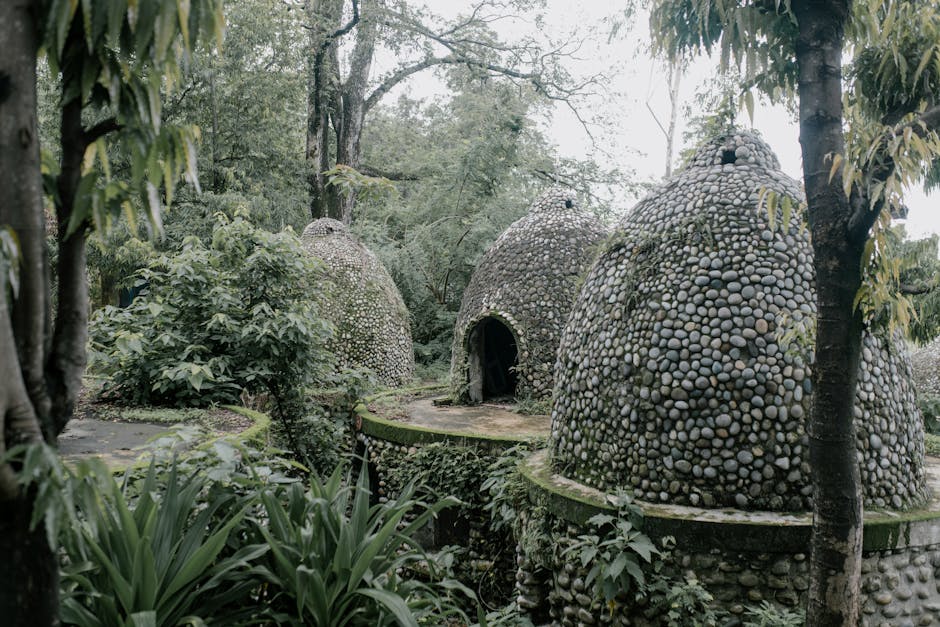
Old Manali

4. Old Manali

Above main town | Free

Bohemian village with stone houses, backpacker cafes, apple orchards, and a laid-back vibe. The real soul of Manali.

5

5. Vashisht Hot Springs

3 km from Manali | ₹30–50

Natural sulphur hot springs in a tiny village with an ancient temple. The public baths are rustic but authentic.

6

6. Atal Tunnel

10 km south entrance | Free (toll may apply)

World's longest highway tunnel above 3,000m (9.02 km), connecting Manali to Lahaul-Spiti. An engineering marvel opened in 2020.
INSIDER TIP
Rohtang Pass permits are limited to 1,200 vehicles/day. Book online at least 1 day ahead at the Kullu district website. No permits issued on Tuesdays.
7
7

7. Manu Temple

Old Manali | Free

Temple dedicated to sage Manu, the progenitor of humanity in Hindu mythology. Manali is named after him.

8

8. Jogini Waterfall

3 km trek from Vashisht | Free

Beautiful 150-ft waterfall reached via a moderate 45-minute trek through forests and villages. Best in monsoon.

9

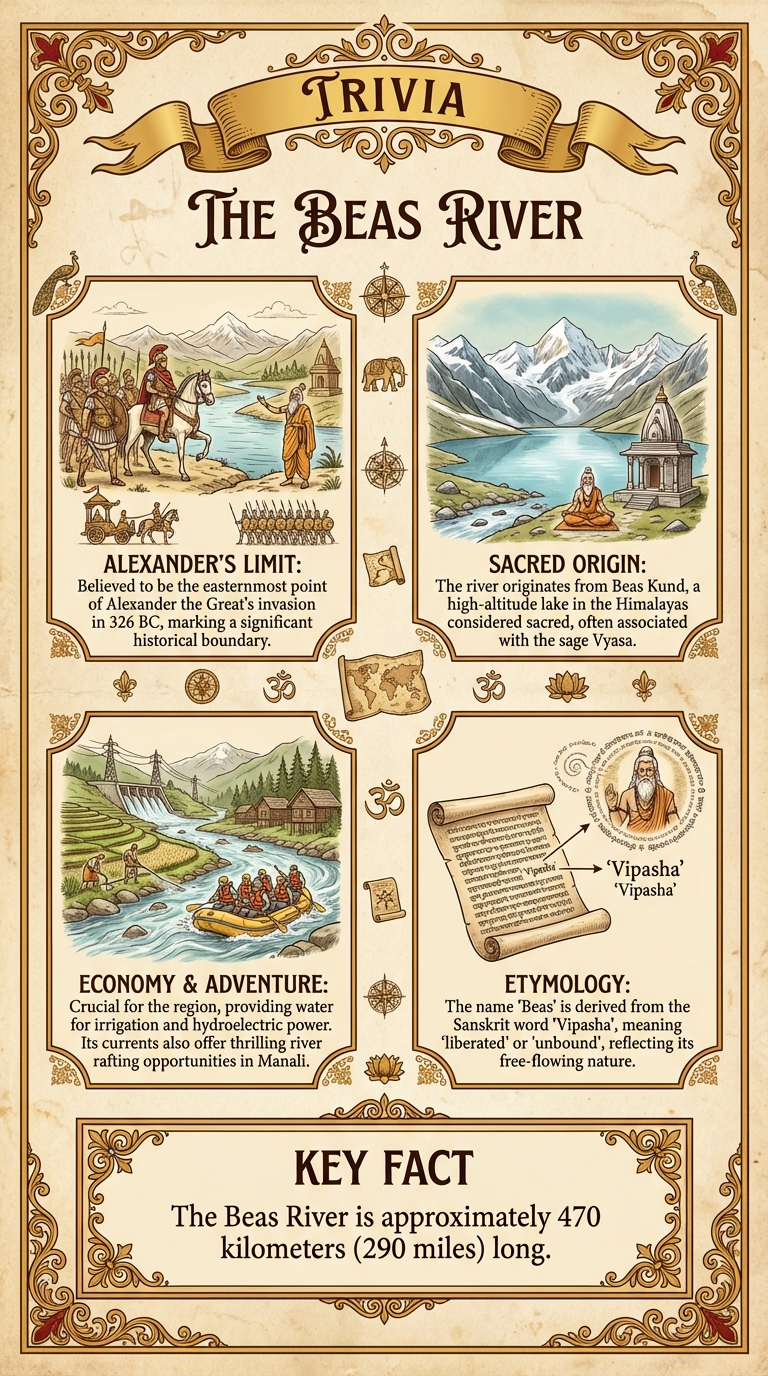
9. Beas River

Through Manali | Free (rafting ₹500–1,500)

The river that defines Manali. Walk along its banks or go white-water rafting on the Pirdi-Jhiri stretch (14 km).

10

10. Club House

Mall Road | ₹50

Colonial-era recreation club with a skating rink, billiards, and a small amusement area. Good for families.

11

11. Van Vihar

Mall Road | ₹50

Municipal park along the Beas River with deodar trees. Rent a paddleboat or just enjoy the riverside scenery.

12

12. Tibetan Monastery

Main town | Free

Gadhan Thekchhokling Gompa, built by Tibetan refugees in the 1960s. Beautiful prayer hall with spinning prayer wheels.

Must-Know Numbers
3,978m: Altitude of Rohtang Pass
9.02 km: Length of Atal Tunnel
1553: Year Hadimba Temple was built
8
13

13. Mall Road

Central Manali | Free

The main commercial street with shops, restaurants, and the Manali bus stand. Lively but crowded.

14

14. Nehru Kund

6 km toward Rohtang | Free

Natural spring named after Jawaharlal Nehru, who reportedly drank from it. Crystal-clear Himalayan water.

15

15. Manali Sanctuary

Behind Hadimba Temple | Free

Dense deodar and birch forest home to Himalayan brown bears, musk deer, and snow leopards (rare sightings).

16

16. Gulaba

22 km toward Rohtang | Free

First snow point on the Rohtang road. Accessible even when Rohtang is closed. Snow activities available.

17

17. Jana Waterfall

30 km from Manali | Free

Dramatic waterfall near Naggar, reached by a short drive and 1 km walk. Often combined with Naggar Castle visit.

18

18. Naggar Castle

21 km from Manali | ₹25/₹100

Medieval stone and wood castle (1460) overlooking the Kullu Valley. Now a heritage hotel. Nicholas Roerich art gallery nearby.

19. Hampta Pass Trek (Basecamp near Manali, ₹5,000–8,000 guided): 4-day trek crossing from the lush Kullu Valley to the arid Lahaul. One of India's most rewarding moderate treks.

20. Sissu & Lahaul Valley (Via Atal Tunnel, Free): The stunning Lahaul Valley is now just 30 minutes from Manali via the Atal Tunnel. Sissu waterfall and Tandi confluence are highlights.

9
Trivia
10
Trivia
11
Trivia
12
02

Need to Know

Essential practical information

Altitude

At 2,050m, most people have no issues. If heading to Rohtang (3,978m), acclimatize first and carry water. Symptoms: headache, nausea, breathlessness.

Money

ATMs on Mall Road (SBI, HDFC, PNB). Carry cash for Old Manali, Vashisht, and Rohtang — no ATMs there. UPI works at most cafes.

Safety

Manali is safe for all travelers. River currents are strong — don't swim in the Beas without local guidance. Rohtang road requires a careful driver.

Permits

Rohtang Pass requires an online permit (₹550/vehicle). Limited to 1,200 vehicles/day. No permits on Tuesdays (ecology day). Apply 1+ days ahead.

Weather

Weather changes fast. Carry rain gear even in summer. Rohtang can have blizzards in September. Check conditions before attempting the pass.

Crowds

May–June and Christmas/New Year are extremely crowded. Old Manali is quieter than Mall Road. October–November is the sweet spot.

Driving

Roads are narrow and winding. If you're not an experienced mountain driver, hire a local taxi. Night driving is risky.

Drugs

Manali has a reputation for cannabis (it grows wild in the valley). Possession is illegal and police conduct raids, especially in Old Manali.

Budget LevelDaily CostIncludes
Budget₹1,000–2,000/dayOld Manali guesthouse, café food, walking
Mid-Range₹4,000–8,000/dayRiverside hotel, restaurants, adventure sports
Luxury₹12,000+/daySpan Resort, fine dining, private Rohtang trip
Essential Apps
Download Google Maps (offline — coverage is spotty beyond town), HRTC for bus schedules, and IRCTC if traveling via Kalka–Shimla–Manali route.
13
03

Getting Around

Navigate the city like a local

From the Airport

The nearest airport is Bhuntar (KUU), 50 km south of Manali (₹1,500–2,000 by taxi, 1.5 hours). Limited flights from Delhi. Most travelers arrive by bus.

Walking

The best way to explore Old Manali and Vashisht. Main town is compact. Cost: Free

Auto-Rickshaw

For Mall Road to Old Manali, Vashisht, and Hadimba Temple. Cost: ₹50–150

Local Taxi

For Solang Valley, Rohtang Pass, and day trips. Hire from union stands. Cost: ₹1,500–4,000/day

HRTC Bus

Government buses to Kullu (₹50), Rohtang (seasonal), and Leh (₹800–1,200). Cost: ₹50–1,200

Bike Rental

Royal Enfield rentals (₹1,000–2,000/day) are popular for Rohtang and Leh trips. Bring license. Cost: ₹1,000–2,000/day

Transport Tips
The overnight Volvo bus from Delhi (₹1,200–1,800, 12–14 hours) is the most popular way to reach Manali. Book HRTC or private Volvos — they depart from ISBT Kashmere Gate at 5–6 PM.
14

Month by Month

When to go and what to expect

Mar–May

Spring blooms and melting snow. Pleasant 10–25°C. Rohtang begins opening (May). Solang activities resume. Apple blossoms everywhere.

Jun–Aug

Peak tourist season. Warm days (15–30°C) but monsoon rains Jul–Aug. Rohtang fully open. Lush green valleys. Rafting at its best.

Sep–Nov

Post-monsoon magic. Clear skies, crisp air (5–20°C). Apple harvest season. Best photography conditions. Rohtang closes late October.

Dec–Feb

Winter wonderland. Snowfall in Manali, heavy snow at Solang and Gulaba. Skiing available. Rohtang closed. Temperatures drop to -5°C.

Best Time to Visit
October is arguably Manali's best month — clear skies, apple harvest, fewer crowds than summer, and Rohtang still accessible. December–January for guaranteed snow.
ManaliManali — best experienced in October–June
15
04

Itineraries

Make the most of your time

Day 1: Old Manali & Temples
9:00 AMCheck in and breakfast at Lazy Dog Lounge, Old Manali (₹200–400)
10:30 AMHadimba Temple — explore the ancient deodar wood temple in the forest (free)
12:00 PMWalk through Old Manali village — stone houses, cafes, apple orchards
1:00 PMLunch at Drifters' Café, Old Manali (₹250–500)
2:30 PMManu Temple — ancient temple of sage Manu (free)
3:30 PMVashisht Hot Springs — soak in the sulphur springs, visit the temple (₹30–50)
5:00 PMWalk along the Beas River — sunset over the mountains
7:30 PMDinner at Johnson's Café (₹500–900) — Manali's most atmospheric restaurant
Day 2: Solang Valley Adventure
7:30 AMEarly start for Solang Valley (14 km, 30 min by taxi)
8:30 AMSolang Gondola — ride to 3,000m for panoramic Himalayan views (₹800–1,000)
10:00 AMParagliding from Solang (₹2,000–3,500) or zorbing (₹500)
12:00 PMLunch at a dhaba in Solang (₹150–300)
1:30 PMReturn via Gulaba for snow activities if available
3:30 PMTibetan Monastery — prayer wheels and peaceful courtyard (free)
5:00 PMMall Road shopping — Kullu shawls, Himachali caps, woolens
7:30 PMDinner at Il Forno, Old Manali — wood-fired pizzas (₹300–600)
Day 3: Rohtang Pass or Atal Tunnel
6:00 AMEarly departure for Rohtang Pass (51 km, 2.5 hours, permit required ₹550)
9:00 AMRohtang Pass (3,978m) — snow activities, photos, hot chai at the top
11:00 AMDescend and continue through Atal Tunnel to Sissu, Lahaul Valley
1:00 PMLunch at Sissu — Lahauli food and stunning valley views (₹200–400)
3:00 PMReturn to Manali via Atal Tunnel (30 min)
4:30 PMJogini Waterfall trek from Vashisht (1 hour each way, free)
7:00 PMFarewell dinner at Chopsticks, Mall Road — Tibetan & Chinese (₹300–500)
TIMING TIP
If Rohtang Pass is closed (November–May) or permits unavailable, spend Day 3 exploring Naggar Castle, Great Himalayan National Park, or the hot springs trail.
16

More Itineraries

Extended stays and themed routes

Five Days

Add Naggar Castle and the Nicholas Roerich Art Gallery (Day 4), plus a day trip to the Great Himalayan National Park (UNESCO site) for birding and nature trails.

One Week

Continue to Lahaul-Spiti via Atal Tunnel: Keylong (Day 5), Jispa and Baralacha La (Day 6), Chandratal Lake (Day 7). Or drive the Manali-Leh Highway if open (Jun–Sep).

Adventure Itinerary

River rafting on the Beas (Day 1), paragliding at Solang (Day 2), Hampta Pass 4-day trek (Days 3–6), and mountain biking to Naggar (Day 7).

Honeymoon Special

Stay at Span Resort or The Himalayan. Private Rohtang trip, couples' hot springs at Vashisht, candlelit dinner at Johnson's Café, and a nature walk through the Manali Sanctuary.

Booking Essentials
Book Rohtang permits 1+ days ahead online (kullumanali.nic.in). Summer Volvo buses sell out — book 3+ days ahead. Winter hotels offer 40–50% discounts.
17
Old Manali

Old Manali

Where the Himalayas slow time to a walk

18
Old Manali

Old Manali

The Bohemian Village

Old Manali is everything Mall Road isn't — quiet, organic, and soulful. Perched on the hillside above the main town, this cluster of traditional stone-and-wood houses, apple orchards, and backpacker cafes has been drawing travelers since the hippie trail of the 1970s. The narrow lanes wind past Israeli bakeries, Italian trattorias, and rainbow-painted guesthouses with names like Lazy Dog and Drifters'.

The vibe is unmistakably bohemian — acoustic guitar drifts from cafe terraces, travelers compare Himalayan trek stories over banana pancakes, and the pace is deliberately, defiantly slow. Yet Old Manali also has genuine Himachali character in its stone temples, ancient water channels, and orchards where families have farmed apples for generations. The bridge over the Manalsu stream marks the boundary between Old Manali and the modern world below.
LOCAL SECRET
Stay at least two nights in Old Manali. The magic reveals itself slowly — morning mist over the orchards, the sound of the stream at night, the stars from your terrace.
19

Eating & Drinking

Where to eat in Old Manali

Drifters' Café (₹250–500): The quintessential Old Manali café — great coffee, Israeli food, and mountain views.

Lazy Dog Lounge (₹200–400): Pancakes, smoothie bowls, and chill vibes on a terrace overlooking the valley.

Il Forno (₹300–600): Genuine wood-fired pizzas that rival any big-city pizzeria.

Shopping: Kullu shawls (₹500–5,000) at roadside shops, Tibetan silver jewellery (₹200–2,000), handmade soaps and candles from local artisans.

20

Old Manali by the Numbers

2,050m
Altitude of Manali
3,978m
Altitude of Rohtang Pass
9.02 km
Length of Atal Tunnel
Did You Know?
The Atal Tunnel, opened in 2020, is the world's longest highway tunnel above 3,000 metres at 9.02 km. It reduces the travel time from Manali to Lahaul-Spiti from over 5 hours (via Rohtang Pass, seasonal) to just 30 minutes — year-round.
Old Manali by the Numbers
Hadimba Temple in Manali has no idol — devotees worship the footprint of Hadimba, a forest demoness who married the Pandava prince Bhima in the Mahabharata.
Old Manali was a hippie trail destination in the 1960s–70s, and the bohemian culture survives in its Israeli cafes, trance music, and laid-back atmosphere.
21
Mall Road & Main Town

Mall Road & Main Town

Where the mountains meet the road and every journey begins

22
Mall Road & Main Town

Mall Road & Main Town

The Bustling Hub

Manali's main commercial strip runs through the lower town, connecting the bus stand to the tourist office and beyond. Mall Road is where you'll find banks, ATMs, pharmacies, tour operators, and the main shopping area. It's busier and noisier than Old Manali, but it's also where the practical infrastructure lives. The Tibetan Market here sells everything from prayer flags to pashmina shawls.

The main town is the base for transport connections — HRTC buses depart from the bus stand for Leh, Delhi, Shimla, and Dharamshala. Taxi unions here arrange vehicles for Rohtang, Solang, and day trips. While Old Manali wins on atmosphere, Mall Road wins on convenience. The area around the bus stand has the cheapest accommodation (₹400–800/night) and the best selection of budget eateries.
LOCAL SECRET
The best shopping deals are at the Tibetan Market on Mall Road — prices are lower than Old Manali shops. Buy Kullu caps (₹200–400) and pashmina stoles (₹1,000–3,000).
23

Eating & Drinking

Where to eat in Mall Road & Main Town

Chopsticks (₹300–500): Popular for Tibetan and Chinese food — try the thukpa and momos.

Mayur Restaurant (₹200–400): Reliable North Indian food near the bus stand.

Johnson's Café (₹500–900): Manali's most famous restaurant in a colonial cottage with a fireplace and garden.

24

Mall Road & Main Town by the Numbers

1553
Year Hadimba Temple was built
14 km
Beas River rafting stretch
1460
Year Naggar Castle was built
Did You Know?
Manali is named after sage Manu, who is believed in Hindu mythology to be the progenitor of all humanity. The Manu Temple in Old Manali marks the spot where he supposedly meditated after a great flood.
Mall Road & Main Town by the Numbers
The Beas River that flows through Manali is named after sage Vyas (Vyasa), who is believed to have composed the Mahabharata on its banks.
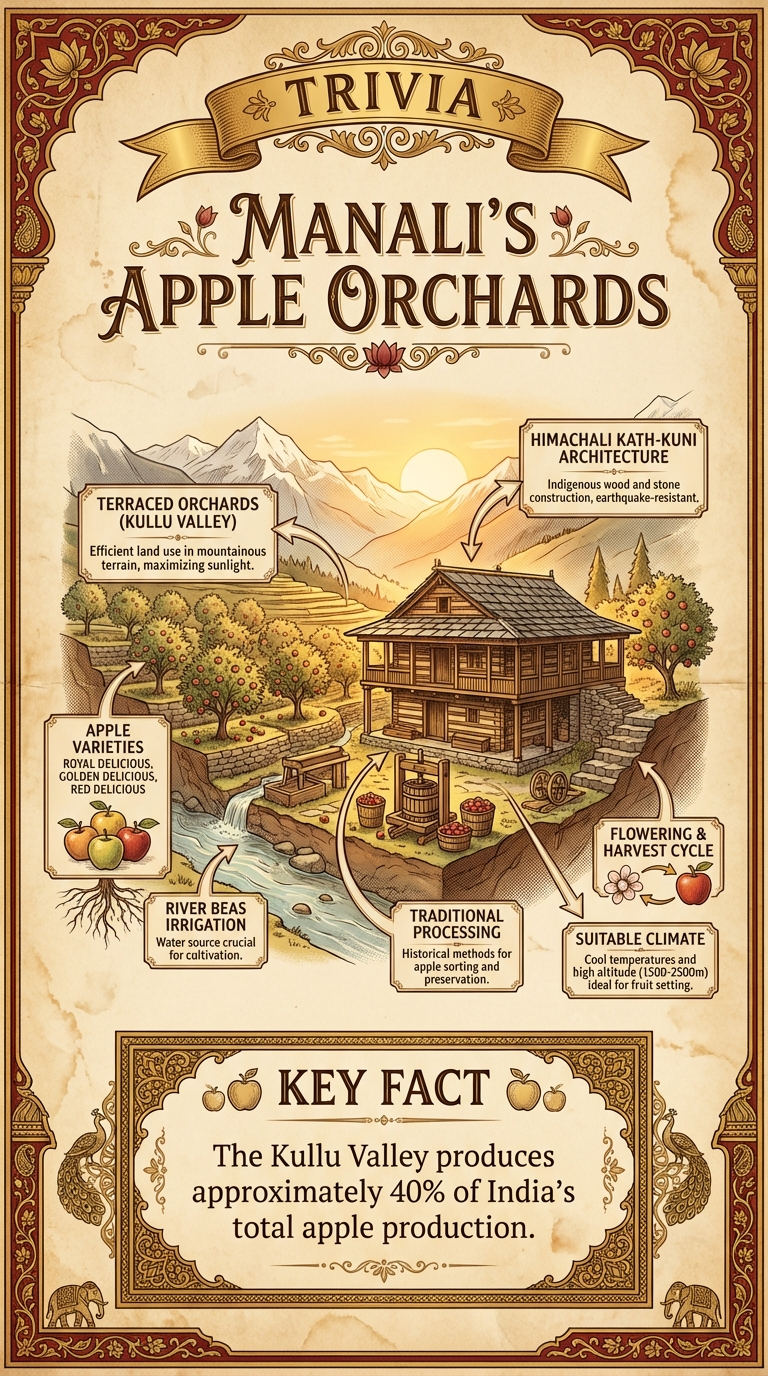
Manali produces some of India's finest apples, and the apple orchards are the economic backbone of the Kullu Valley. Harvest season (August–October) is a festive time.
25
Vashisht & Beyond

Vashisht & Beyond

Where hot springs heal and mountain trails beckon

26
Vashisht & Beyond

Vashisht & Beyond

Hot Springs & Hidden Trails

Three kilometres from Manali, the tiny village of Vashisht sits above the Beas River, famous for its natural sulphur hot springs. The ancient Vashisht Temple and adjacent public baths have been drawing pilgrims and travelers for centuries. The hot springs are believed to have curative properties — the rustic public bath (₹30) and the slightly nicer private one (₹50) offer a genuinely local experience.

Beyond Vashisht, the trail to Jogini Waterfall (45 minutes uphill) passes through pine forests and traditional Himachali villages where wooden houses balance on steep slopes. The waterfall, at 150 feet, is spectacular in monsoon. This area represents Manali's quieter side — still accessible but removed from the tourist frenzy. Several boutique resorts and homestays along the Vashisht road offer riverside settings with mountain views.
LOCAL SECRET
Visit the hot springs early morning (7–8 AM) before the crowds arrive. The water is naturally hot (40–45°C) and genuinely relaxing after a day of trekking.
27

Eating & Drinking

Where to eat in Vashisht & Beyond

Freedom Café (₹200–400): Vashisht institution with river views and generous portions.

Himachali Kitchen (₹150–300): Family-run place serving authentic siddu, madra, and local trout.

28

Vashisht & Beyond by the Numbers

₹550
Rohtang Pass permit fee
1,200
Daily vehicle limit for Rohtang
10
Years to build the Atal Tunnel
Did You Know?
Rohtang Pass gets its name from the Persian "Rohtang" meaning "pile of corpses" — a grim reference to the many travelers who perished attempting the crossing before modern roads were built.
Vashisht & Beyond by the Numbers
The Atal Tunnel was built at a cost of ₹3,200 crore (US$400 million) and took 10 years to complete through the Pir Panjal range under extreme conditions.
Manali receives over 5 million tourists annually, making it one of India's most visited hill stations — a staggering number for a town with just 8,000 permanent residents.
29
Food Guide
30
05

Food Guide

What to eat and where to find it

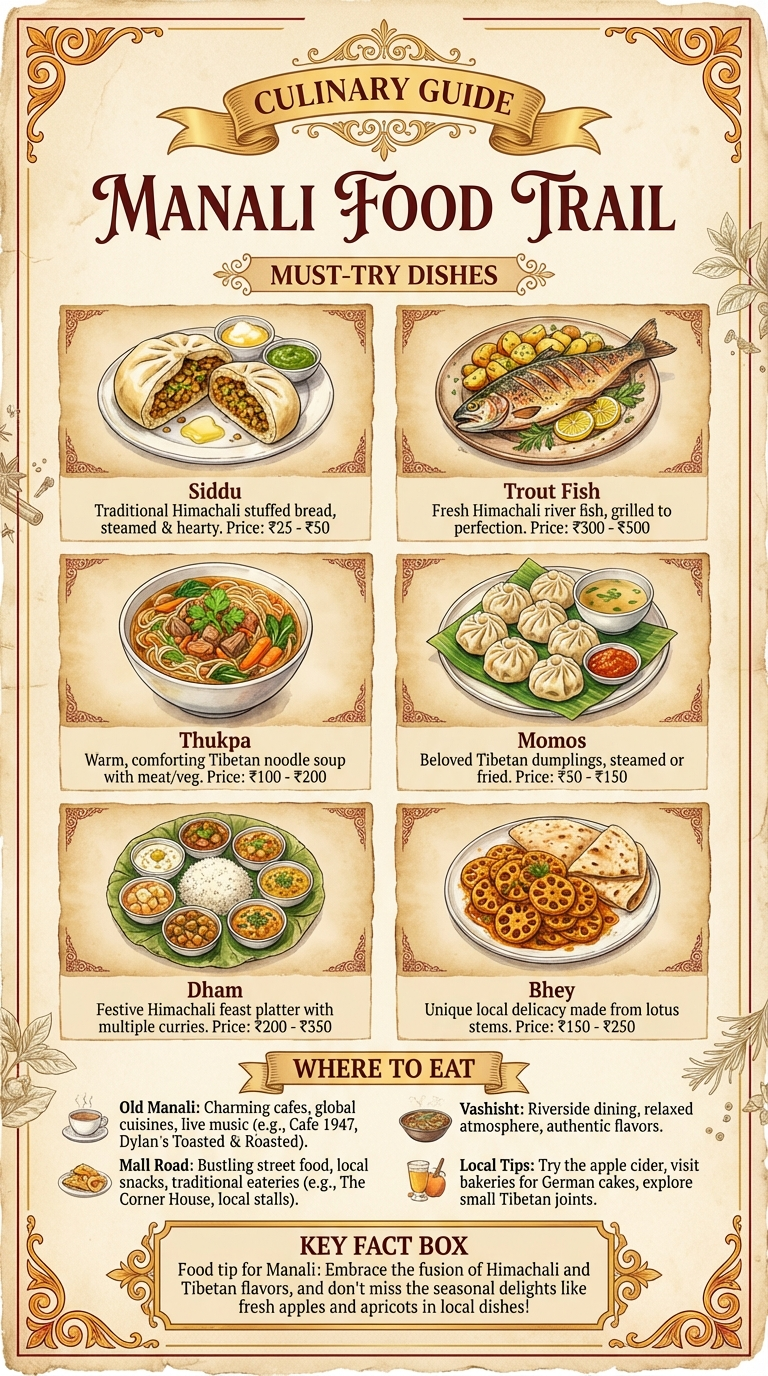
Manali's food scene is wonderfully diverse — a product of its position at the crossroads of Himalayan cultures. Himachali mountain food (siddu, madra, trout) meets Tibetan refugee cuisine (momos, thukpa, tingmo) and the backpacker café culture that brought Italian, Israeli, and Continental cooking to these remote valleys. The result is that you can eat wood-fired pizza for lunch, Himalayan trout for dinner, and Tibetan butter tea for breakfast, all within a 15-minute walk.

Siddu (₹60–100): Steamed bread stuffed with poppy seeds or walnut paste, served with ghee. The quintessential Himachali mountain food.

Momos (₹60–120): Tibetan dumplings — steamed, fried, or in soup. Every café and stall serves them. The pork momos at Chopsticks are legendary.

Trout (₹300–500): Fresh rainbow trout from Himachal's cold streams, pan-fried with butter and lemon. Best at Johnson's Café.

Thukpa (₹80–150): Tibetan noodle soup with vegetables or chicken. Perfect on cold evenings. Every Tibetan café serves it.

Kullu Trout Curry (₹250–400): Local preparation of trout in a Himachali yoghurt-based sauce. Ask at Vashisht restaurants.

Babru (₹30–50): Deep-fried bread stuffed with black gram dal. A filling mountain breakfast.

Dham (₹200–400): Himachali ceremonial feast — rice, dal, rajma, curd, and sweet rice on leaf plates.

Apple Cider (₹100–300/glass): Kullu Valley produces excellent apple cider. Try it at Johnson's Café or local orchards.

31

Where to Eat

Best restaurants, markets, and street food

Top Restaurants

Johnson's Café (₹500–900): Colonial cottage restaurant with fireplace, garden, and Manali's best trout.

Drifters' Café (₹250–500): Old Manali institution — Israeli food, great coffee, and mountain views.

La Plage (₹400–800): French-inspired café in Old Manali with excellent crepes and pastries.

Chopsticks (₹300–500): Mall Road favourite for Tibetan and Chinese — their thukpa is warming perfection.

Street Food & Markets

Mall Road momos stalls: Steamed momos for ₹50–80 — the pork momos are the best.

Old Manali bakeries: Fresh bread, cinnamon rolls, and banana cake from Israeli-style bakeries.

Vashisht stalls: Maggi noodles (₹40) and chai (₹20) after the hot springs — a Manali ritual.

FOODIE TIP
The trout at Johnson's Café (₹450) is pan-fried fresh from local streams with butter and herbs — the single best dish in Manali. Pair it with their apple cider.
32

Food by the Numbers

40%
Of India's apples from Kullu Valley
₹450
Johnson's Café trout — worth every rupee
₹50
A plate of momos on Mall Road
Did You Know?
The Kullu Valley produces over 40% of India's apple crop. During harvest season (August–October), you can visit orchards and buy fresh apples directly from farmers at ₹50–80/kg.
Food by the Numbers
Food by the Numbers
Food by the Numbers
The Atal Tunnel was built at a cost of ₹3,200 crore (US$400 million) and took 10 years to complete through the Pir Panjal range under extreme conditions.
Manali receives over 5 million tourists annually, making it one of India's most visited hill stations — a staggering number for a town with just 8,000 permanent residents.
33
06

History

Understanding the story of Manali

Manali's history stretches back to mythology — it is named after sage Manu, who is believed in Hindu tradition to have stepped off his ark here after a great flood, making it the birthplace of human civilization. The ancient Hadimba Temple (1553) in its deodar grove connects the town to the Mahabharata epic. For centuries, the Kullu Valley was a remote kingdom, its rajas ruling from Naggar Castle (1460) before shifting the capital to Kullu town in the 17th century.

34

Culture & Identity

The British discovered Manali's apple-growing potential in the early 20th century, and orchards transformed the valley's economy. The construction of the Manali-Leh Highway in the 1960s–70s turned the sleepy town into a strategic transit point and, eventually, a major tourist destination. The hippie trail brought Western travelers in the 1970s, leaving behind the café culture that defines Old Manali today. The opening of the Atal Tunnel in 2020 — connecting Manali to the Lahaul-Spiti Valley year-round — marked a new chapter, transforming Manali from a seasonal gateway into an all-weather hub.

Culture & People

Manali sits at the confluence of multiple Himalayan cultures. The Kullu Dussehra festival (October) is a spectacular week-long celebration where over 200 village deities are carried in palanquins to the Dhalpur Maidan in Kullu town — unique in all of India. The Tibetan refugee community, settled here since the 1960s, maintains monasteries, prayer wheels, and a vibrant food culture. Traditional Kullu shawls, hand-woven with distinctive geometric patterns, are a living craft. Local Nati dance — the world's largest folk dance with thousands participating — was recently recognized by the Guinness Book of World Records.

Cultural Etiquette
Remove shoes at temples and monasteries. Ask before photographing locals, especially women. Respect the hot springs — don't use soap in the public baths. Don't litter on trails. Cannabis is illegal despite growing wild.
35
07

Day Trips

Excursions from Manali

The Kullu Valley extends far beyond Manali, offering ancient castles, UNESCO-listed national parks, and sacred hot springs within easy day-trip distance.

Naggar Castle & Roerich Gallery (21 km (45 min))

Medieval castle (1460) overlooking the Kullu Valley, now a heritage hotel. The nearby Nicholas Roerich Art Gallery houses works by the Russian painter who lived here. Entry: ₹25/₹100 castle, gallery free

Great Himalayan National Park (60 km (2 hours))

UNESCO World Heritage site with 375 species of fauna. Day hikes to Tirthan Valley. Best for birding and nature walks. Entry: ₹50/₹200

Manikaran Hot Springs (85 km (2.5 hours))

Sacred hot springs in the Parvati Valley where water boils hot enough to cook rice. Important Sikh and Hindu pilgrimage site. Entry: Free

Kullu Town & Bijli Mahadev (40–50 km (1.5 hours))

Kullu town for shawl shopping and the hilltop Bijli Mahadev Temple — struck by lightning that shatters the Shiva lingam, which is reformed with butter. Entry: Free

36
Manali day trip
Getting There
Hire a taxi from the Manali union stand (₹1,500–3,500/day). HRTC buses run to Kullu (₹50, 1 hour), Naggar (₹30, 45 min), and Manikaran (₹100, 2 hours). Bike rentals for self-drive trips (₹1,000–2,000/day).
37
08

Directory A–Z

Practical information from A to Z

Alcohol

Available at hotels, restaurants, and wine shops. Local apple cider and plum wine are Himachali specialties worth trying.

ATMs

SBI, HDFC, and PNB ATMs on Mall Road. No ATMs in Old Manali or Vashisht. Carry cash for mountain activities.

Clinics

Lady Willingdon Hospital on Mall Road for emergencies. Private clinics near bus stand. Carry basic medication.

Electricity

220V/50Hz. Power cuts common, especially in winter storms. Hotels have generators. Carry a power bank.

Internet

Wi-Fi at most hotels and cafes. 4G works in town but fails beyond Solang/Rohtang. Download offline maps.

LGBTQ+

Old Manali has a generally tolerant bohemian atmosphere. India decriminalized homosexuality in 2018. Discretion in rural areas.

Laundry

Laundry services on Mall Road and Old Manali (₹30–60/piece). Takes 24–48 hours due to mountain humidity.

38

Mail

Post office on Mall Road. International mail takes 10–14 days. No courier services to remote areas.

Parking

Limited. Use the public parking near the bus stand (₹50–100/day). Old Manali has very limited vehicle access.

Permits

Required for Rohtang Pass (₹550/vehicle, online only). Inner Line Permits for Spiti from SDM office in Manali.

Police

Tourist police on Mall Road. Emergency: 112. Mountaineering Institute provides rescue info.

Taxes

GST 5–18%. Most cafes include taxes. Hotels charge 12–18% GST.

Toilets

Western toilets at hotels and restaurants. Public toilets at bus stand (₹5). Carry tissue on treks.

Water

Mountain spring water is generally safe in Manali, but bottled water (₹20) is safest for tourists.

Weather

Check forecasts before Rohtang attempts. Roads close in heavy snow/rain. Landslides possible Jun–Sep.

39

Transport

Getting to and around Manali

From Delhi: Overnight Volvo bus (12–14 hours, ₹1,200–1,800) from ISBT Kashmere Gate is the most popular option. Private Volvos by HPTDC and operators like Himachal Volvo depart 5–6 PM. Flights to Bhuntar (KUU) then taxi 50 km.

From Shimla: 260 km, 7–8 hours by bus (₹500–700) or taxi (₹4,000–5,000). A scenic but long mountain drive.

Within Manali: Walk in Old Manali and main town. Autos for short rides (₹50–150). Taxis for Solang, Rohtang, and day trips.

ModeDetailsCost
WalkingThe best way to explore Old Manali and Vashisht. Main town is compact.Free
Auto-RickshawFor Mall Road to Old Manali, Vashisht, and Hadimba Temple.₹50–150
Local TaxiFor Solang Valley, Rohtang Pass, and day trips. Hire from union stands.₹1,500–4,000/day
HRTC BusGovernment buses to Kullu (₹50), Rohtang (seasonal), and Leh (₹800–1,200).₹50–1,200
Bike RentalRoyal Enfield rentals (₹1,000–2,000/day) are popular for Rohtang and Leh trips. Bring license.₹1,000–2,000/day
TRANSPORT TIP
The overnight Volvo bus from Delhi (₹1,200–1,800, 12–14 hours) is the most popular way to reach Manali. Book HRTC or private Volvos — they depart from ISBT Kashmere Gate at 5–6 PM.
40

Language

Essential phrases for travelers

Hindi is universally understood in Manali. The local Kullvi (Kullu Pahari) dialect is spoken among residents. English is widely spoken in tourist areas, cafes, and hotels — Old Manali in particular has an international, multilingual atmosphere.

EnglishHindi / Pahari / Kullvi
Hello / GreetingsNamaste
Thank youDhanyavaad / Shukriya
Yes / NoHaan / Nahin
How much?Kitna hai?
Too expensiveBahut mehnga hai
WaterPaani
FoodKhana
Where is...?...kahan hai?
HelpMadad
GoodAccha
BeautifulSundar
ColdThanda
MountainPahad
SnowBarf
How far?Kitni door hai?
Language Note
In Old Manali, you'll hear Hebrew, Russian, French, and English as often as Hindi. Most cafe owners and guides speak 3–4 languages.
41
Maps
42

Top 10 Picks

Our favourite experiences in Manali

Best Adventure

Paragliding at Solang

Soar over the valley with snow-capped peaks in every direction

Best View

Rohtang Pass

Standing at 3,978m with the world spread below you

Best Food

Johnson's Café Trout

Pan-fried Himalayan trout in a colonial cottage — Manali's finest

Best Café

Drifters' Café, Old Manali

The original backpacker café — mountain views and Israeli food

Best Luxury

Span Resort & Spa

Riverside luxury with mountain views and a cedar-panelled spa

Best History

Hadimba Temple

A 1553 deodar wood temple in a sacred forest — timeless

Best Hidden Gem

Jogini Waterfall

45-minute forest trek to a 150-ft cascade — most tourists miss it

Best Photo

Old Manali Bridge at Dawn

The Manalsu stream with misty mountains behind

Best Winter

Solang Valley Skiing

Fresh powder and Himalayan panoramas at 3,000m

Best Free

Beas River Walk

Follow the riverbank at sunset — the mountains turn pink and gold

43

Packing List

Everything you need for Manali

Essentials

☐ Passport & e-Visa printout
☐ Phone with offline maps
☐ Cash (₹) & cards
☐ Travel insurance docs
☐ Power bank

Clothing

☐ Warm jacket (essential all year at altitude)
☐ Waterproof trekking shoes
☐ Rain jacket
☐ Thermal layers for Rohtang
☐ Sun hat and sunglasses

Health & Comfort

☐ Sunscreen SPF 50+
☐ Lip balm (dry mountain air)
☐ Hand sanitizer
☐ Altitude sickness medication
☐ Basic first aid kit

Before You Go

☐ Book Rohtang permit online
☐ Book Volvo bus from Delhi
☐ Download offline maps
☐ Check weather & road conditions
☐ Pack for subzero temps if visiting Rohtang
PACKING TIP
Even in summer, Rohtang Pass temperatures drop below freezing. Rent warm jackets and boots at the base (₹200–500/set) if you haven't packed them. Always carry sunscreen at altitude.
44

About This Guide

About Travorea

Travorea creates comprehensive, beautifully designed travel guides that combine insider knowledge with practical information. Our guides are crafted to help you experience destinations like a local, not just a tourist.

This Guide

This premium guide to Manali was researched and written to give you everything you need for an unforgettable trip. All prices and information were verified at the time of writing (2026) but may change — always confirm locally.

Photography

All photographs in this guide are sourced from free-to-use image libraries (Pexels, Unsplash) and original Travorea photography. Infographics are original Travorea creations.

Explore More Guides

Visit www.travorea.com/ebooks for premium guides to 50+ destinations worldwide.

45
Travorea

Manali

Valley of the Gods

• Rohtang Pass
• Old Manali
• Solang Valley
• Hadimba Temple
• River Rafting
2026 Edition | www.travorea.com
© 2026 Dreamadsdigital. All rights reserved. Content may not be reproduced without permission.