
Birthplace of Lord Krishna
Where Krishna was born in a prison cell and the world's most joyous festival of colors began
Birthplace of Lord Krishna
Mathura is the birthplace of Lord Krishna — the city where the divine cowherd was born in a prison cell to Devaki and Vasudeva over 5,000 years ago, according to Hindu tradition. Situated on the banks of the Yamuna River in Uttar Pradesh, Mathura and its twin city Vrindavan together form one of Hinduism's most important pilgrimage circuits. The air here is thick with devotion: temple bells ring ceaselessly, the Hare Krishna chant echoes from every corner, and the ghats along the Yamuna throb with ritual activity from before dawn until well after dark.
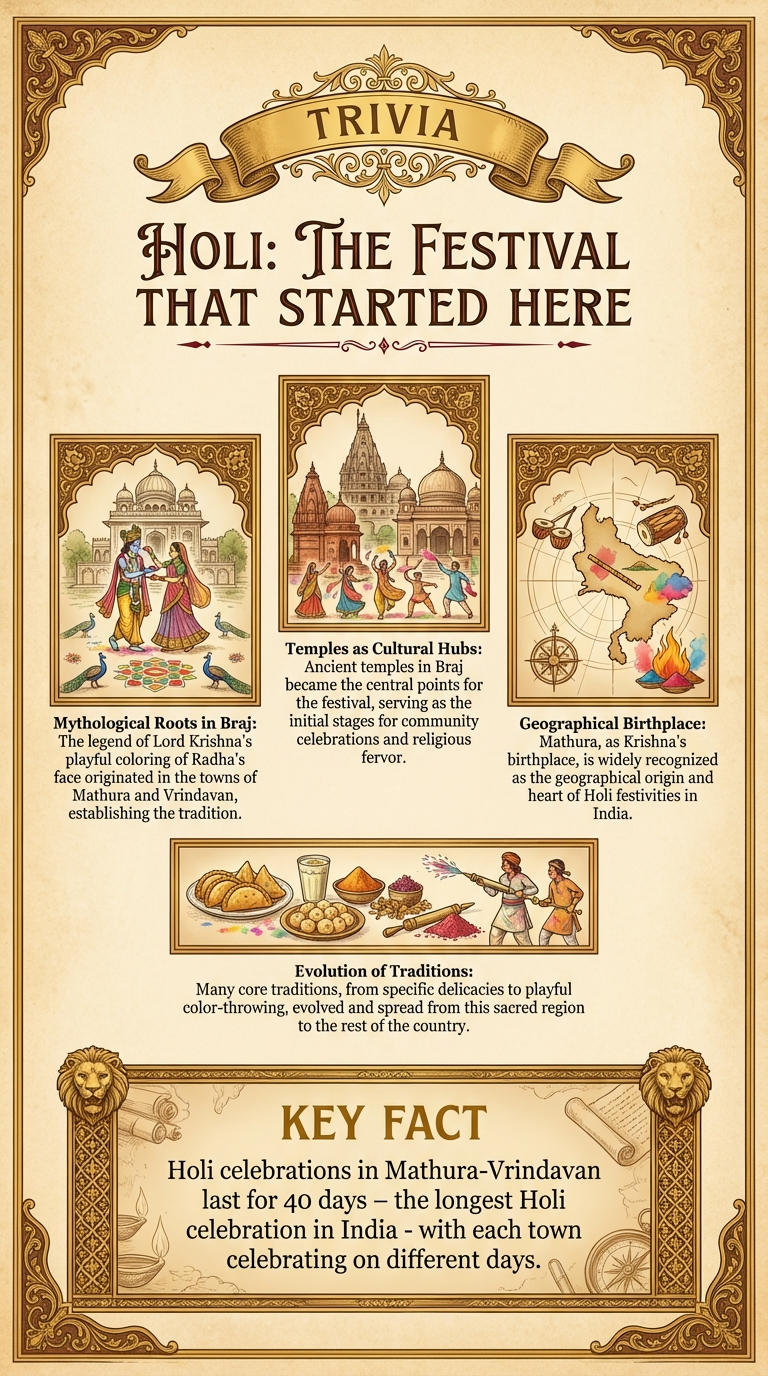
But Mathura is not just for pilgrims — it is an extraordinary cultural experience. The city explodes during Holi (February/March) when the famous Lathmar Holi of nearby Barsana and the colour-drenched celebrations in Vrindavan draw visitors from around the world. The ancient Keshav Dev Temple at Krishna Janmasthan, the mystical atmosphere of Vrindavan's 5,000+ temples, and the sacred Govardhan Parikrama circuit make Mathura-Vrindavan a journey through living mythology.
Mathura
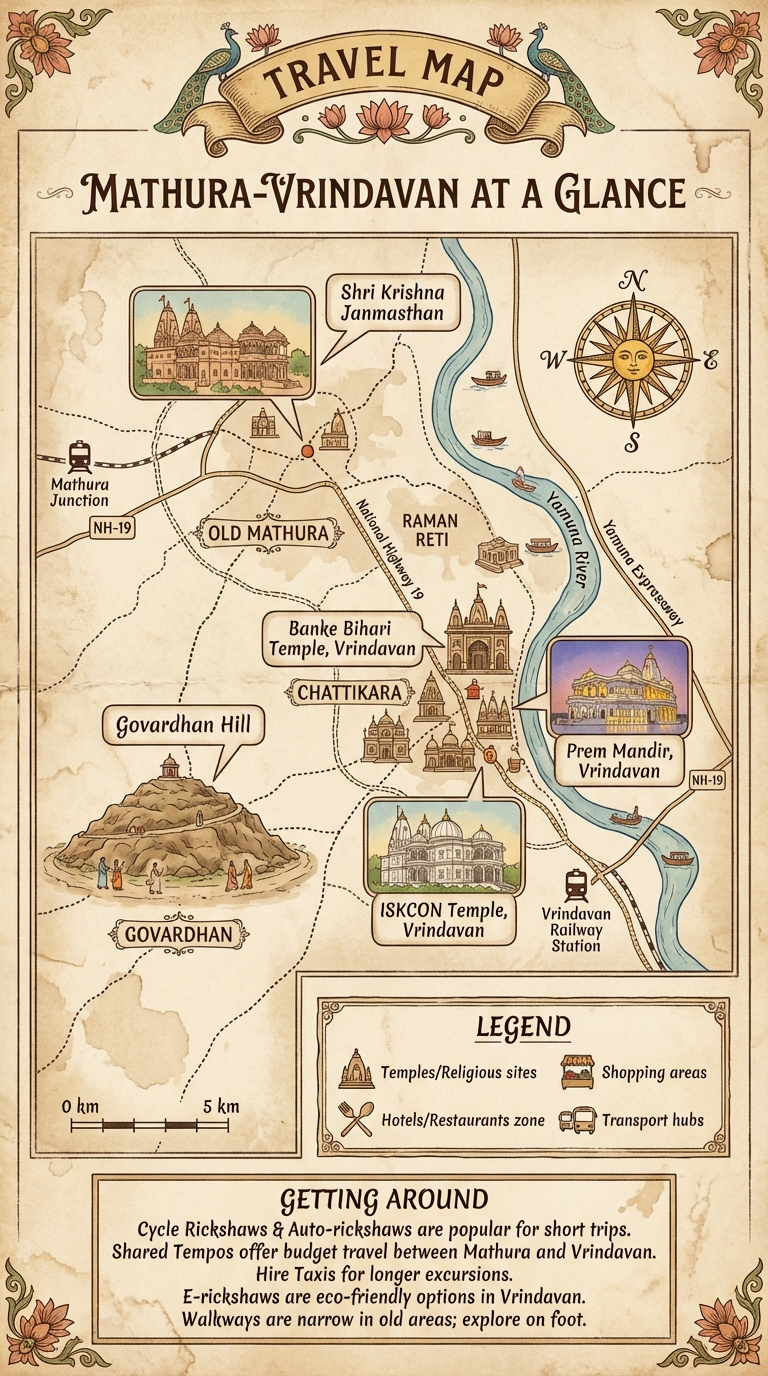
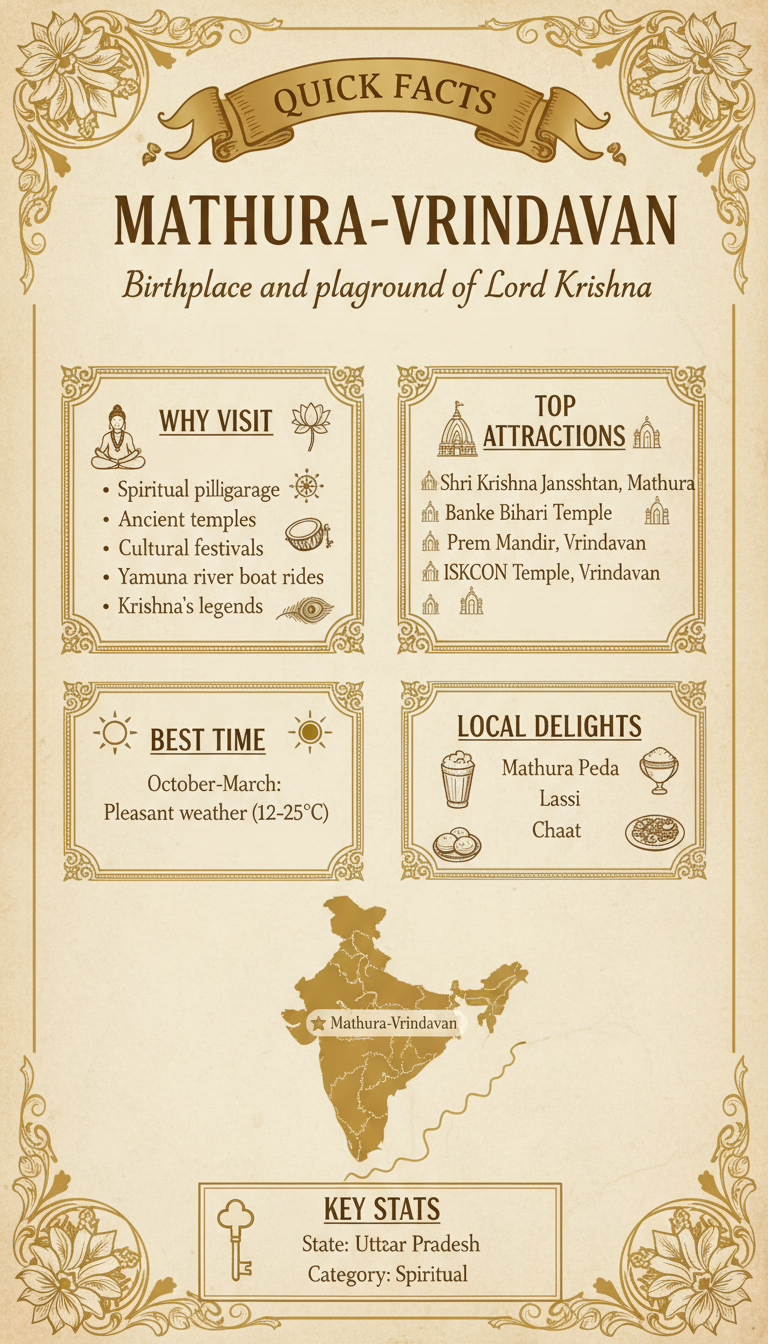
Mathura sits on the Yamuna River, 145 km south of Delhi and 58 km from Agra. Together with Vrindavan (12 km away), it forms the Braj region — the land of Krishna. The twin cities have over 5,000 temples and are especially vibrant during Janmashtami and Holi.
The essential sights and experiences
Krishna Janmasthan Complex | Free
The exact spot where Lord Krishna was born — the prison cell (garbha griha) is the most sacred site. Adjacent to the Shahi Idgah mosque.
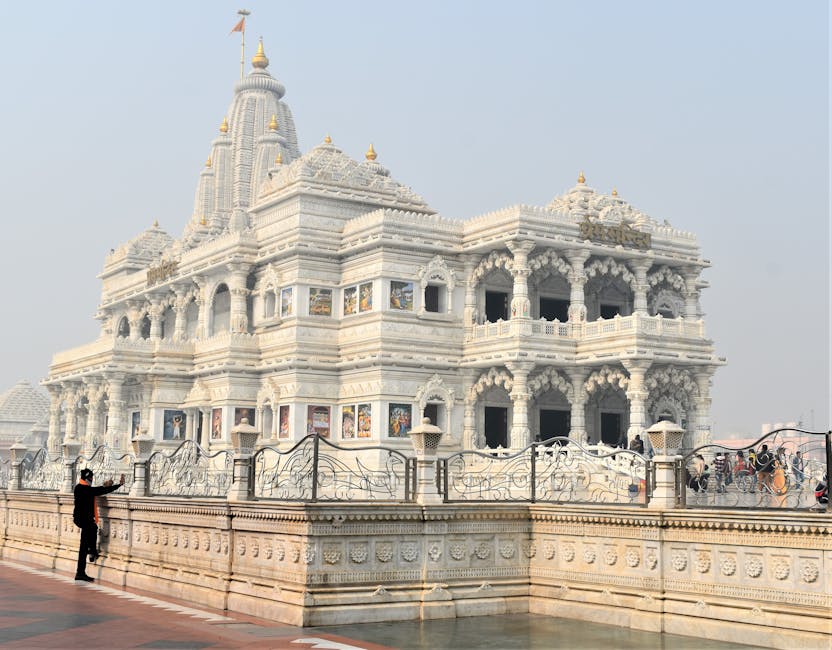
Vrindavan, 12 km | Free
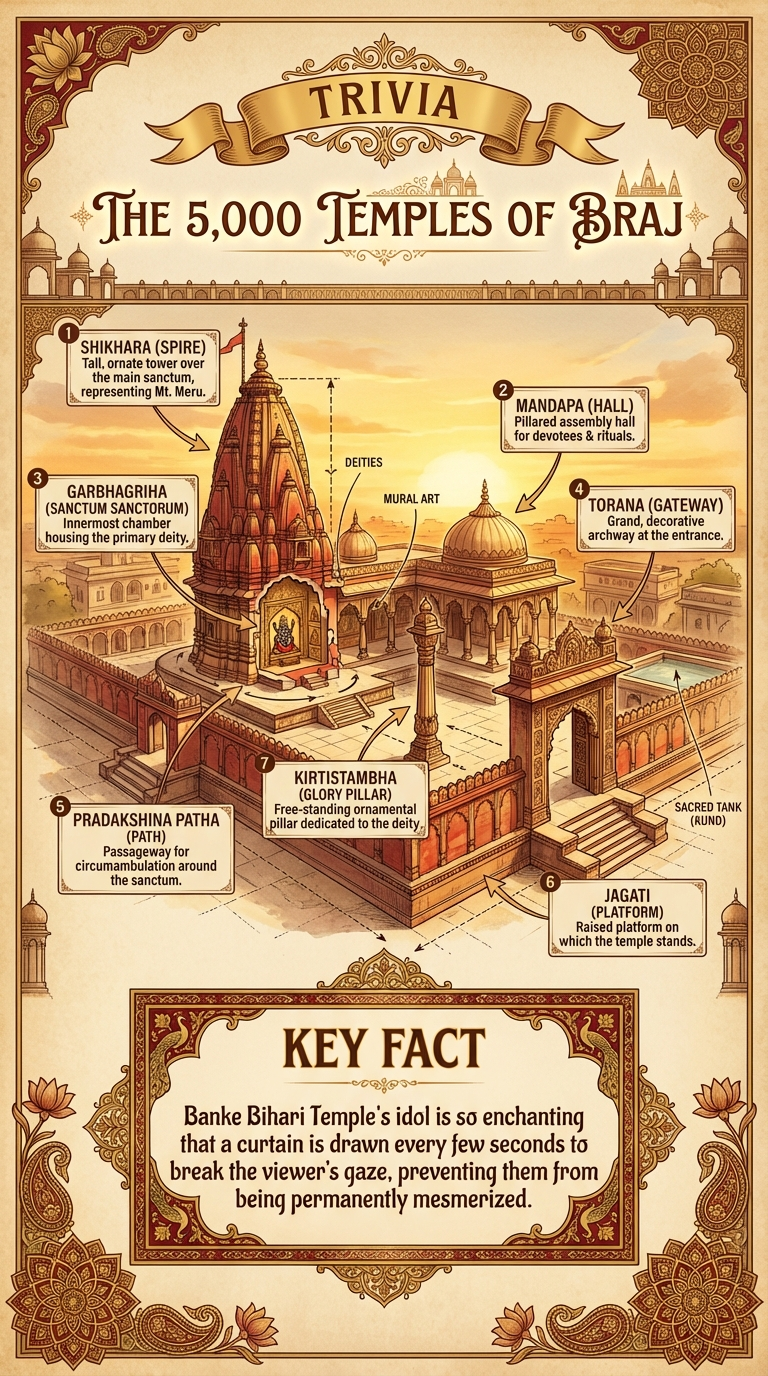
The most visited temple in the Braj region. The curtain before the deity is drawn back and forth because the idol's beauty is considered too intense for continuous viewing.
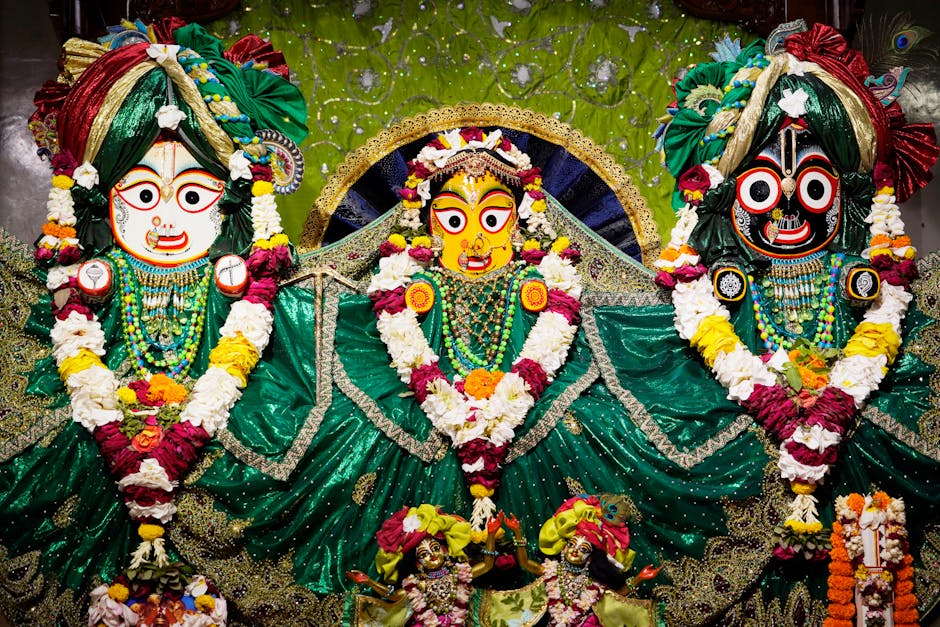
Vrindavan, 12 km | Free
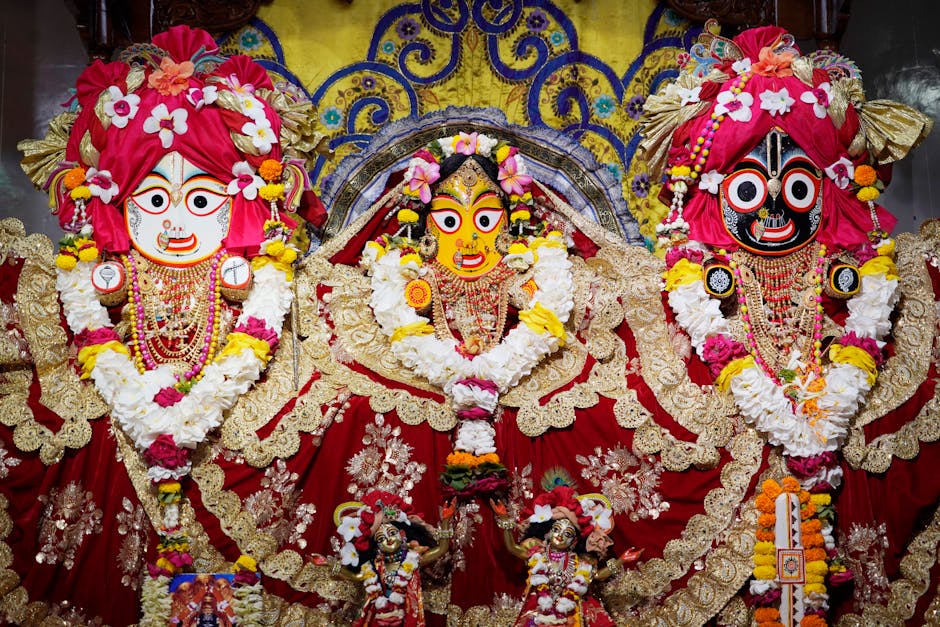
The grand Sri Krishna-Balaram Mandir built by ISKCON (Hare Krishna movement). Beautiful architecture, food court, and guest house.
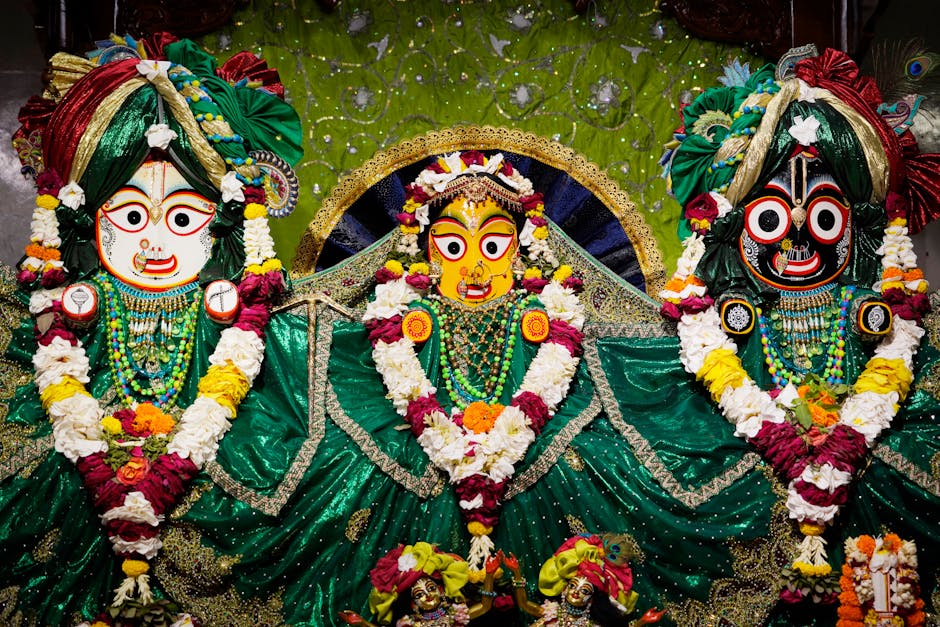
Yamuna riverfront, Mathura | Free
The main ghat where Lord Krishna is believed to have rested after killing the tyrant Kansa. Evening aarti is atmospheric.
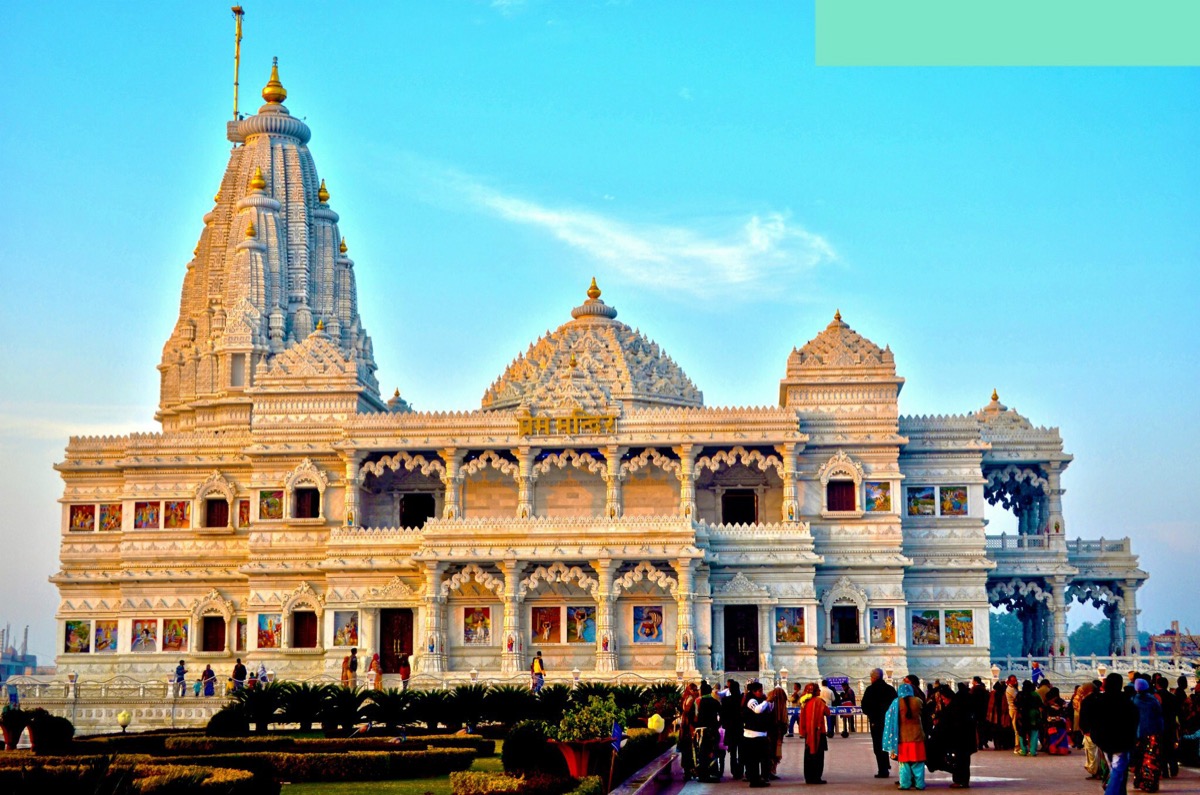
Near Vishram Ghat | Free
Magnificent 19th-century temple with ornate carvings, swing festivals, and the famous Jal Vihar boat festival on Yamuna.
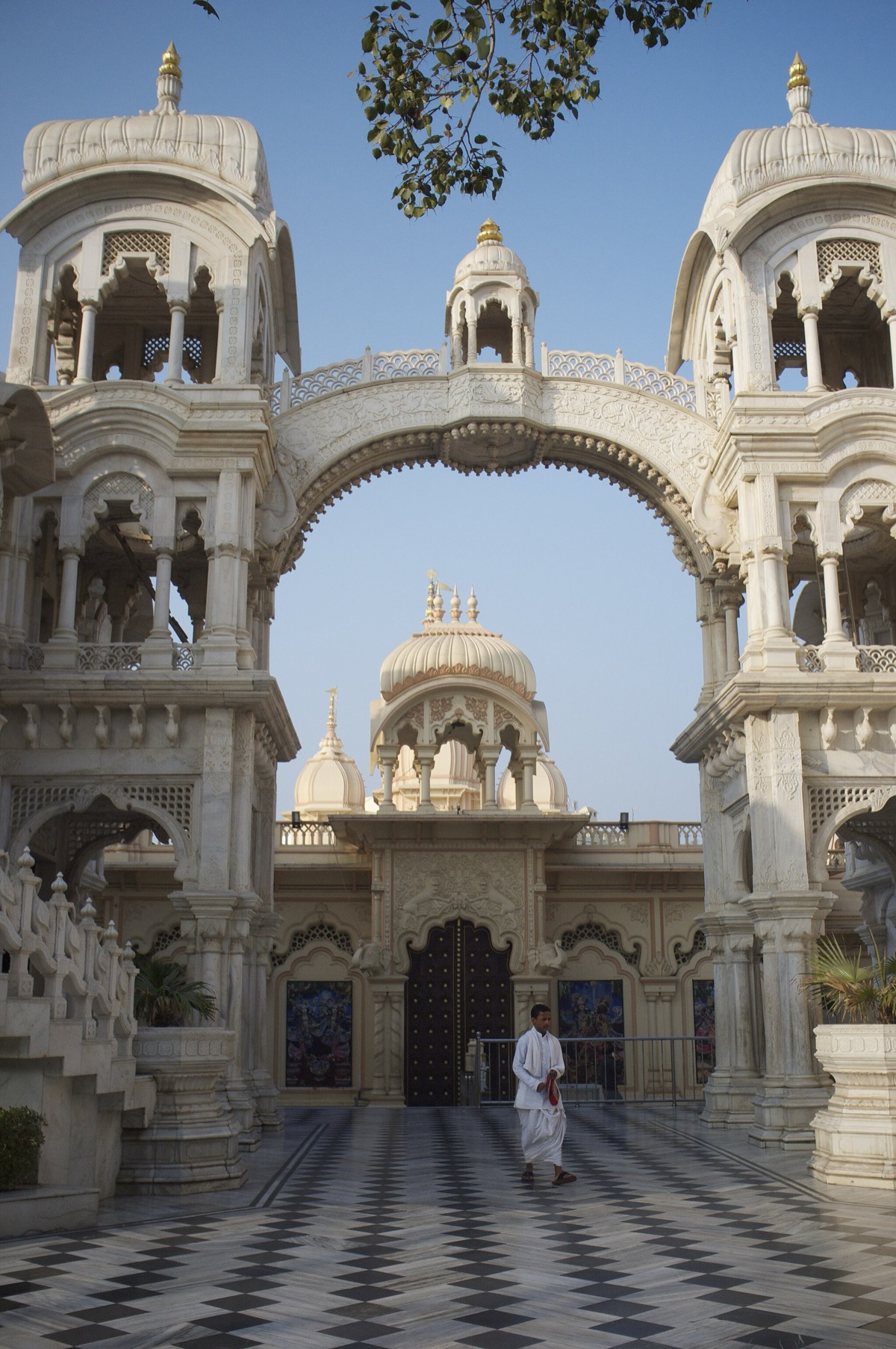
Vrindavan | Free
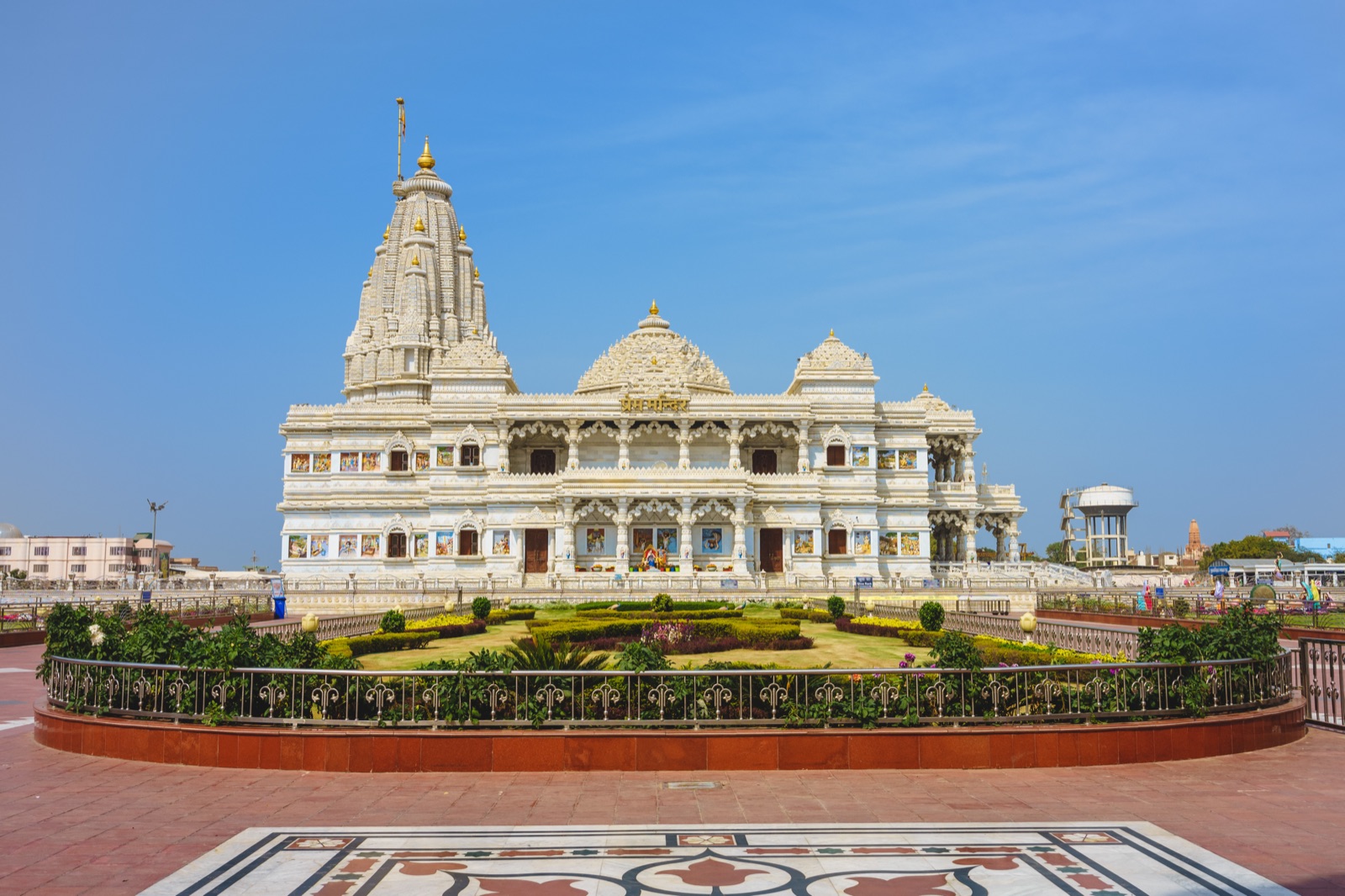
Stunning modern temple in white Italian marble, built by Kripalu Maharaj. The night illumination is spectacular.
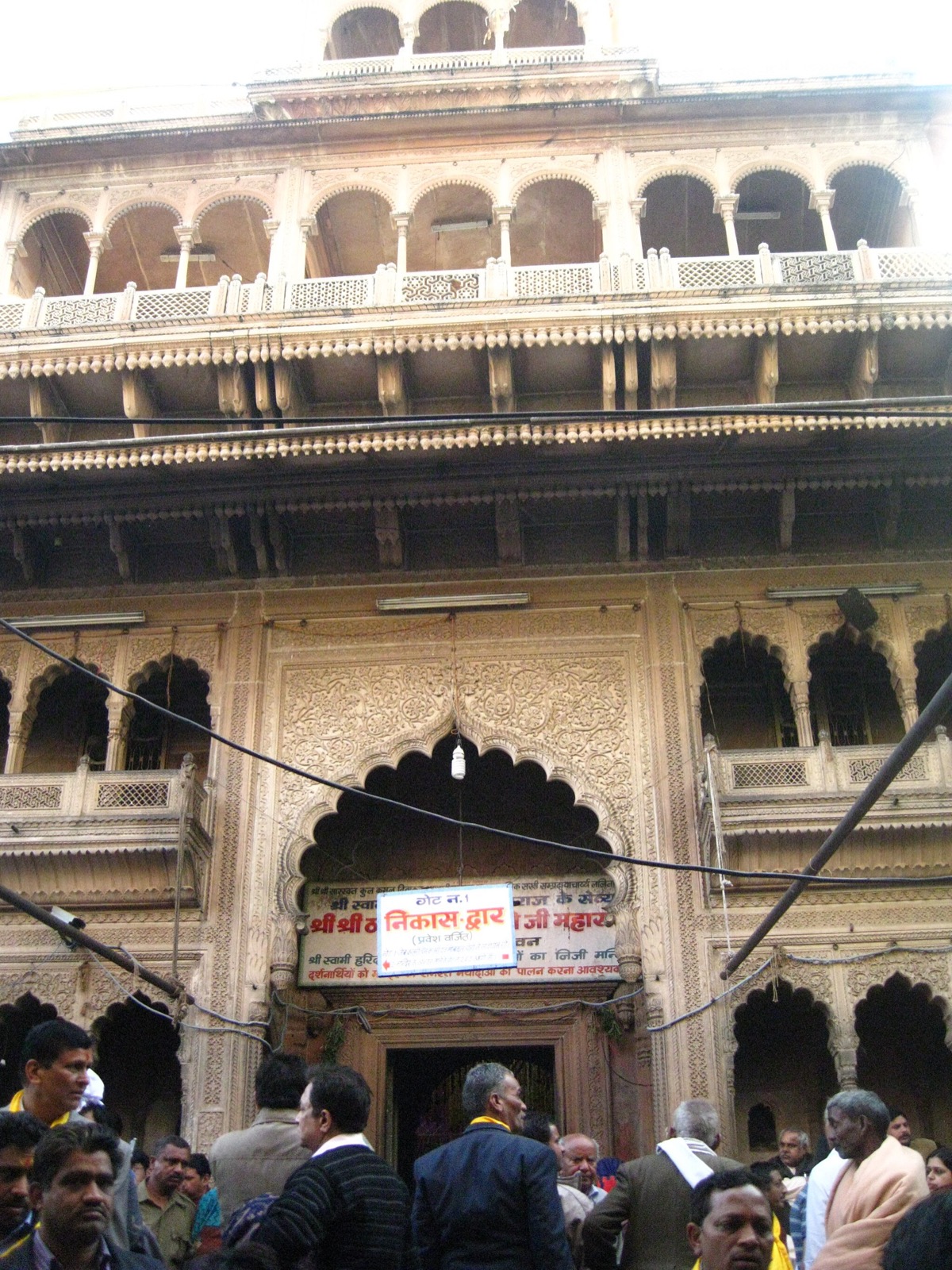
25 km from Mathura | Free
The sacred hill that Krishna lifted on his finger to protect villagers from Indra's rain. Pilgrims do a 21 km parikrama (circumambulation).
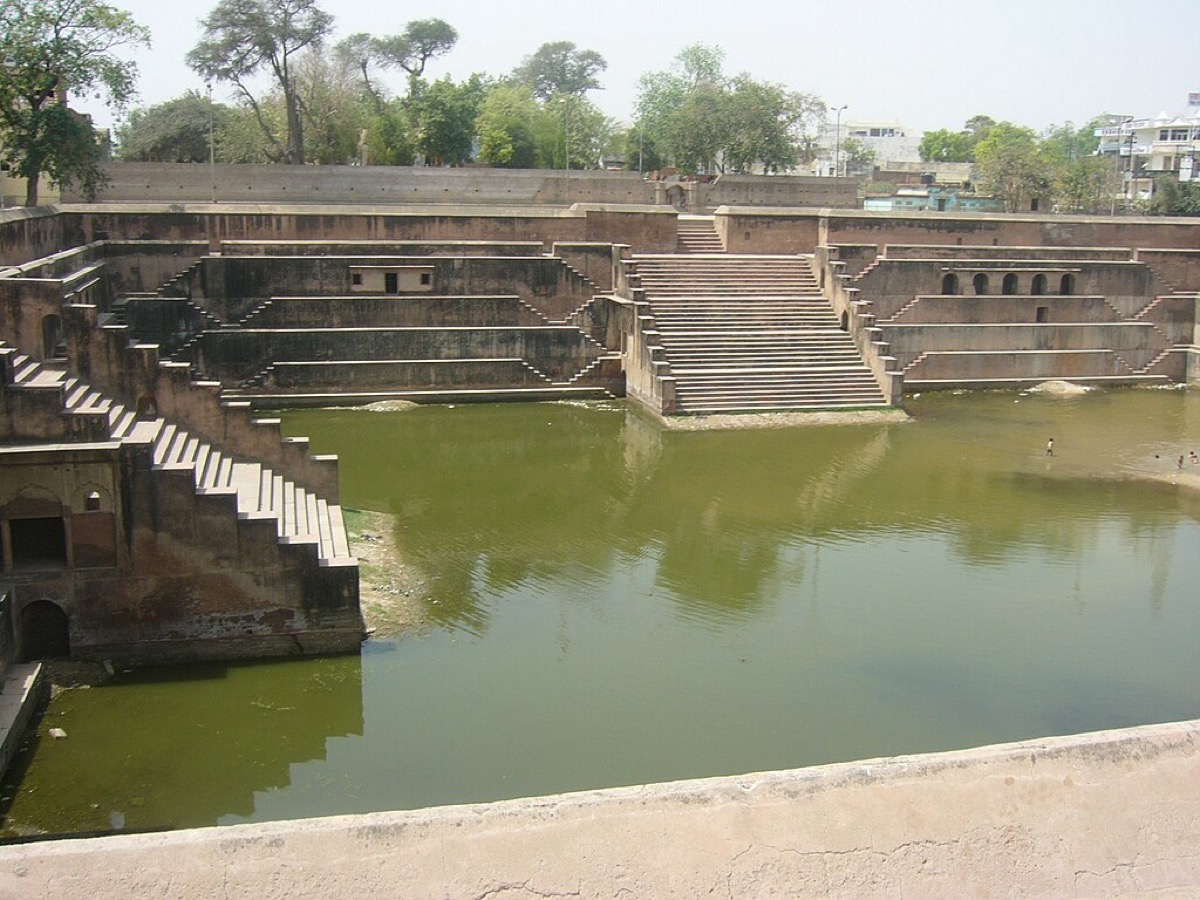
Dampier Nagar | ₹20/₹300
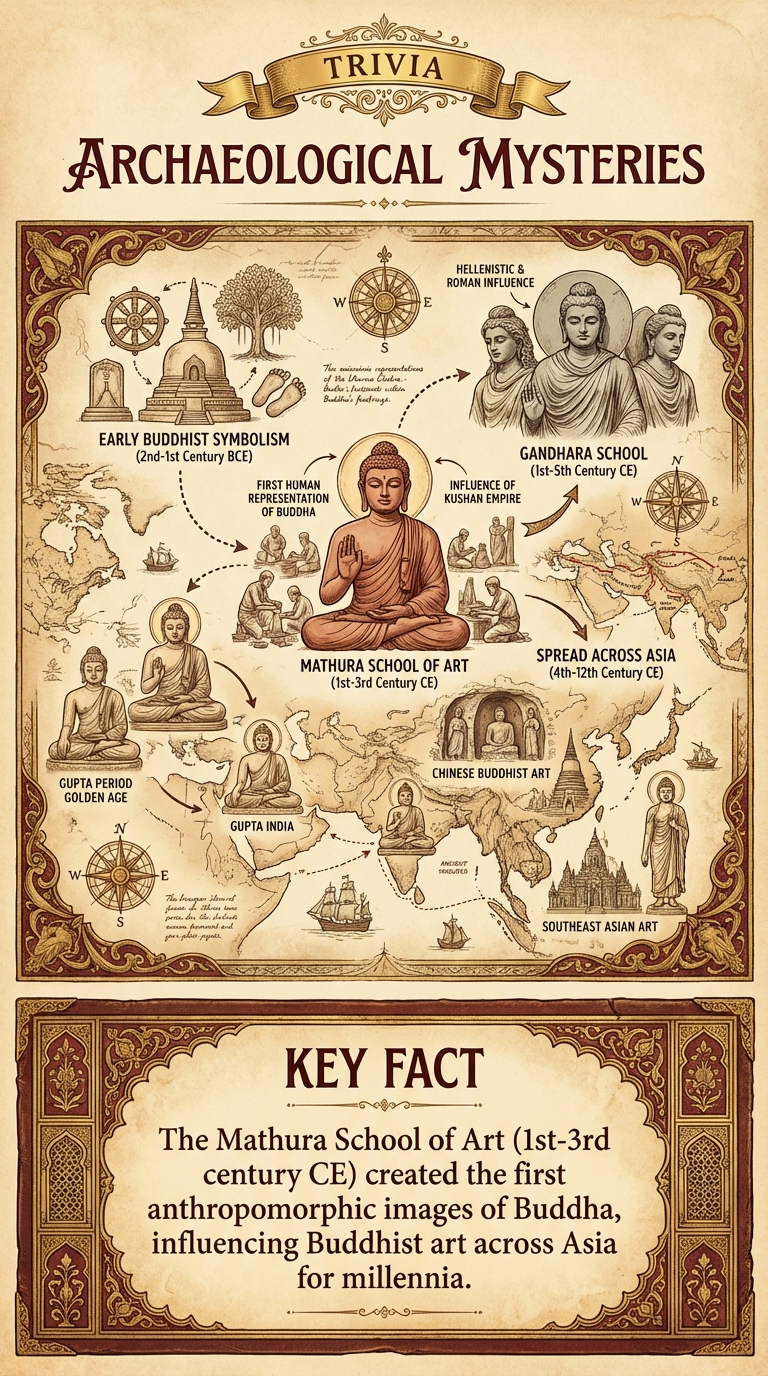
One of India's finest archaeological museums with a world-class collection of Mathura school sculptures (1st–6th century CE).
Near Govardhan, 27 km | Free
Twin sacred ponds considered the most sacred spot in the Braj region by Gaudiya Vaishnavites.
Vrindavan | Free (closes at dusk)
Mysterious sacred grove where Krishna is believed to dance the raas leela with the gopis every night. All trees lean toward the ground.
Near Govardhan | Free
Beautiful stepped tank surrounded by cenotaphs and gardens. One of Braj's most photogenic spots.
Vrindavan | Free
South Indian-style temple with a towering 50-foot gold-plated dhwajastambham (flag pillar) and elaborate gopuram.
Vrindavan | Free
One of the oldest temples in Vrindavan (16th century), perched on a hill overlooking the Yamuna. Atmospheric ruins of the original structure.
Vishram Ghat | ₹50–100/person
Scenic boat ride on the Yamuna passing ghats, temples, and the confluence points. Best at dawn or sunset.
50 km from Mathura | Free
Radha's birthplace — home to the famous Lathmar Holi where women chase men with sticks. Beautiful hilltop temple.
Yamuna bank, Mathura | Free
Ruined fort attributed to Krishna's uncle Kansa. Archaeological excavations reveal Gupta and Kushan period remains.
Mathura-Vrindavan Road | Free
Temple with the entire Bhagavad Gita inscribed on its columns and walls.
Vrindavan | Free
Multi-storey temple with miniature replicas of all major Indian temples. Quirky and fascinating.
19. Yamuna Aarti (Vishram Ghat, Free): Evening aarti ceremony at the main ghat — fire, chanting, and bells as oil lamps float on the Yamuna.
20. Radha Rani Temple (Barsana) (50 km from Mathura, Free): Hilltop temple dedicated to Radha, one of the few temples in India where Radha is the primary deity.
Essential practical information
ATMs available on main roads. Old city is cash-only. UPI works at larger shops. Carry small change for rickshaws and temple donations.
Generally safe. Watch out for aggressive monkeys at Vrindavan temples — they snatch food, glasses, and phones. Keep valuables in closed bags.
Dress very modestly — Vrindavan and Mathura are conservative religious cities. Cover shoulders and knees. Remove shoes at all temples.
Photography prohibited inside most temple sanctums, especially Banke Bihari. Exterior photos generally allowed. Ask permission.
Navigate the city like a local
Nearest airport is Agra (AGR, 58 km, 1.5 hours by taxi ₹1,200–1,500) or Delhi IGI (145 km, 3–4 hours, ₹3,000–4,000). Mathura Junction is well-connected by train.
Primary transport. Negotiate fares. Mathura to Vrindavan: ₹100–150. Cost: ₹10–15/km
Essential for Vrindavan's narrow lanes. Most temple trips within ₹20–40. Cost: ₹20–50/ride
Shared electric rickshaws on fixed routes. Very common and cheap. Cost: ₹10–20/person
Available for longer distances. Good for the Mathura–Vrindavan–Govardhan circuit. Cost: ₹8–12/km
When to go and what to expect
Pleasant weather (20–30°C). Post-monsoon greenery. Temple festivals and Kartik month celebrations.
Cool (5–18°C). Fog adds mystical atmosphere. Paush Purnima and Republic Day events. Carry warm layers.
Holi in March is spectacular. Then increasingly hot (30–45°C). Visit temples early morning only after April.
Monsoon brings heavy rain. Janmashtami (Aug/Sep) is the biggest festival — massive celebrations despite the heat.
Mathura — best experienced in October–MarchMake the most of your time
Extended stays and themed routes
Add Gokul (15 km, where Krishna grew up), Nandgaon (50 km, foster father Nanda's village), and a full day at the Mathura Museum studying Gandhara and Kushan art.
Combine with Agra (58 km, Taj Mahal) and Delhi for the Golden Triangle plus Braj pilgrimage circuit.
Kids love the Prem Mandir light show, ISKCON food court, and boat rides on the Yamuna. The monkey temples are exciting (but keep snacks hidden!).
Try Mathura pedas at Brijwasi, Vrindavan's rabri-jalebi, ISKCON's pure vegetarian food, and the seasonal Holi special gujiya sweets.
Where Krishna took his first breath and Mathura's sweetest pedas are still made
The Sacred Core
The area around Krishna Janmasthan — believed to be the exact spot of Krishna's birth — is the spiritual heart of Mathura. The temple complex, adjacent to the Shahi Idgah Mosque, is heavily secured and deeply atmospheric. Nearby, the old city lanes radiate outward in a maze of temples, sweet shops, and bazaars. The Holi Gate area is the commercial centre, and the streets around it come alive during festivals with colour, music, and dance.
This neighbourhood is where you'll find Mathura's best street food — pedas (the city's famous milk sweets), kachori, and jalebi from shops that have been operating for generations. The old bazaars sell everything from brass Krishna figurines to traditional Braj textiles. The atmosphere is chaotic and intensely devotional — temple bells, traffic, vendors, and pilgrims all compete for space.
Where to eat in Krishna Janmasthan & Old Mathura
Brijwasi Sweet House (₹50–200): The most famous sweet shop in Mathura. The pedas are legendary.
Brijwasi Royal (₹100–300): Upgraded restaurant from the same family, with thalis and North Indian food.
Holi Gate area stalls (₹20–60): Kachori, samosa, and chaat.
Shopping: Mathura pedas (₹200–500/kg), brass Krishna statues, Braj textiles, and religious items near Holi Gate and Janmasthan.


Where every lane echoes with 'Radhe Radhe' and Krishna's childhood legends come alive
Land of 5,000 Temples
Vrindavan (12 km from Mathura) is where Krishna spent his childhood — playing with the gopas (cowherds), dancing the raas leela with the gopis, and performing his legendary miracles. Today, the small town has over 5,000 temples ranging from ancient 16th-century structures to the modern ISKCON and Prem Mandir complexes. The narrow lanes are a sensory overload — temple bells, kirtan singing, incense, and the constant cries of 'Radhe Radhe!'
The Hare Krishna movement has its spiritual base here, and ISKCON's Krishna-Balaram Temple is one of the most visited. Banke Bihari Temple, in the heart of the old town, draws the largest crowds. The mysterious Nidhivan grove, the hilltop Madan Mohan Temple, and the South Indian-style Rangaji Temple offer variety. Despite the crowds, Vrindavan has a magic that transcends the chaos.
Where to eat in Vrindavan Temple District
ISKCON Food Court (₹80–200): Clean, pure vegetarian food in a hygienic setting. Great for families.
MVT Restaurant (₹60–150): Affordable, sattvic (pure veg, no onion/garlic) meals.
Street stalls near Banke Bihari (₹20–50): Rabri, jalebi, and samosa.
Shopping: Krishna flutes (₹50–300), Vrindavan incense, tulsi malas, Radha-Krishna paintings, and handmade paper from Vrindavan craft shops.


Where the hill that Krishna lifted stands witness to millions of barefoot pilgrims
The Sacred Circumambulation
Govardhan Hill, 25 km from Mathura, is the hill that Krishna lifted on his little finger to protect the villagers of Braj from Indra's furious rainstorm. Today, hundreds of thousands of pilgrims perform the 21 km parikrama (circumambulation) barefoot, passing through sacred ponds, ancient temples, and rural Braj villages. Kusum Sarovar, a magnificent stepped tank surrounded by cenotaphs, is the most photogenic stop.
The broader Braj countryside — including Barsana (Radha's birthplace), Nandgaon (Nanda's village), and Gokul (where Krishna grew up) — offers a chance to experience rural India through the lens of Krishna mythology. The landscape is flat, dotted with temples, ponds, and groves that correspond to specific episodes from the Krishna legends. During Holi, each village celebrates on a different day, creating a fortnight of festivities.
Where to eat in Govardhan & Braj Countryside
Dining options are simple dhabas along the parikrama route and near the main temples. Carry water and snacks.
Govardhan temple prasad stalls (₹20–40): Simple meals served to pilgrims.


What to eat and where to find it
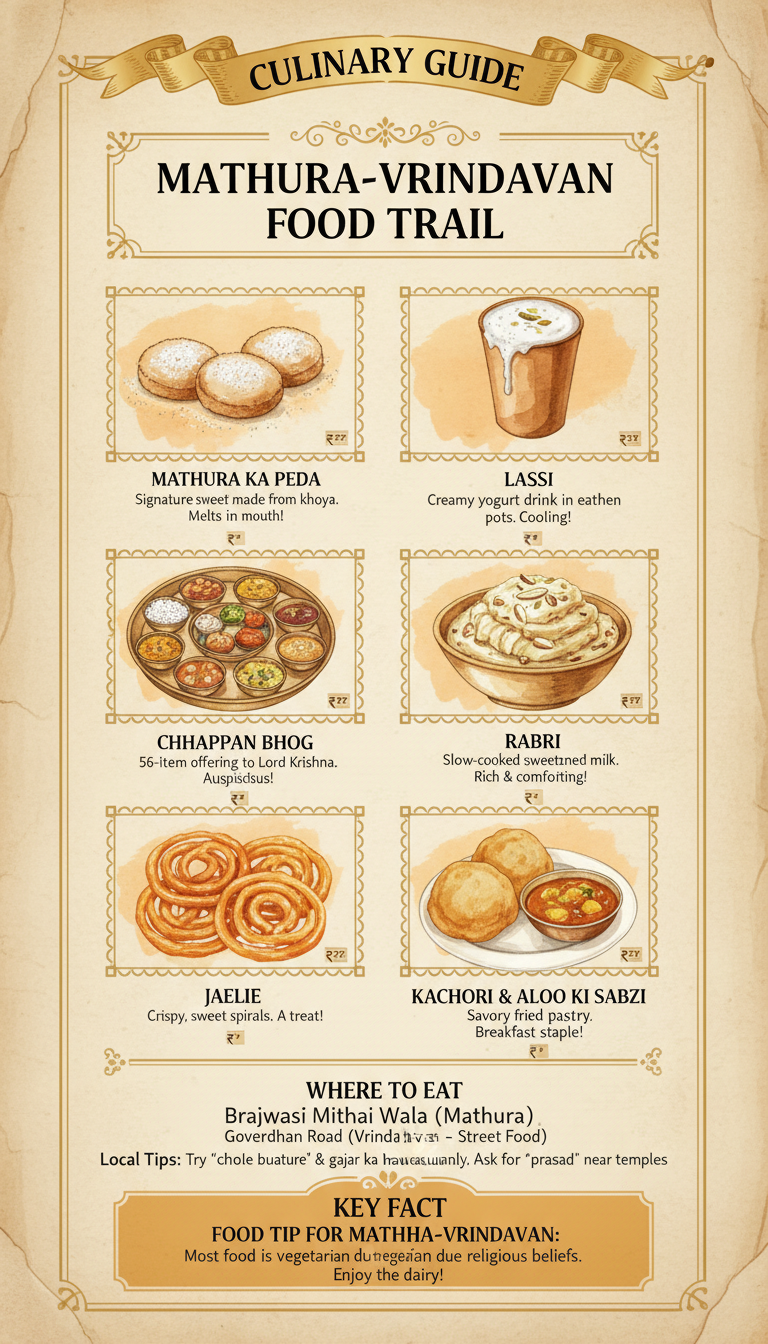
Mathura-Vrindavan is a vegetarian paradise with a special emphasis on sattvic (pure) food — many restaurants avoid onion, garlic, and even root vegetables in keeping with Vaishnava tradition. The region is famous for its pedas (milk sweets), rabri, lassi, and the elaborate prasad meals served at temples. During Holi, special seasonal sweets like gujiya and malpua are everywhere.
Mathura Peda (₹200–500/kg): The city's iconic caramelized milk sweet — dense, crumbly, and addictive. Brijwasi is the most famous maker.
Rabri (₹40–80): Thickened sweetened milk with layers of cream. Vrindavan's rabri stalls are legendary.
Kachori-Sabzi (₹20–40): Standard breakfast — fried bread with spicy potato curry. Available at every street corner.
Gujiya (₹10–20/piece): Crescent-shaped fried pastry filled with khoya and dry fruits — the Holi special sweet.
Chhappan Bhog (₹20–50 (as prasad)): The legendary 56-item offering at Govardhan temples — everything from sweets to savories prepared for Krishna.
Malpua (₹30–50): Fried pancake soaked in sugar syrup, topped with rabri — a festive treat.
Peda Khurchan (₹300–600/kg): Crispy, caramelized milk flakes — a Mathura specialty rarer than regular pedas.
Lassi (₹20–40): Thick, sweet buttermilk drink. Especially refreshing during the hot months.
Best restaurants, markets, and street food
Brijwasi Sweet House (₹50–200): The landmark sweet shop — try the Mathura peda, peda khurchan, and seasonal specials.
Brijwasi Royal (₹100–300): Full meals with thali, chaats, and sweets in a cleaner setting.
ISKCON Vrindavan Food Court (₹80–200): Clean, sattvic food with no onion/garlic.
MVT Restaurant, Vrindavan (₹60–150): Budget-friendly pure vegetarian meals.
Holi Gate area, Mathura: Pedas, kachori, samosa, and jalebi from century-old stalls (₹20–60).
Banke Bihari lane, Vrindavan: Rabri, jalebi, and chaat vendors catering to temple crowds (₹20–50).
Govardhan parikrama stalls: Simple prasad meals and snacks for pilgrims (₹20–40).


Understanding the story of Mathura
Mathura's history spans over 3,000 years of recorded civilization and far longer in Hindu tradition. The Mathura school of art flourished under the Kushan Empire (1st–3rd century CE), producing some of the earliest depictions of the Buddha and Hindu deities. Under the Guptas (4th–6th century CE), Mathura reached its cultural zenith. Chinese pilgrim Xuanzang visited in the 7th century and described a thriving Buddhist city with 20 monasteries. The city suffered devastating invasions by Mahmud of Ghazni (1018), who destroyed most temples.
The Mughal period saw further temple destruction under Aurangzeb, who demolished the Keshav Dev Temple in 1669. The current Krishna Janmasthan Temple was rebuilt in the 20th century adjacent to the mosque (Shahi Idgah) that Aurangzeb built on the old temple site. Vrindavan was revived in the 16th century when Chaitanya Mahaprabhu's followers identified and restored its sacred sites. The ISKCON movement, founded in 1966, brought global attention to Vrindavan. Today, Mathura-Vrindavan is one of India's most visited pilgrimage circuits.
The Braj region has its own distinct culture centered on Krishna bhakti. The Braj Bhasha dialect, the Raslila dance drama, and the Holi celebrations here are unique in India. The 16-day Braj Holi includes Lathmar Holi in Barsana (women beat men with sticks), Phoolon ki Holi in Vrindavan (flowers instead of colours), and Huranga in Dauji Temple (torn clothes). Janmashtami (Krishna's birthday, Aug/Sep) features night-long celebrations, Dahi Handi (human pyramids), and grand temple decorations.
Excursions from Mathura
Mathura is centrally located in the Braj region with easy access to Krishna pilgrimage sites, Agra's Mughal heritage, and Bharatpur's wildlife.
The Taj Mahal, Agra Fort, and Baby Taj are an easy day trip from Mathura. Entry: ₹50/₹1,100 (Taj)
Radha's birthplace (Barsana) and Krishna's foster village (Nandgaon). The Lathmar Holi here is world-famous. Entry: Free
Where baby Krishna grew up. The Raman Reti area (sandy banks where Krishna played) and Gokul temples. Entry: Free
Keoladeo National Park — a UNESCO World Heritage Site with 350+ bird species. Best Oct–Feb. Entry: ₹75/₹500

Practical information from A to Z
Not sold in the temple areas of Mathura and Vrindavan. Available in select hotels on the outskirts and highway restaurants.
SBI, HDFC, and PNB ATMs on Station Road and near Holi Gate. Vrindavan has fewer ATMs — carry cash.
District Hospital Mathura and private clinics on Station Road. Vrindavan has basic clinics near Banke Bihari.
220V/50Hz with Type C/D/M plugs. Power cuts common, especially in summer. Hotels have inverters.
4G coverage good in Mathura. Spotty in Vrindavan's old town. Hotels have Wi-Fi. Download offline maps.
Very conservative religious area. Discretion essential. Hotels are professional with all guests.
India Post offices in both Mathura and Vrindavan. Courier services on Station Road.
Krishna Janmasthan: 5am–12pm, 4pm–9pm. Banke Bihari: 7:45am–12pm, 5:30pm–9:30pm. ISKCON: 4:30am–1pm, 4:15pm–8:30pm.
Yamuna River is heavily polluted. Air quality moderate. Dust and traffic in old city areas.
Cycle rickshaws essential in Vrindavan. Autos for Mathura-Vrindavan route. Negotiate fares.
GST applies. Small sweet shops include tax in prices. Hotels charge 12% GST.
Public toilets at major temples. Hotels and ISKCON guest house have western toilets. Carry tissue.
Drink only bottled water (₹20). Never drink river water. ISKCON provides filtered water.
Vrindavan's monkeys are aggressive. Don't carry food openly. Remove glasses at temples. Keep bags closed.
Krishna Janmasthan has airport-style security. No bags, cameras (phone OK), or leather items inside.
Getting to and around Mathura
From Delhi: Trains (2–3 hours, ₹100–400) or road via Yamuna Expressway (145 km, 2.5 hours). Taj Express and Braj Express are popular trains.
From Agra: Frequent trains (1 hour, ₹50–150) or road (58 km, 1.5 hours via NH-2).
Within Mathura-Vrindavan: Auto-rickshaws (₹100–150 between cities), cycle rickshaws in Vrindavan, shared e-rickshaws on fixed routes.
| Mode | Details | Cost |
|---|---|---|
| Auto-Rickshaw | Primary transport. Negotiate fares. Mathura to Vrindavan: ₹100–150. | ₹10–15/km |
| Cycle Rickshaw | Essential for Vrindavan's narrow lanes. Most temple trips within ₹20–40. | ₹20–50/ride |
| E-Rickshaw | Shared electric rickshaws on fixed routes. Very common and cheap. | ₹10–20/person |
| Ola/Uber | Available for longer distances. Good for the Mathura–Vrindavan–Govardhan circuit. | ₹8–12/km |
Essential phrases for travelers
Hindi and Braj Bhasha are spoken. The traditional greeting in Vrindavan is "Radhe Radhe" instead of "Namaste." English is limited to hotels and ISKCON.
| English | Hindi |
|---|---|
| Hello / Greetings | Namaste |
| Thank you | Dhanyavaad |
| Yes / No | Haan / Nahin |
| How much? | Kitna hai? |
| Too expensive | Bahut mehnga hai |
| Water | Paani |
| Food | Khana |
| Where is...? | ...kahan hai? |
| Help | Madad |
| Good | Accha |
| Beautiful | Sundar |
| Please | Kripya |
| I don't understand | Mujhe samajh nahin aaya |
| Taxi/auto | Auto-rickshaw |
| How far? | Kitni door hai? |
Our favourite experiences in Mathura
Vishram Ghat at Dawn
Watch priests perform morning rituals as the Yamuna catches the first light
Yamuna Boat Ride
The ghats and temples of Mathura glow golden from the river at dusk
Brijwasi Pedas
Mathura's century-old sweet shop defines the city's culinary identity
Holi Gate Area Stalls
Kachori, jalebi, and chaat from stalls that have served pilgrims for decades
ISKCON Vrindavan Guest House
Clean, well-managed, and right next to the temple
Government Museum
World-class Kushan and Gandhara sculptures from the Mathura school
Nidhivan Grove
Mysterious sacred forest that is locked every night — eerie and enchanting
Prem Mandir Night Illumination
White marble temple glowing in rainbow LED lights — surreal
Holi Gate Bazaars
Krishna figurines, flutes, Braj textiles, and Mathura pedas
Braj Holi Celebrations
The world's most colourful festival in the land where it was born
Everything you need for Mathura
Travorea creates comprehensive, beautifully designed travel guides that combine insider knowledge with practical information. Our guides are crafted to help you experience destinations like a local, not just a tourist.
This premium guide to Mathura was researched and written to give you everything you need for an unforgettable trip. All prices and information were verified at the time of writing (2026) but may change — always confirm locally.
All photographs in this guide are sourced from free-to-use image libraries (Pexels, Unsplash) and original Travorea photography. Infographics are original Travorea creations.
Visit us at www.travorea.com for more destinations, interactive trip planners, and the latest travel tips.
Explore More Guides
Visit www.travorea.com/ebooks for premium guides to 50+ destinations worldwide.
Birthplace of Lord Krishna