
Queen of the Hills
Where the British Raj retreated to escape the summer heat and left behind a Himalayan jewel
Queen of the Hills
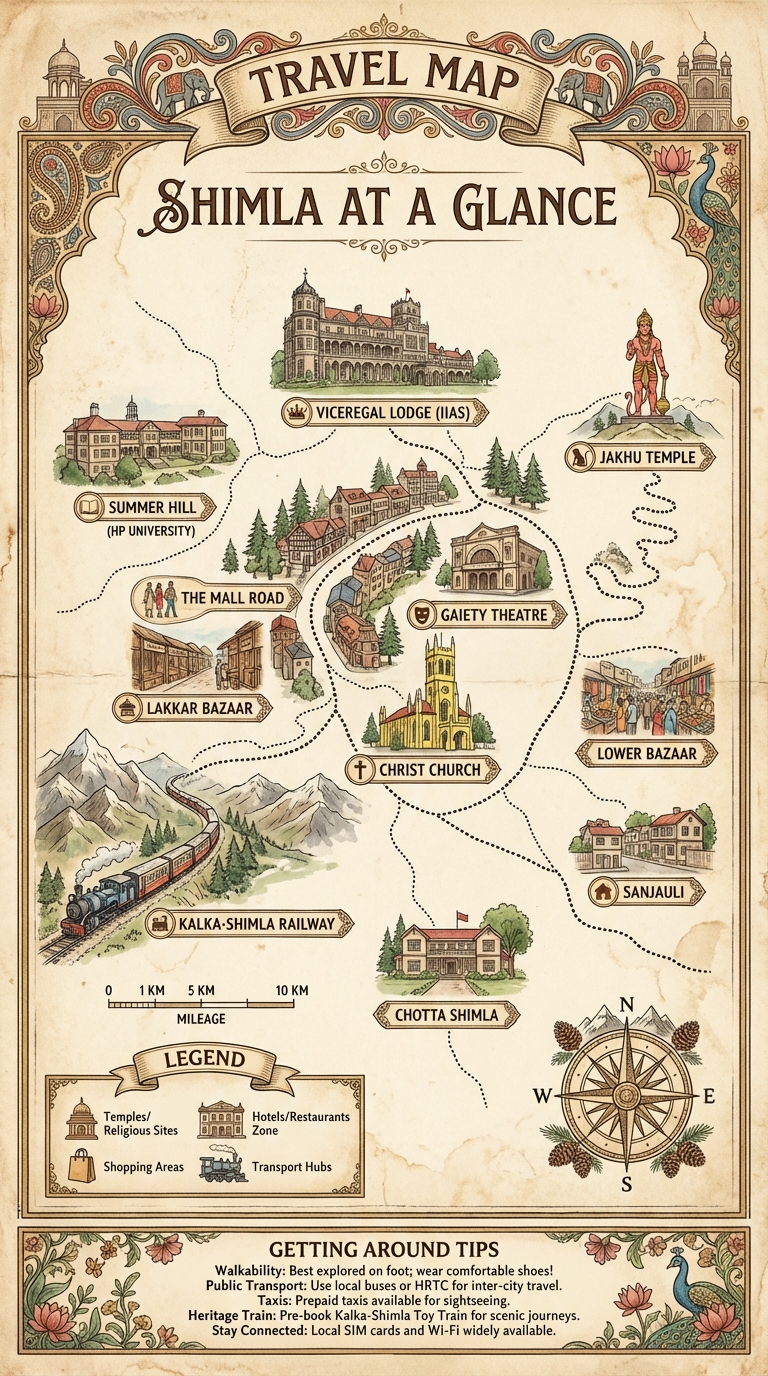
Shimla sits draped across a crescent-shaped ridge at 2,205 metres in the western Himalayas, a city of steeply stacked colonial buildings, deodar forests, and mist-wrapped valleys. Once the summer capital of British India, its legacy lives on in Tudor-fronted buildings along Mall Road, the neo-Gothic Christ Church, and the Viceregal Lodge where the subcontinent's destiny was debated. But Shimla is far more than a museum of the Raj — it is a living hill town where apple orchards perfume the autumn air, langur monkeys swing through pine canopies, and the toy train chugs through 102 tunnels on its way up from Kalka.
The best way to experience Shimla is on foot. The car-free Mall Road is the social spine of the town, lined with bookshops, cafes, and Gaiety Theatre. Walk east to Jakhoo Hill for panoramic Himalayan views, or west to the quiet trails around Chadwick Falls. In winter, fresh snowfall transforms the Ridge into a postcard, and the nearby slopes of Kufri and Narkanda offer skiing. Year-round, Shimla rewards the traveler who slows down — sipping chai on a misty terrace, browsing at Maria Brothers bookshop, or watching the sun set over layer upon layer of blue Himalayan ridges.
Shimla
Perched at 2,205m in the western Himalayas, Shimla served as the summer capital of British India from 1864 to 1947. Today it is the capital of Himachal Pradesh and one of India's most beloved hill stations, known for its colonial architecture, toy train, and cool mountain climate.
The essential sights and experiences
Central Shimla | Free
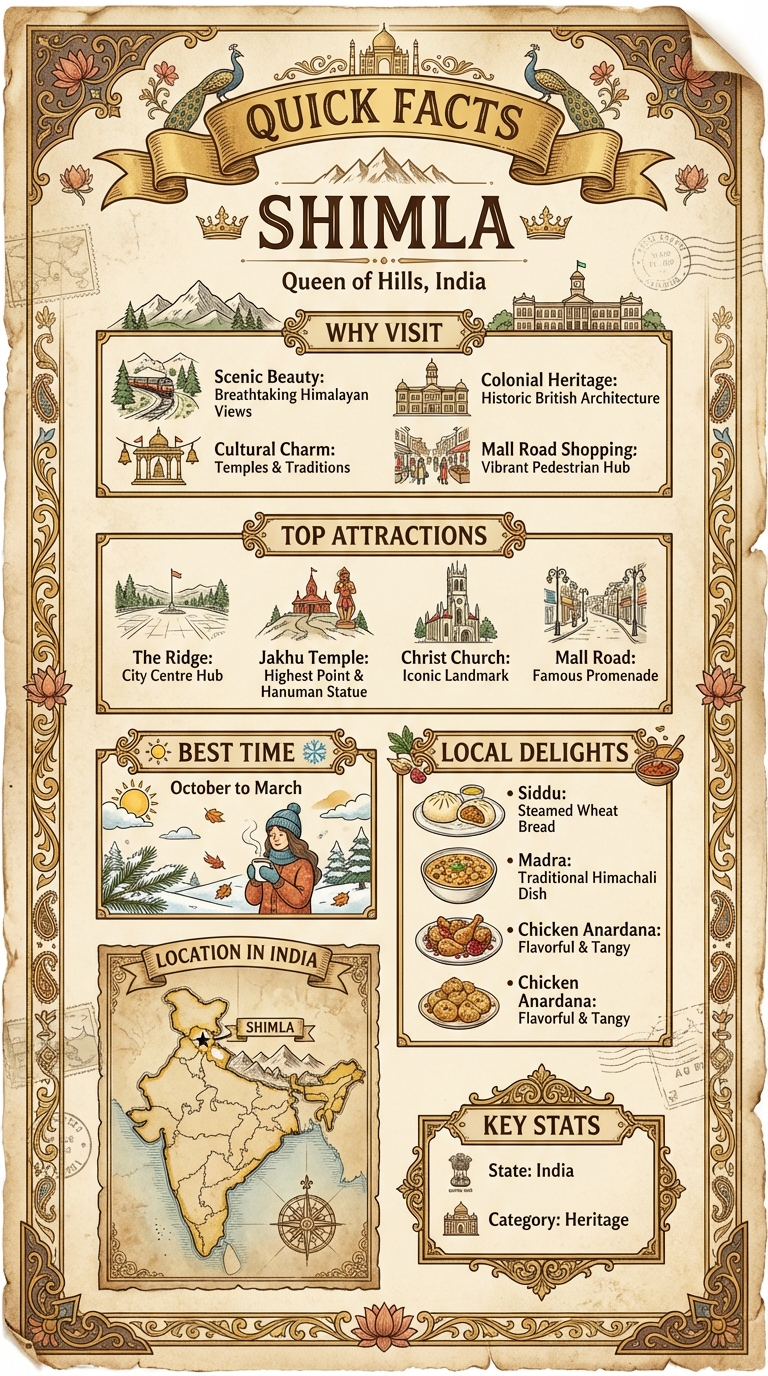
Shimla's iconic open space with panoramic views of snow-capped peaks. The social heart of the town, especially lively at sunset.
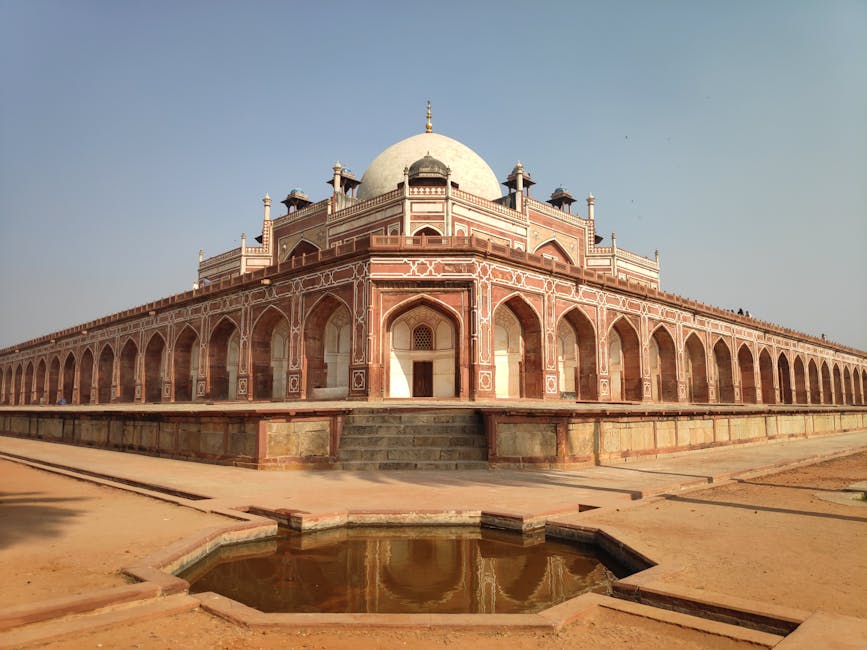
Central Shimla | Free
The car-free promenade lined with colonial-era shops, cafes, and the famous Gaiety Theatre. Shimla's main artery since 1825.
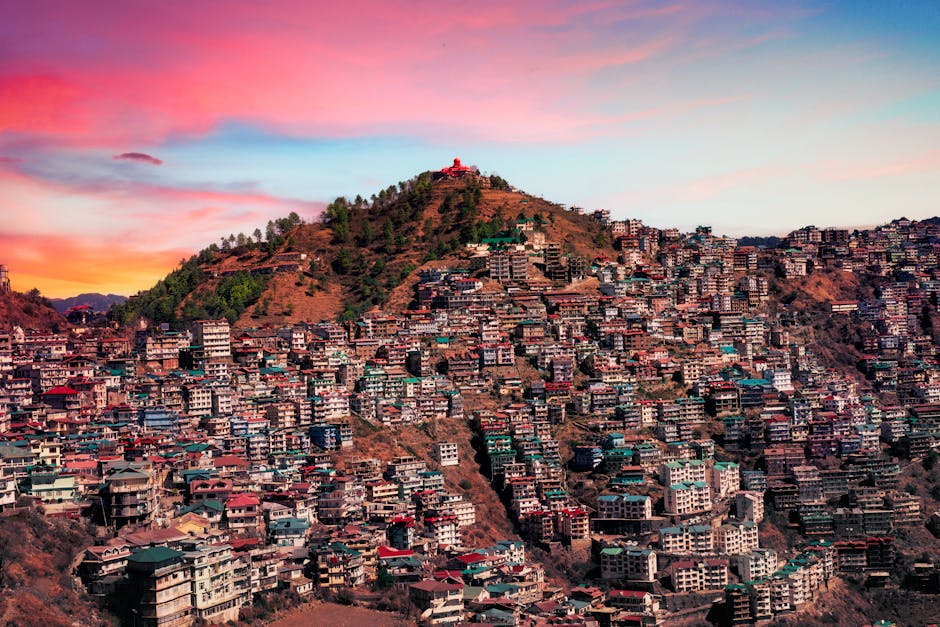
The Ridge | Free
Second-oldest church in North India (1857), with stunning stained-glass windows. Its yellow facade dominates The Ridge.
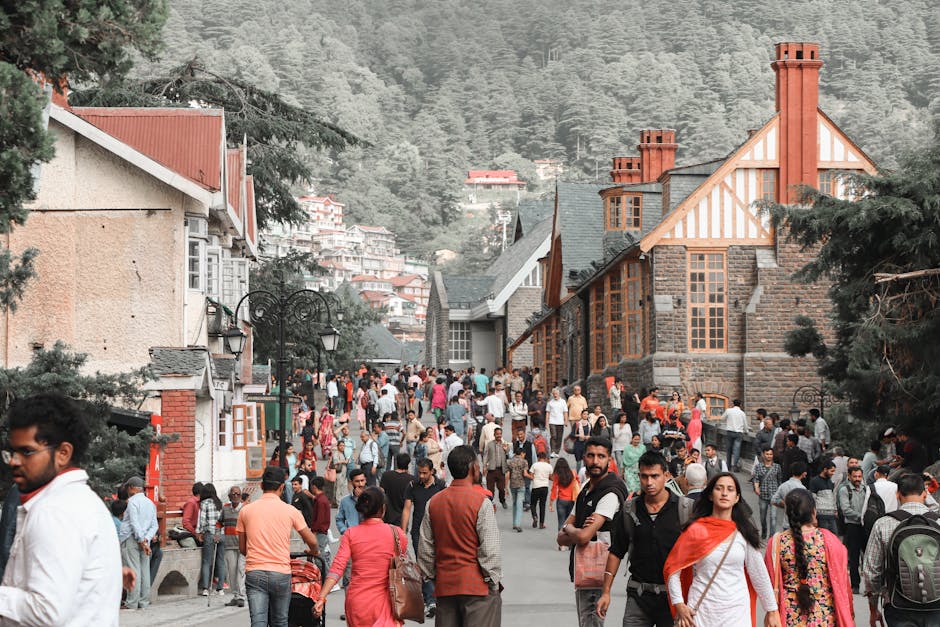
Jakhoo Hill, 2.5 km | Free
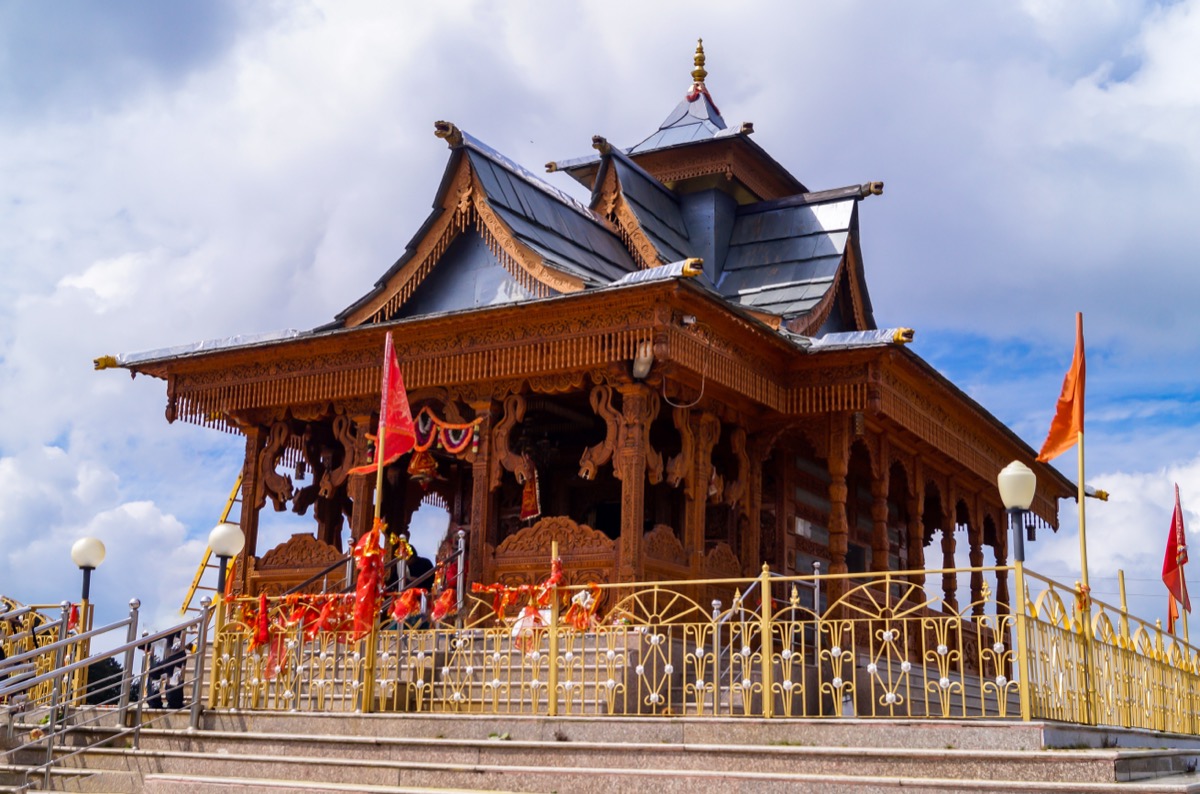
Hanuman temple at Shimla's highest point (2,455m) with a massive 108-ft statue and sweeping Himalayan panoramas.
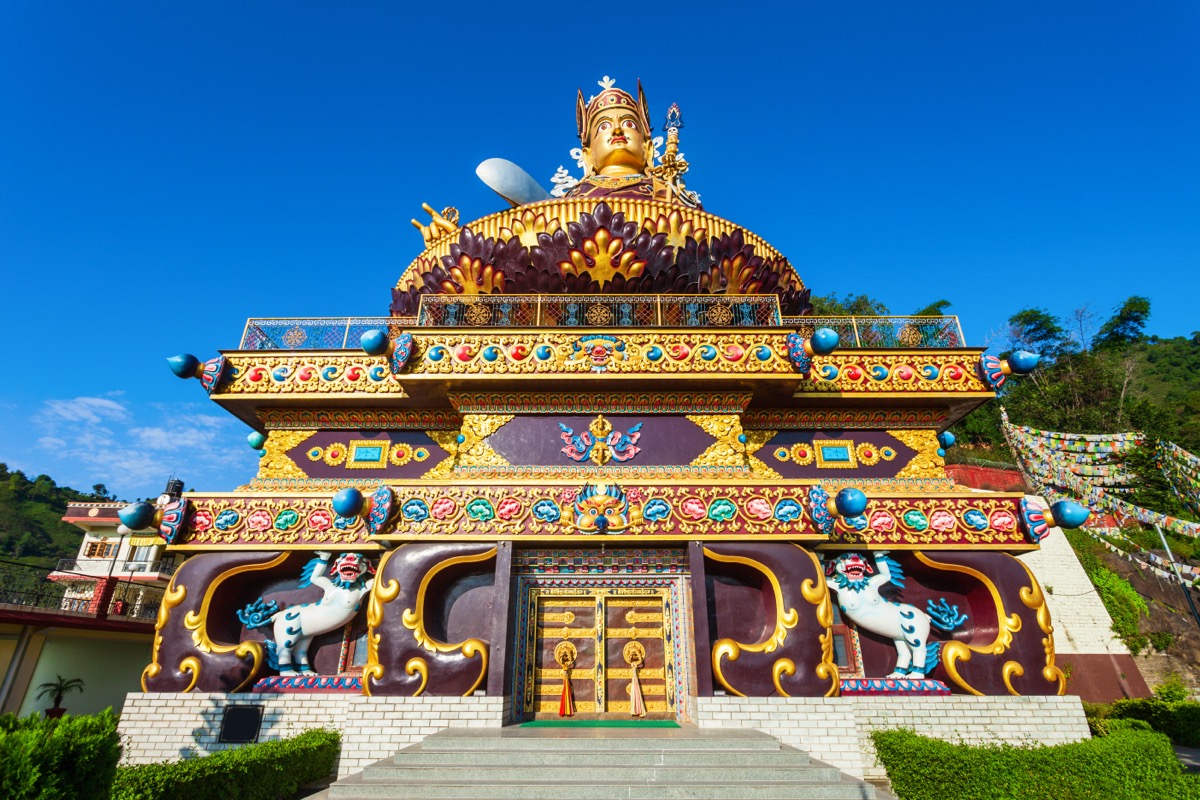
Observatory Hill | ₹30/₹150
The former residence of the British Viceroy (1888), built in Jacobethan style. Where the Partition of India was planned.
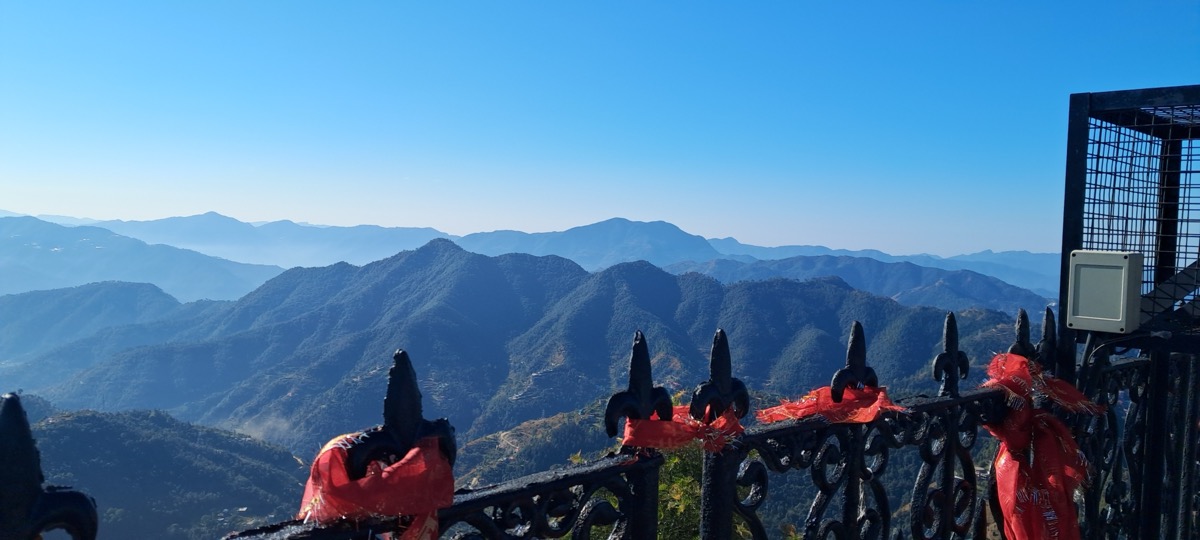
Kalka to Shimla | ₹300–600
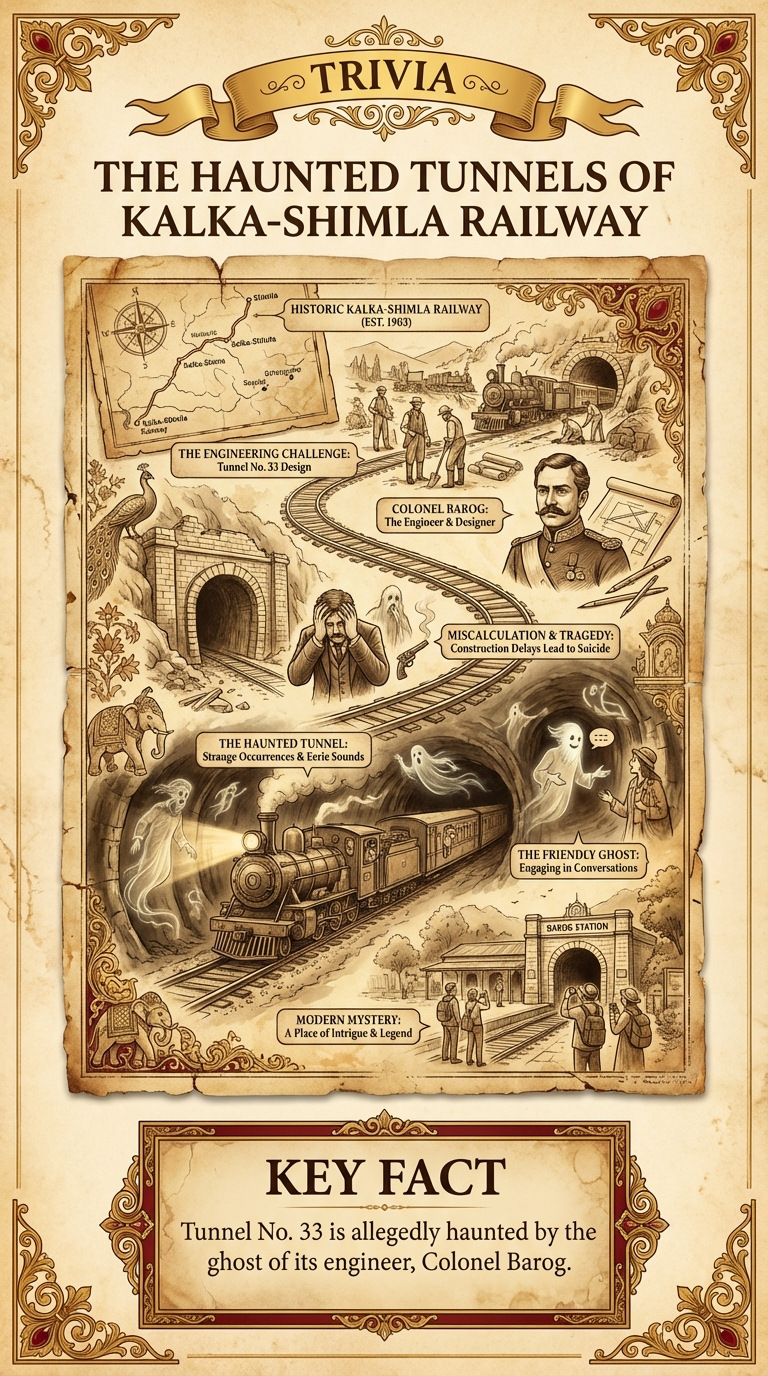
UNESCO World Heritage toy train covering 96 km through 102 tunnels and 800+ bridges. A 5-hour journey through spectacular scenery.
Junction of Mall & Ridge | Free
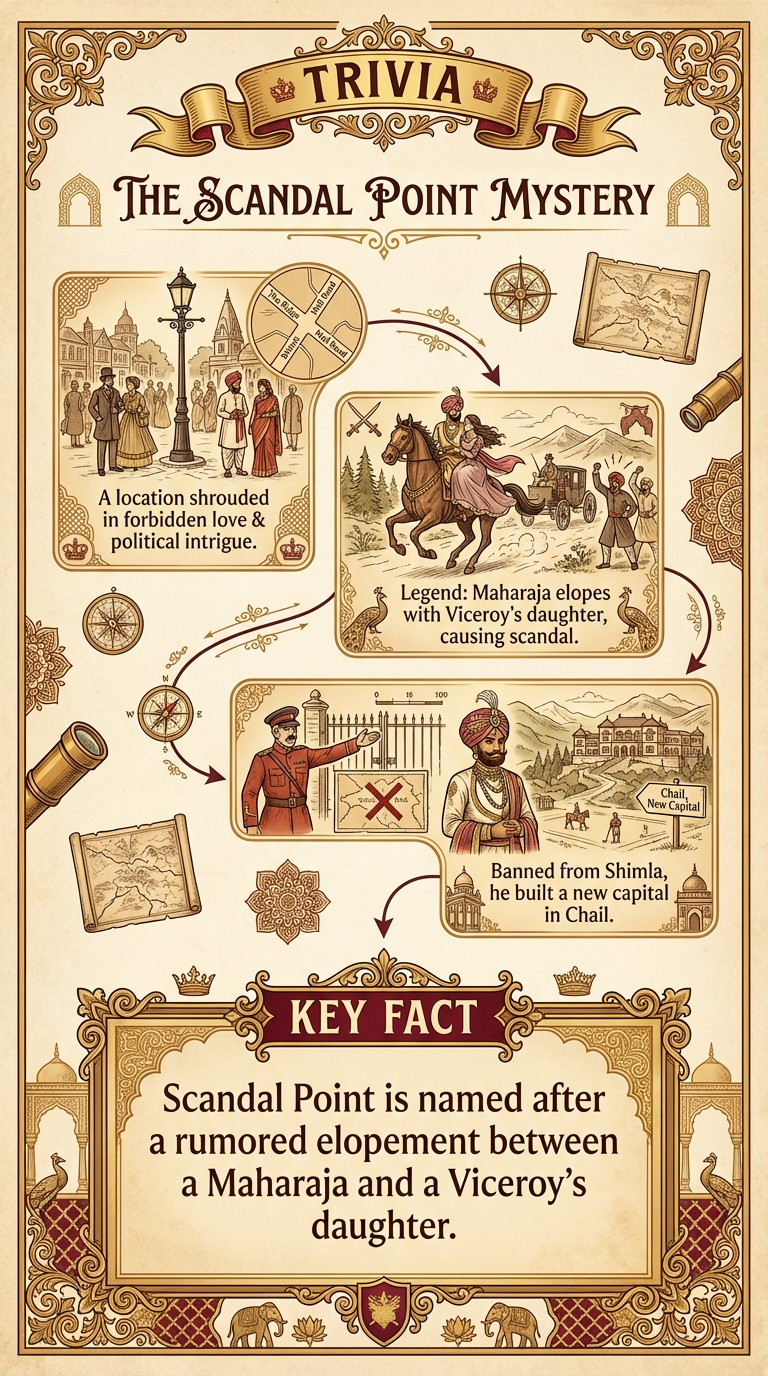
Where Mall Road meets The Ridge. Named after a legendary 19th-century elopement between a British girl and a Maharaja.
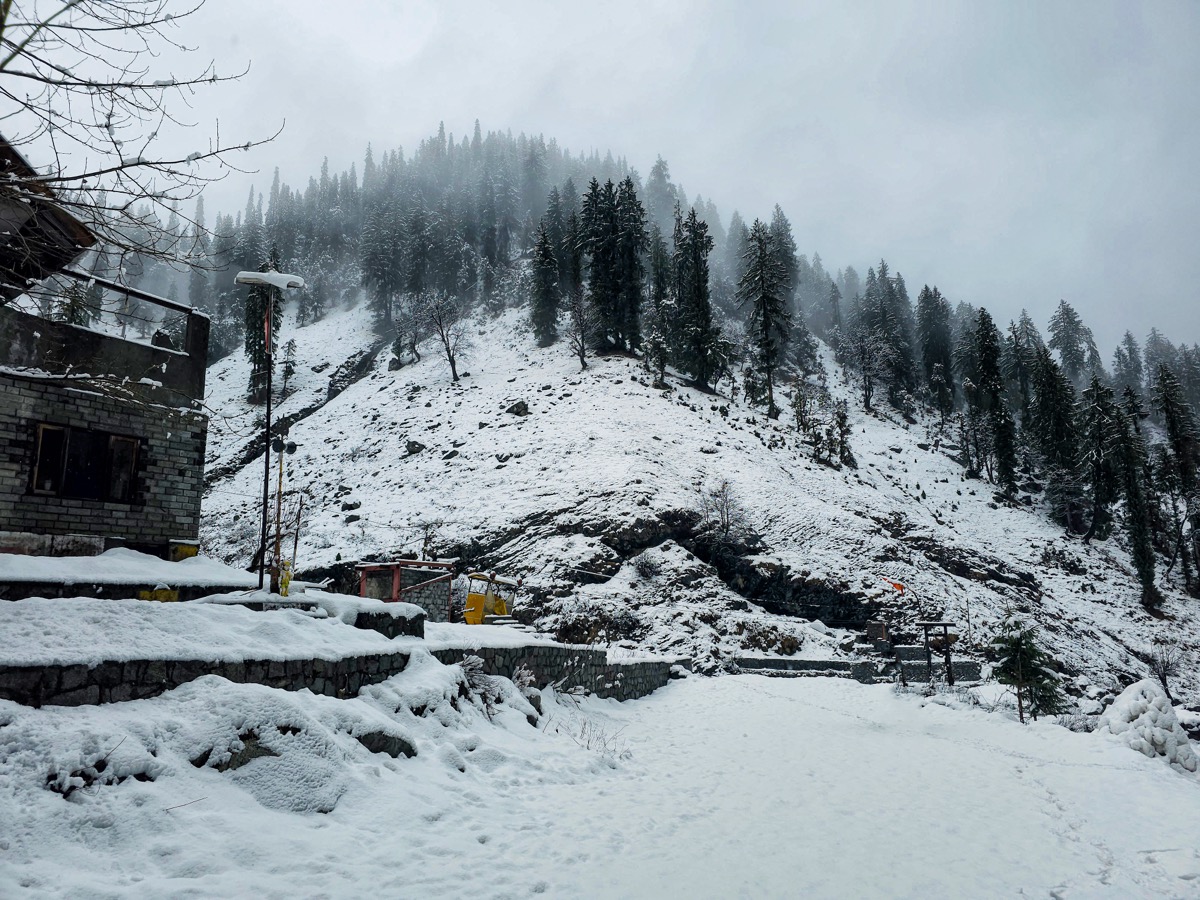
Mall Road | ₹20–50
Restored Victorian Gothic theatre (1887) where Rudyard Kipling watched plays. Still hosts performances.
16 km from Shimla | ₹50–200
Popular hill station above Shimla with horse rides, a small ski slope in winter, and Himalayan Nature Park.
3 km from Ridge | Free
Historic flat ground once used by the British for polo and cricket. Now a sports ground with a small army museum.
7 km from Shimla | Free
Seasonal 67-metre waterfall tucked in thick deodar forest. Best visited during monsoon (Jul–Sep).
Ridge to Jakhoo | ₹500 return
Cable car from The Ridge to Jakhoo Hill — spectacular views and saves a steep 30-minute climb.
Chaura Maidan | ₹20/₹150
Excellent collection of Pahari miniature paintings, Gandhara sculptures, and Himachali folk art.
Shimla-Kufri Road | Free
Dense deodar-lined valley visible from the road. A popular stop for photos, especially when mist rolls through.
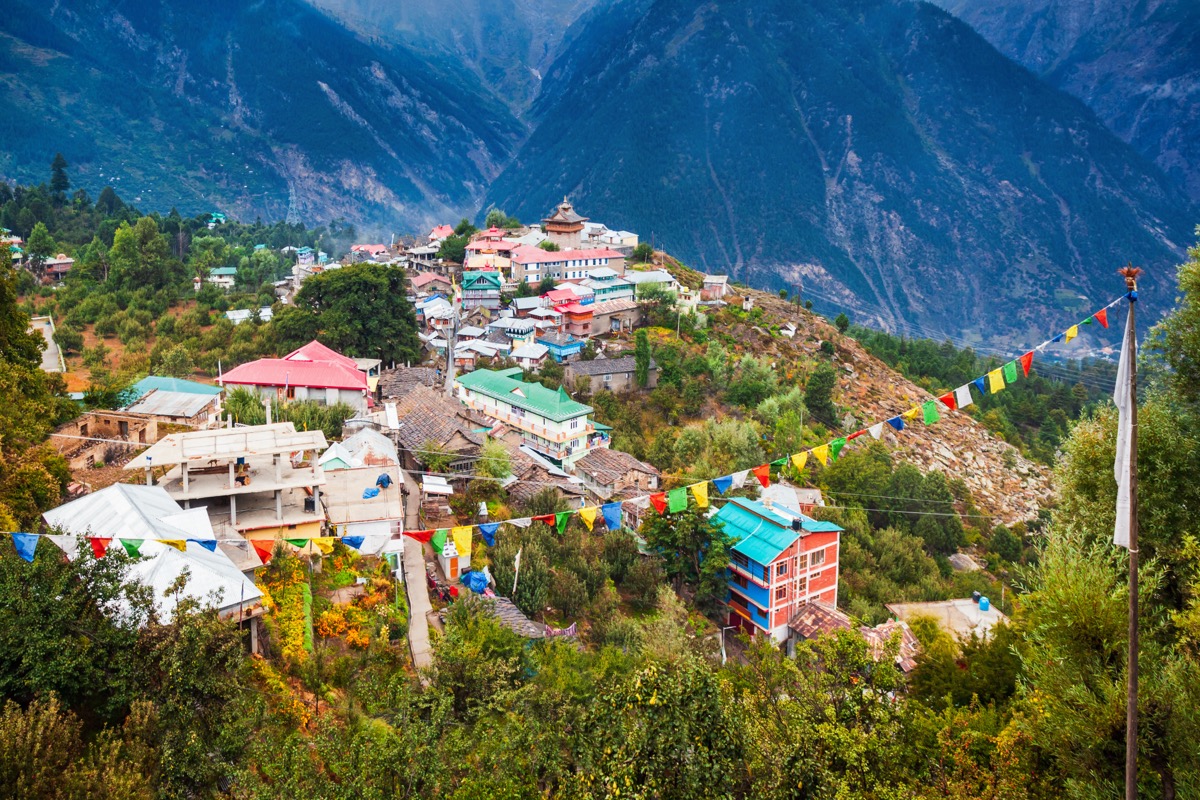
Above The Ridge | Free
Wooden crafts market selling walking sticks, toys, boxes, and carved souvenirs. Great for gifts.
11 km from Shimla | Free
Hilltop temple dedicated to Goddess Tara with stunning sunset views. A peaceful alternative to the tourist crowds.
4 km from Mall Road | Free
Deep, narrow valley surrounded by pine and deodar trees. Popular for picnics and quiet walks.
5 km from Ridge | Free
Quiet leafy suburb home to Himachal Pradesh University. Mahatma Gandhi stayed here during his Shimla visits.
19. Maria Brothers Bookshop (Mall Road, Free to browse): Shimla's legendary bookshop (since 1956) with rare Himalayan books and first editions. A bibliophile's treasure.
20. Ice Skating Rink (Lakkar Bazaar, ₹250–400): Asia's only natural open-air ice rink, operational December to February when temperatures drop below freezing.
Essential practical information
At 2,205m, take it easy on Day 1. Drink plenty of water. Mild altitude effects (breathlessness on stairs) are common.
ATMs available on Mall Road and near The Ridge. UPI works at most shops. Carry cash for smaller establishments and the toy train.
Shimla is very safe, even at night on Mall Road. Watch for monkeys near Jakhoo — they snatch food and glasses.
Weather changes rapidly. Carry a rain jacket even in summer. Winter temperatures drop to -4°C. Warm layers are essential Dec–Feb.
Langur and rhesus monkeys are everywhere. Don't carry visible food. Don't make eye contact or show teeth. Carry a stick near Jakhoo.
Shimla is extremely hilly. Comfortable shoes are essential. Most sightseeing requires walking uphill and downhill on steep paths.
Photography is free at most sites. The Ridge at sunset and Christ Church at dawn offer the best light.
Navigate the city like a local
Shimla Airport (SLV) at Jubbarhatti is 23 km from town (₹600–800 by taxi, 45 min). Very limited flights. Most travelers arrive by road or toy train from Kalka.
The best way to explore Shimla. Mall Road and most attractions are pedestrian-friendly. Cost: Free
HRTC buses connect Shimla to Kufri, Mashobra, and other nearby spots. Cost: ₹15–50
Available on Cart Road and lower areas. Not allowed on Mall Road. Cost: ₹50–200
For day trips to Kufri, Narkanda, Chail. Hire from Union stands near the bus station. Cost: ₹1,500–3,000/day
Public lift connects Cart Road (lower) to Mall Road (upper). Saves a steep 10-minute climb. Cost: ₹10
When to go and what to expect
Pleasant spring (15–25°C). Apple blossoms and clear Himalayan views. Ideal for walking and sightseeing. Peak domestic tourism.
Monsoon season. Misty, rainy, and green. Landslides can block roads. Fewer tourists. Lush forests and waterfalls at their best.
Post-monsoon clarity. Best Himalayan views. Apple harvest season. Comfortable weather (10–20°C). Excellent for photography.
Winter wonderland. Snowfall transforms Shimla. Temperatures drop to -4°C. Ice skating season. Christmas and New Year are magical but crowded.
Shimla — best experienced in March–June, December–FebruaryMake the most of your time
Extended stays and themed routes
Add the Kalka-Shimla toy train journey (Day 1), Narkanda for skiing and Hatu Peak (65 km), and the Shimla Water Catchment Sanctuary for bird-watching.
Combine Shimla with Manali (260 km, 7–8 hours). Or add Chail (45 km) for the world's highest cricket ground and Naldehra (22 km) for India's oldest golf course.
Kids love the toy train, Kufri horse rides, Jakhoo ropeway, and the ice skating rink (winter). Advance Retreat hotel has family suites with valley views.
December–February brings snowfall. Build snowmen on The Ridge, try ice skating at the natural rink, ski at Kufri or Narkanda, and warm up with hot chocolate at Wake & Bake.
Where the British Empire came to breathe and Shimla still exhales
Colonial Heart of Shimla
The Ridge is Shimla's signature open space — a wide, flat stretch at the top of the town where Mall Road meets the sky. On clear days, the snow-capped Himalayan ranges stretch across the horizon. Christ Church, with its yellow facade and stained-glass windows, anchors the eastern end. The western end connects to Scandal Point and the start of Mall Road, Shimla's car-free promenade that has been the town's social spine since 1825.
Mall Road is where Shimla comes alive — locals and tourists stroll past colonial-era shopfronts housing bookshops, cafes, handicraft stores, and the restored Gaiety Theatre. In the evening, the road fills with families, couples, and solo walkers enjoying the mountain air. Street vendors sell roasted corn (₹30), momos (₹40–60), and kulhad chai. The energy is relaxed and convivial — a stark contrast to the frantic plains below.
Where to eat in The Ridge & Mall Road
Wake & Bake Café (₹300–500): Shimla's favourite café with excellent coffee, crepes, and mountain views.
Ashiana Restaurant (₹400–700): North Indian and Chinese on The Ridge with panoramic valley views.
Indian Coffee House (₹100–200): No-frills institution serving filter coffee and dosas since the 1960s.
Shopping: Lakkar Bazaar (above The Ridge) for wooden crafts — walking sticks (₹100–500), carved boxes, and toys. Lower Bazaar for woolen shawls (₹500–3,000) and Himachali caps (₹200–500).


Where monkeys guard ancient temples and pine forests whisper history
The Hilltop Temples
Rising above The Ridge to 2,455 metres, Jakhoo Hill is Shimla's highest point and home to the ancient Jakhoo Temple dedicated to Lord Hanuman. The hill is crowned by a massive 108-foot Hanuman statue visible from across the valley. The 2 km hike from The Ridge winds through dense deodar forest alive with langur monkeys and Himalayan birds. Alternatively, the Jakhu Ropeway whisks you up in minutes with spectacular views.
The surrounding area — Observatory Hill, Summer Hill, and the quiet lanes leading to the Viceregal Lodge — represents the quieter, more refined side of Shimla. This is where the British built their grandest residences, including the Viceregal Lodge (now the Indian Institute of Advanced Study), where decisions about the partition of India were made. The pine-scented trails here are perfect for morning walks away from the tourist crowds.
Where to eat in Jakhoo Hill & Upper Shimla
Café Simla Times (₹300–500): Cosy café near the Viceregal Lodge with views, books, and excellent lemon tarts.
Honey Hut (₹200–400): Organic café specializing in Himachali honey-infused dishes.


The beating heart of everyday Shimla — steep, stacked, and utterly alive
The Local Shimla
Below the polished facade of Mall Road, the real Shimla tumbles downhill in a cascade of narrow lanes, stacked buildings, and bustling markets. Lower Bazaar is where locals shop for groceries, spices, and daily essentials. The lanes are steep, crowded, and atmospheric — far removed from the tourist-oriented Mall Road above. Cart Road, the main vehicular artery, wraps around the hillside below, connecting the bus station, railway station, and parking lots.
This is where you find Shimla's best street food — steaming plates of chana puri at hole-in-the-wall stalls, fresh samosas for ₹10, and the town's famous Sharma Sweets for jalebis. The old Shimla temples — Kali Bari and Sankat Mochan — are tucked into these lower lanes. The public lift connecting Cart Road to Mall Road is a Shimla institution and saves a brutal uphill climb.
Where to eat in Lower Bazaar & Cart Road
Baljees Restaurant (₹300–600): Shimla institution since 1950, famous for butter chicken and the legendary Baljee's cake.
Sharma Sweets (₹50–150): Best jalebis and samosas in Lower Bazaar.
Sita Ram & Sons (₹80–200): Family-run dhaba with hearty rajma-chawal and dal makhani.
Street Food Trail: Start at the samosa stalls near the lift (₹10), try the chana puri at Lower Bazaar (₹30), pick up jalebis from Sharma Sweets (₹40/plate), and finish with a kullhad chai (₹20).


What to eat and where to find it
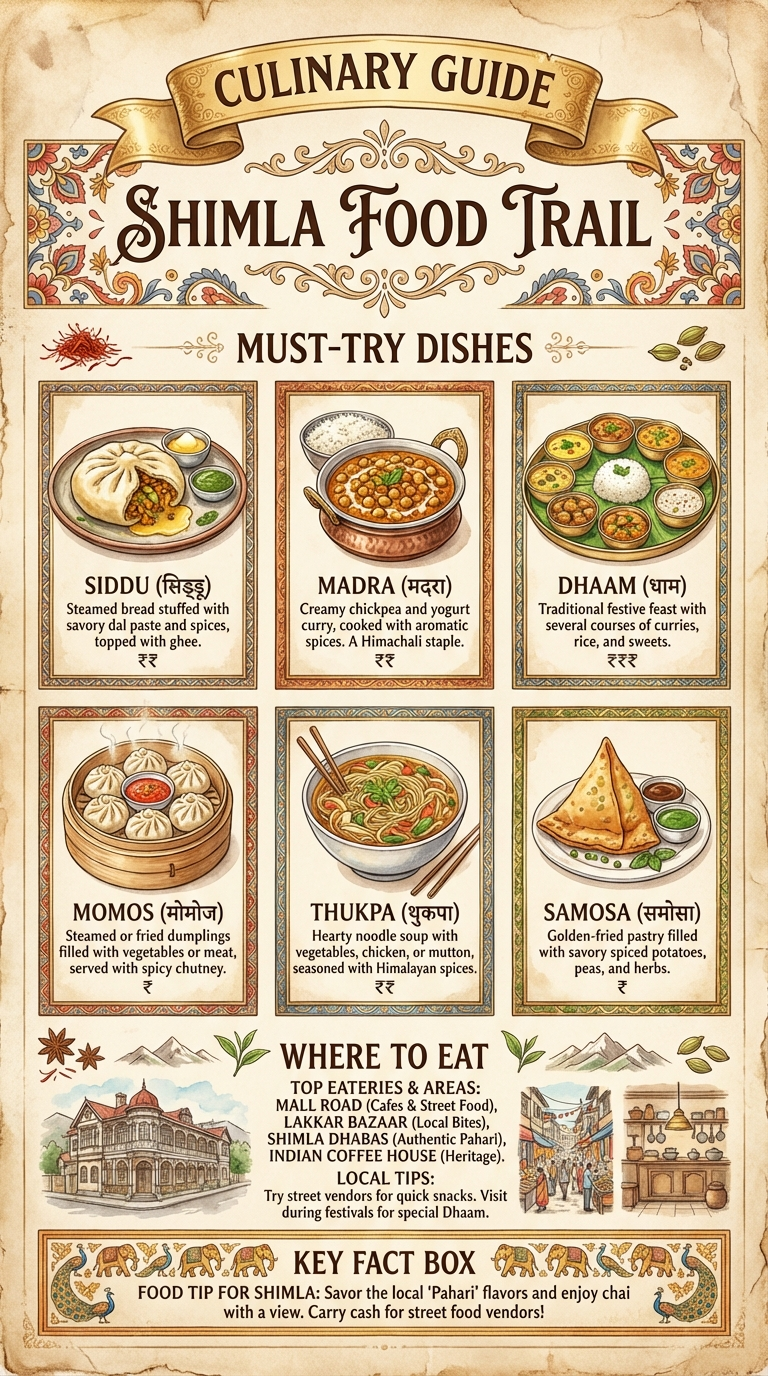
Shimla's food scene reflects its mountain setting and colonial history. Himachali cuisine — hearty, warming, and spice-rich — anchors the local diet, with dhaam (ceremonial feast), siddu (steamed bread), and trout from mountain streams. The British left behind a bakery tradition that survives in Shimla's legendary cake shops. And the influx of Tibetan refugees brought momos and thukpa, now as much a part of Shimla's food identity as any local dish.
Siddu (₹60–100): Steamed wheat bread stuffed with poppy seeds or walnuts, served with ghee and dal. The quintessential Himachali comfort food.
Momos (₹50–100): Tibetan dumplings — steamed or fried, stuffed with chicken, pork, or vegetables. Available at every corner in Shimla.
Madra (₹100–200): Chickpeas or rajma cooked in yoghurt gravy with Himachali spices. A staple of the dhaam (feast).
Trout (₹300–500): Fresh rainbow trout from Himachal's cold streams, grilled or pan-fried. Best at Wildflower Hall or local dhabas near Kufri.
Chana Madra (₹80–150): Chickpeas cooked in a yoghurt-based sauce with fenugreek and cardamom — a Himachali specialty.
Babru (₹30–50): Deep-fried bread stuffed with black gram dal. Shimla's version of a kachori, usually served for breakfast.
Dham (₹200–400): Himachali ceremonial feast served on leaf plates: rice, dal, rajma, curd, and sweet rice. Found at festivals and some restaurants.
Aktori (₹50–80): Buckwheat pancake made during Dussehra, sweetened with jaggery. A seasonal treat unique to Himachal.
Best restaurants, markets, and street food
Cecil Restaurant, Oberoi Cecil (₹1,500–2,500): Fine dining in a restored Raj-era ballroom. The trout and lamb shanks are excellent.
Ashiana & Goofa (₹400–700): Two restaurants at The Ridge — Ashiana for Indian, Goofa for a cave-themed ambience.
Cafe Sol (₹300–600): European-style café on Mall Road with wood-fired pizzas, pastas, and Himachali wine.
Baljees (₹300–600): Shimla institution since 1950. Famous for butter chicken, cakes, and the plum cake at Christmas.
Lower Bazaar stalls: Samosas (₹10), chana puri (₹30), and fresh jalebis at Sharma Sweets.
Mall Road momos: Multiple stalls selling steamed and fried momos (₹50–80). The pork momos near Scandal Point are the best.
Lakkar Bazaar: Roasted corn (bhutta, ₹30) and kulhad chai (₹20) while shopping for wooden crafts.


Understanding the story of Shimla
Shimla's recorded history begins in 1819 when British Lieutenant Charles Kennedy built the first European house here. The cool climate at 2,205 metres offered blessed relief from the scorching plains, and by the 1830s, a steady stream of British officials was constructing summer homes. In 1864, Shimla was officially declared the summer capital of British India — every year, the entire colonial administration, along with tons of files and hundreds of staff, made the grueling journey up from Calcutta. The Kalka-Shimla Railway, completed in 1903, made this migration considerably easier.
Shimla hosted several pivotal moments in Indian history. The Simla Conference of 1945 between the British and Indian leaders attempted to resolve the independence question. The Partition plan was finalized here in 1947. After independence, Shimla became the capital of Punjab (later Himachal Pradesh when the state was formed in 1971). The Shimla Agreement of 1972 between India and Pakistan, signed at the Viceregal Lodge, defined the post-war Line of Control in Kashmir. Today, Shimla is a bustling state capital that balances its colonial heritage with the challenges of mountain urbanization.
Shimla's culture blends Himachali mountain traditions with a colonial legacy. The annual Summer Festival (May–June) features folk music, dance, and handicraft exhibitions. Lavi Fair (November) at nearby Rampur is one of India's oldest trade fairs, dating back centuries. The Ice Skating Carnival (January) on Asia's only natural ice rink is a Shimla institution. Local crafts include Kullu shawls, Kinnauri caps, and wooden carvings from Lakkar Bazaar. The Gaiety Theatre hosts regular performances of drama and music.
Excursions from Shimla
Shimla is a gateway to some of Himachal's most beautiful hill stations, each offering a different mountain experience within a few hours' drive.
Hill stations above Shimla with horse rides, yak rides, and panoramic views. Skiing available in winter at Kufri. Entry: ₹50–200
Apple country with the Hatu Peak trek (3,400m) and a small ski slope. October apple harvest is magical. Entry: Free
Former summer capital of Patiala state with the world's highest cricket ground at 2,444m. Peaceful and uncrowded. Entry: Free (palace grounds ₹100)
India's oldest golf course at Naldehra (1903) and natural hot springs at Tattapani on the Sutlej River. Entry: ₹100–300

Practical information from A to Z
Available at hotels, bars, and wine shops. Himachali apple wine and apple cider are local specialties. Try Himachali fruit wines.
HDFC, SBI, and PNB ATMs on Mall Road and near the bus stand. Carry cash for Kufri and rural areas.
Indira Gandhi Medical College (IGMC) is the main hospital. Private clinics on Mall Road for minor issues.
220V/50Hz. Power cuts occur, especially in winter storms. Hotels have generators. Carry a power bank.
Wi-Fi at most hotels. 4G coverage is good in Shimla but patchy outside town. Jio and Airtel work best.
India decriminalized homosexuality in 2018. Shimla is more relaxed than many Indian cities but discretion is advised.
Most hotels offer laundry service. Quick-service laundromats on Mall Road (₹50–80/piece).
General Post Office on Mall Road, a beautiful colonial-era building. International mail takes 7–14 days.
A serious nuisance. Secure your belongings, especially near Jakhoo. Don't carry food visibly.
Extremely limited. Use Cart Road parking lots. Most tourists walk within town.
Air quality is generally excellent. Water quality varies — drink bottled water.
GST 5–18%. Hotels charge 12–18% GST. Most restaurants include taxes.
Western toilets at hotels and Mall Road restaurants. Public toilets on The Ridge and Mall Road (₹5).
Bottled water is ₹20. Some hotels offer filtered water. Water shortages common in summer.
Check weather before traveling. Roads close during heavy snow. Carry warm clothing even in summer — evenings are cool.
Getting to and around Shimla
From Delhi: The Kalka-Shimla Toy Train is the most scenic option (Kalka via Shatabdi 4h + toy train 5h). By road, Delhi–Shimla is 350 km via NH-5 (7–8 hours by Volvo bus, ₹800–1,200). Direct Volvo buses run from ISBT Kashmere Gate.
From Chandigarh: 115 km, 3–4 hours by road. Regular buses from Sector 43 ISBT (₹200–400). Taxi ₹2,000–2,500.
Within Shimla: Walk on Mall Road and The Ridge. Local buses and taxis for Kufri, Mashobra. The public lift (₹10) connects Cart Road to Mall Road.
| Mode | Details | Cost |
|---|---|---|
| Walking | The best way to explore Shimla. Mall Road and most attractions are pedestrian-friendly. | Free |
| Local Bus | HRTC buses connect Shimla to Kufri, Mashobra, and other nearby spots. | ₹15–50 |
| Auto-Rickshaw | Available on Cart Road and lower areas. Not allowed on Mall Road. | ₹50–200 |
| Taxi | For day trips to Kufri, Narkanda, Chail. Hire from Union stands near the bus station. | ₹1,500–3,000/day |
| Lift/Elevator | Public lift connects Cart Road (lower) to Mall Road (upper). Saves a steep 10-minute climb. | ₹10 |
Essential phrases for travelers
Hindi is widely spoken in Shimla, with the local Pahari dialect used among residents. English is well understood at hotels, restaurants, and tourist sites — Shimla's colonial heritage ensures a higher English literacy than most Indian hill towns.
| English | Hindi / Pahari |
|---|---|
| Hello / Greetings | Namaste |
| Thank you | Dhanyavaad / Shukriya |
| Yes / No | Haan / Nahin |
| How much? | Kitna hai? |
| Too expensive | Bahut mehnga hai |
| Water | Paani |
| Food | Khana |
| Where is...? | ...kahan hai? |
| Help | Madad |
| Good | Accha |
| Beautiful | Sundar |
| Cold | Thanda |
| Hot (tea/coffee) | Garam |
| Snow | Barf |
| How far? | Kitni door hai? |
Our favourite experiences in Shimla
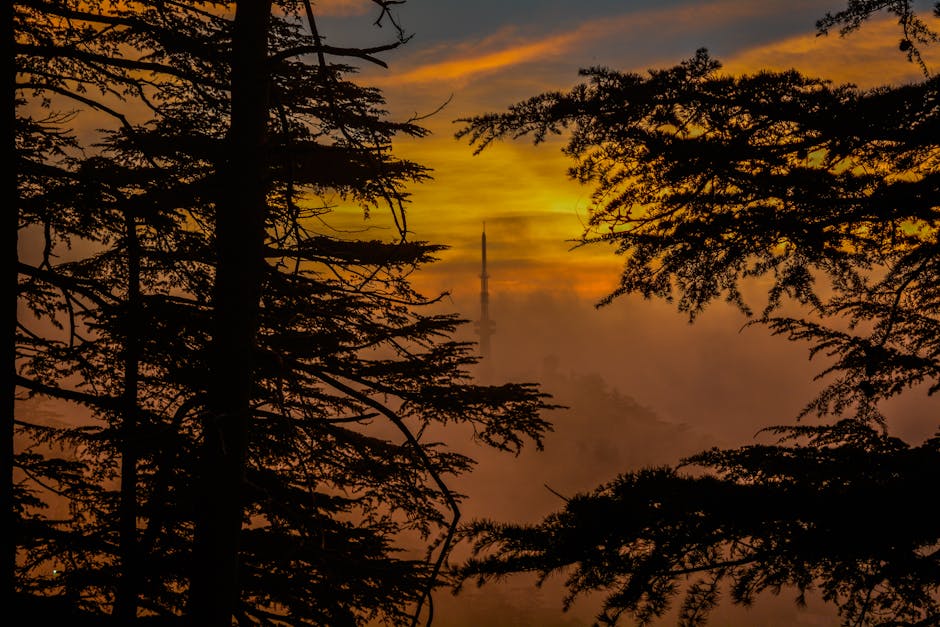
The Ridge at Sunset
Snow-capped Himalayan peaks glowing orange as the sun drops
Kalka-Shimla Toy Train
UNESCO heritage railway through 102 tunnels — pure magic
Baljees Butter Chicken
Shimla institution since 1950 — the OG butter chicken
Lower Bazaar Momos
Steaming pork momos at ₹60 on a cold mountain evening
Wildflower Hall, Oberoi
Former Viceroy's residence turned luxury retreat with cedar forests
Viceregal Lodge
Where India's partition was planned — history in every corridor
Tara Devi Temple
Peaceful hilltop shrine with sunset views away from tourist crowds
Christ Church at Dawn
The yellow facade against blue Himalayan skies — Shimla's icon
Ice Skating Rink
Asia's only natural open-air rink — magical in January
Mall Road Evening Walk
Join the twilight promenade with mountain air and street food
Everything you need for Shimla
Travorea creates comprehensive, beautifully designed travel guides that combine insider knowledge with practical information. Our guides are crafted to help you experience destinations like a local, not just a tourist.
This premium guide to Shimla was researched and written to give you everything you need for an unforgettable trip. All prices and information were verified at the time of writing (2026) but may change — always confirm locally.
All photographs in this guide are sourced from free-to-use image libraries (Pexels, Unsplash) and original Travorea photography. Infographics are original Travorea creations.
Visit us at www.travorea.com for more destinations, interactive trip planners, and the latest travel tips.
Explore More Guides
Visit www.travorea.com/ebooks for premium guides to 50+ destinations worldwide.
Queen of the Hills