
The Andaman Islands are far more than just postcard-perfect beaches; they are a mosaic of ancient cultures, dramatic history, and unparalleled natural wonders waiting to be uncovered. From India's only active volcano to a notorious colonial prison that shaped the nation's freedom struggle, these emerald islands hold secrets that surprise even the most seasoned travelers.

An Engineering or Architectural Marvel of Andaman Islands
The Cellular Jail, also known as 'Kala Pani', stands as a chilling testament to colonial oppression and an architectural marvel designed for isolation and surveillance.
- **Panopticon Design**: Its unique 'spoke-and-wheel' design allowed a single guard to observe prisoners from a central watchtower, fostering a pervasive sense of surveillance.
- **Soundproofing**: Cells were constructed with thick walls and individual ventilation, preventing communication between inmates, thus breaking their morale.
- **Limited Capacity**: Initially designed with 698 individual cells across seven wings, ensuring solitary confinement for political prisoners.
- **Anti-Escape Features**: High walls, iron gratings, and remote island location made escape virtually impossible, isolating revolutionaries from the mainland.
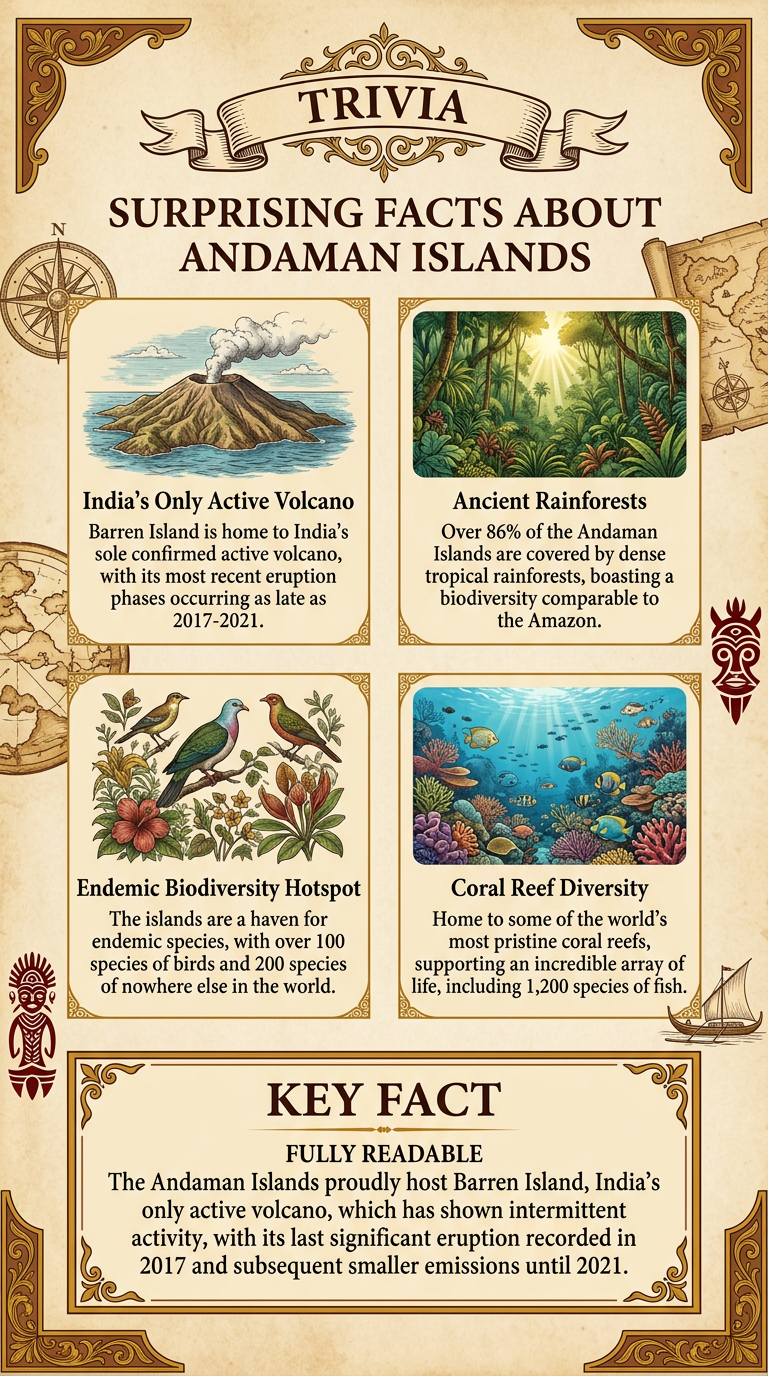
Surprising Facts About Andaman Islands
Beyond its idyllic beaches, the Andaman Islands harbor an array of unexpected wonders, from active volcanoes to ancient rainforests, challenging typical tropical island perceptions.
- **India's Only Active Volcano**: Barren Island is home to India's sole confirmed active volcano, with its most recent eruption phases occurring as late as 2017-2021.
- **Ancient Rainforests**: Over 86% of the Andaman Islands are covered by dense tropical rainforests, boasting a biodiversity comparable to the Amazon.
- **Endemic Biodiversity Hotspot**: The islands are a haven for endemic species, with over 100 species of birds and 200 species of plants found nowhere else in the world.
- **Coral Reef Diversity**: Home to some of the world's most pristine coral reefs, supporting an incredible array of marine life, including 1,200 species of fish.
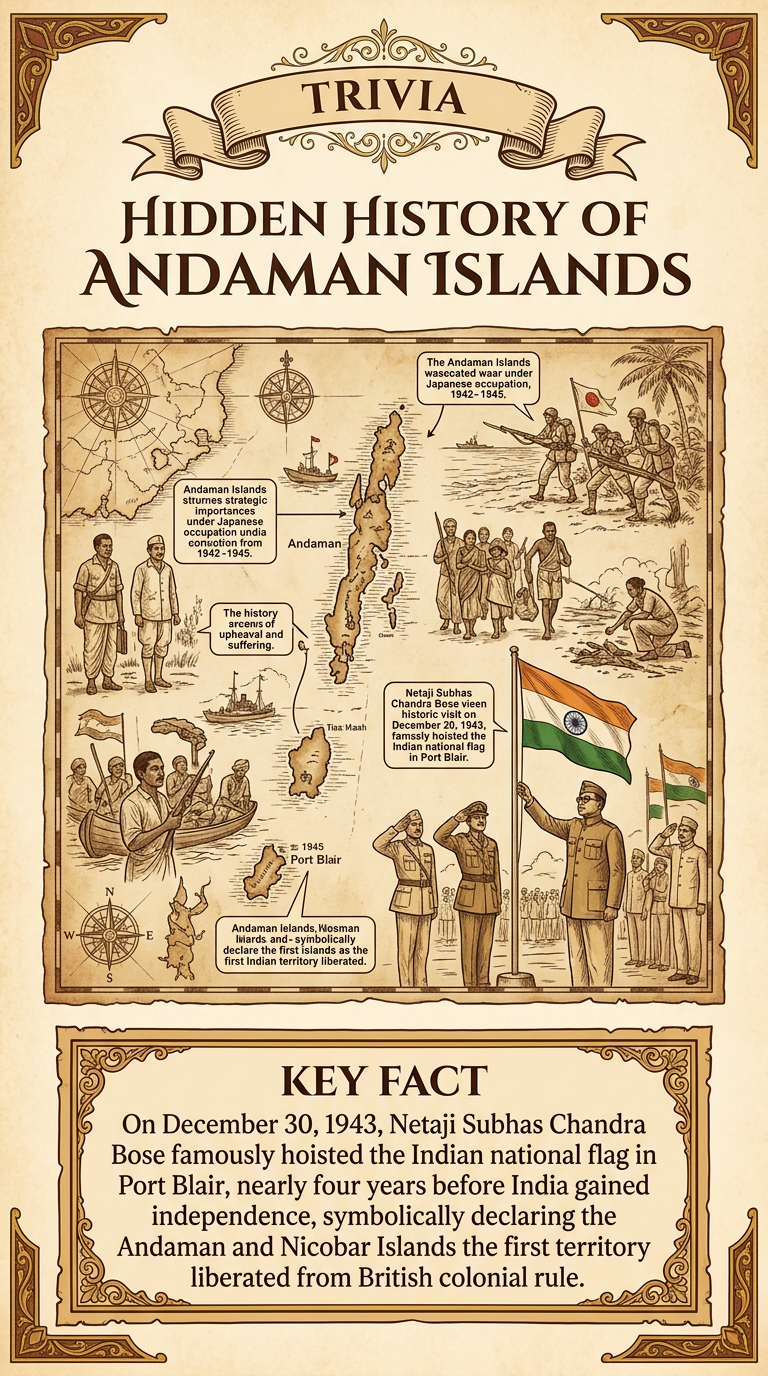
Hidden History of Andaman Islands
Delve into the lesser-known annals of the Andaman Islands, revealing tales of indigenous resilience, wartime occupation, and a pivotal moment in India's freedom struggle.
- **Japanese Occupation**: The islands were under Japanese occupation from 1942 to 1945 during World War II, a period marked by hardship and political shifts.
- **Netaji's Swaraj Declaration**: On December 30, 1943, Netaji Subhas Chandra Bose hoisted the Indian flag here, declaring the islands the first liberated territory from British rule.
- **Pre-Cellular Jail Penal Colony**: Ross Island, now a ruin-laden tourist spot, served as the initial administrative and penal settlement for the British, predating the Cellular Jail.
- **Ancient Indigenous Civilizations**: The islands have been home to distinct indigenous groups for tens of thousands of years, predating modern human civilization in many parts of the world.
More Andaman Islands Secrets
Unique Indigenous Tribes of the Andamans
The Andaman Islands are home to some of the world's most isolated and ancient indigenous communities, including the Great Andamanese, Onge, Jarawa, and the famously uncontacted Sentinelese. These tribes represent distinct linguistic and cultural groups whose ancestors have inhabited these islands for tens of thousands of years.
Their way of life is deeply intertwined with the rainforests and seas, relying on hunting, gathering, and fishing. Efforts are made by the Indian government to protect their lands and preserve their unique heritage, recognizing their profound cultural significance and right to self-determination.
The Enigmatic Marine Life and Coral Reefs
The waters surrounding the Andaman Islands are a diver's paradise, boasting an astounding diversity of marine life and some of the most vibrant coral reefs in the Indian Ocean. These healthy ecosystems support over 1,200 species of fish, including colorful reef dwellers, sharks, manta rays, and various turtles.
The pristine conditions, thanks to limited human intervention in many areas, allow for spectacular snorkeling and diving experiences, revealing breathtaking underwater gardens teeming with life and offering glimpses of rare and endemic marine species.
Post-Tsunami Resilience and Rebuilding
The Andaman Islands bore the brunt of the devastating 2004 Indian Ocean tsunami, which caused widespread destruction and loss of life. Yet, the islands and their communities showed remarkable resilience in the face of such a monumental natural disaster.
The rapid recovery and rebuilding efforts, supported by national and international aid, transformed damaged areas and improved infrastructure, demonstrating the enduring spirit of the islanders and the capacity for renewal even in the wake of immense tragedy.
More Andaman Islands Content Coming Soon
We're crafting a complete guide for Andaman Islands. Stay tuned!
Explore More Trivia