
Athens isn't merely a city of ancient ruins; it's a vibrant metropolis where millennia of history intertwine with pulsating modern life. Prepare to uncover astonishing engineering marvels, surprising cultural quirks, and historical secrets that even seasoned travelers often overlook.
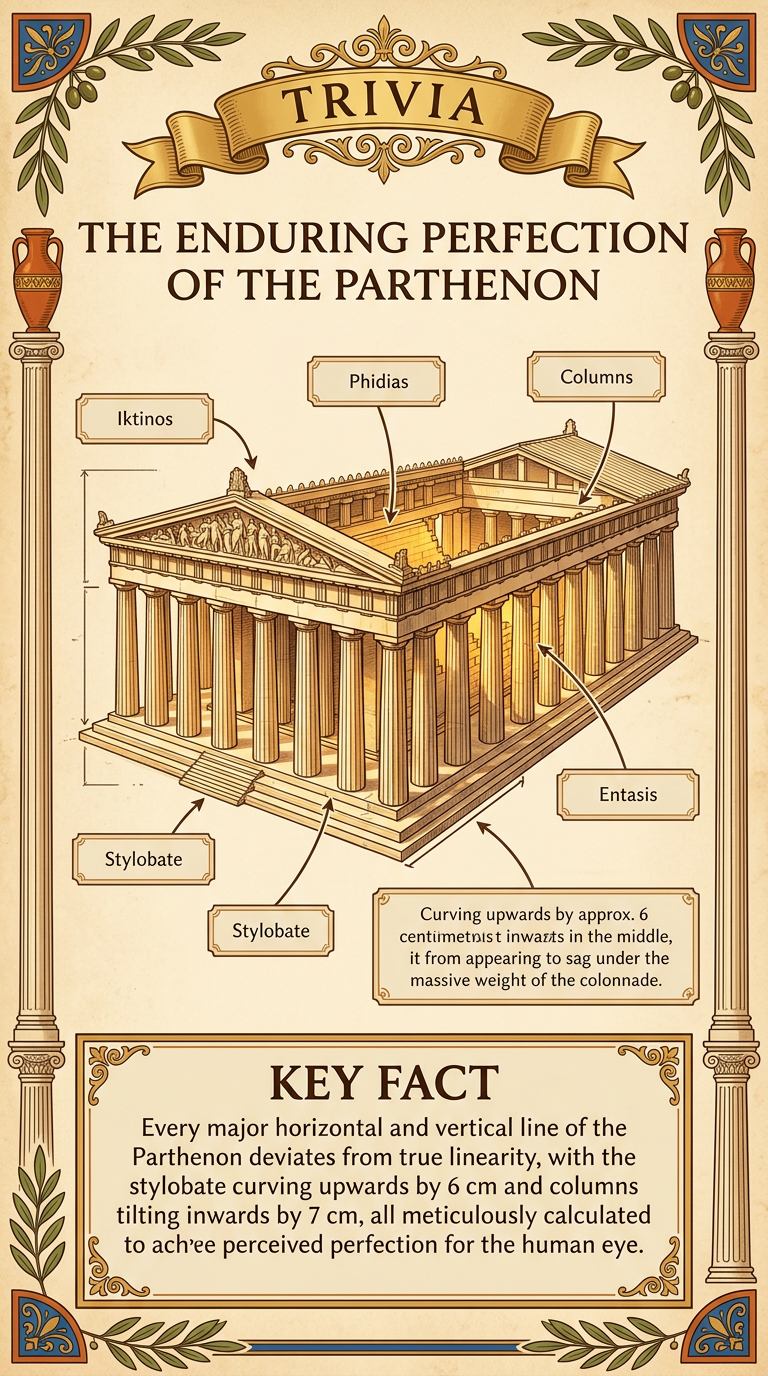
The Enduring Perfection of the Parthenon
The Parthenon stands as the ultimate symbol of ancient Greek achievement, but its visual perfection isn't accidental. It's a masterclass in optical illusion and engineering genius that still baffles modern architects.
- No straight lines exist in the entire temple's construction, challenging perceptions of perfect geometry.
- The columns subtly bulge outwards in the middle, an 'entasis,' to counteract the optical illusion of appearing concave from a distance.
- The stylobate (temple floor) gently curves upwards by approximately 6 cm in the center to prevent it from looking sagged.
- Columns tilt slightly inwards by about 7 cm over their height, creating a sense of stability and converging at an imaginary point miles above the structure.
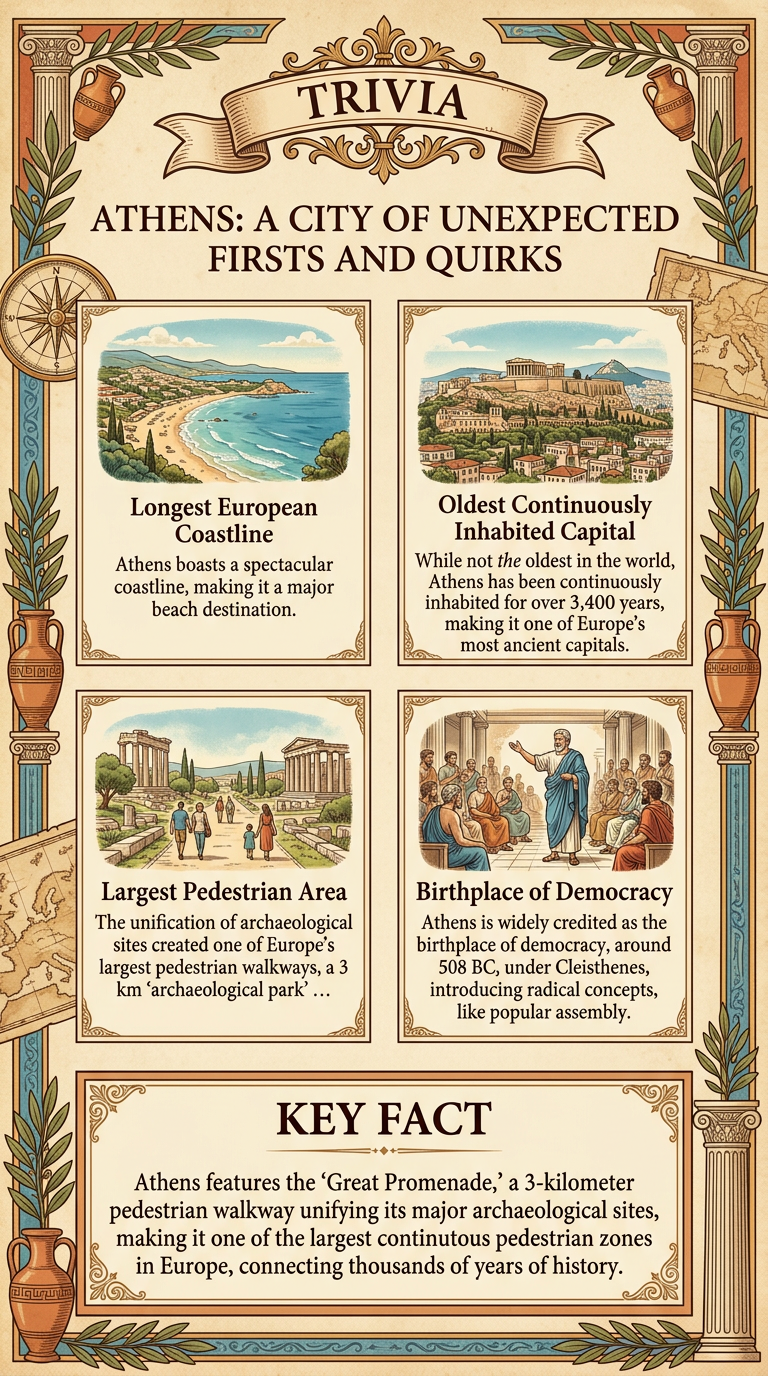
Athens: A City of Unexpected Firsts and Quirks
Beyond its classical facade, Athens holds a trove of surprising modern distinctions and lesser-known cultural facts that paint a vibrant picture of its enduring spirit.
- **Longest European Coastline:** Athens boasts a spectacular coastline within its metropolitan area, making it a major beach destination.
- **Oldest Continuously Inhabited Capital:** While not *the* oldest in the world, Athens has been continuously inhabited for over 3,400 years, making it one of Europe's most ancient capitals.
- **Largest Pedestrian Area:** The unification of archaeological sites created one of Europe's largest pedestrian walkways, a 3 km 'archaeological park'.
- **Birthplace of Democracy:** Athens is widely credited as the birthplace of democracy, around 508 BC under Cleisthenes, introducing radical concepts like popular assembly.
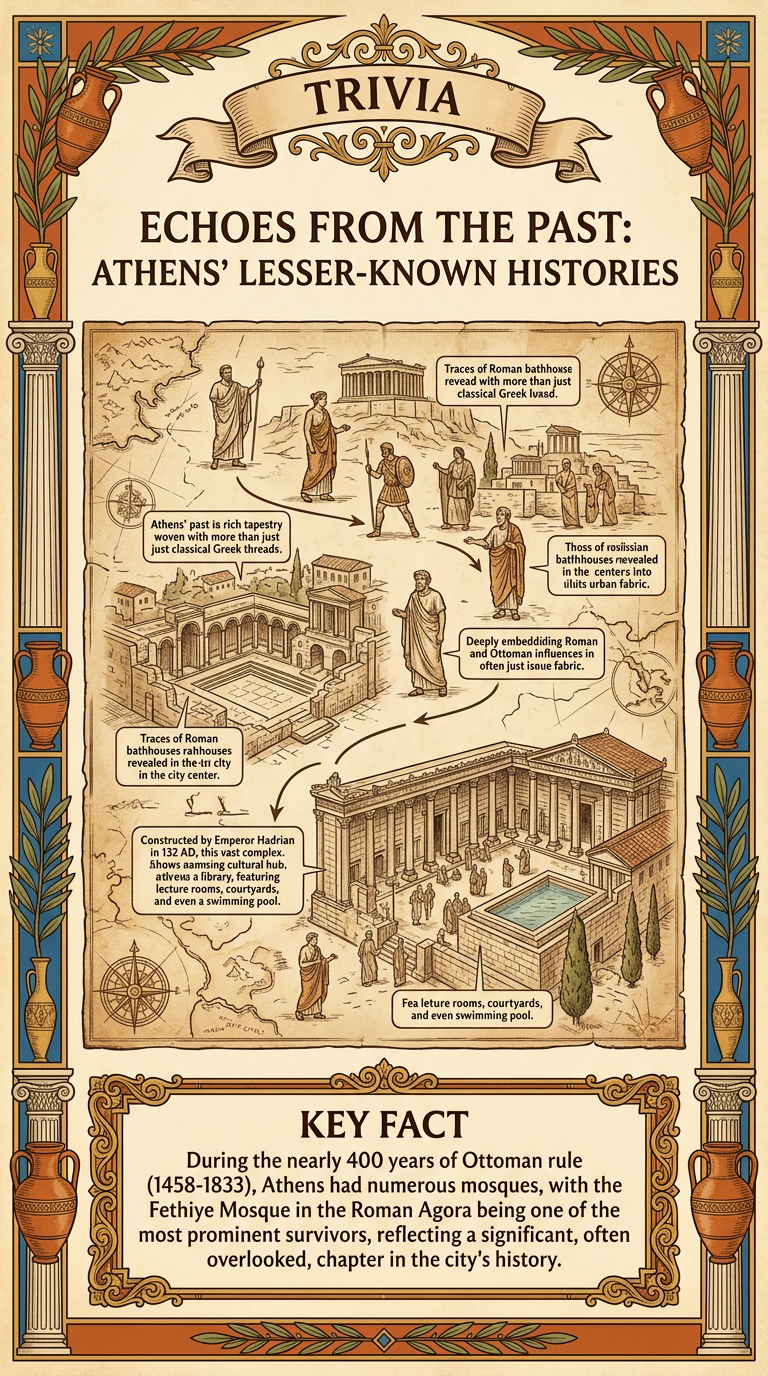
Echoes from the Past: Athens' Lesser-Known Histories
Beneath the well-trodden paths of ancient Athens lie layers of history often overlooked, from Ottoman influences to forgotten cults and Roman emperors' surprising legacies.
- Ancient Roman Baths in the City Center: Ruins of Roman bathhouses, like those near the Roman Agora, reveal a different layer of daily life.
- Hadrian's Library: Not just a library, but a vast complex with lecture halls, courtyards, and a swimming pool, reflecting Roman intellectual life in Athens.
- The Cult of Asclepius: The Asklepieion on the Acropolis slope was a healing sanctuary where patients slept to receive visions from the god of medicine.
- Ottoman Era Mosques: Several mosques still stand, like the Fethiye Mosque in the Roman Agora, silent witnesses to nearly 400 years of Ottoman rule.
More Athens Secrets
The Ancient Athenian Water Supply
The ancient Athenians developed sophisticated water management systems, including the Peisistratian aqueduct built in the 6th century BC, an underground network of tunnels and terracotta pipes that brought fresh water from the Hymettus mountain range.
Remarkably, parts of this ancient aqueduct system were still in use until the 20th century, a testament to their exceptional engineering and durability spanning over 2,500 years.
The Panathenaic Stadium's Modern Revival
The Panathenaic Stadium, originally built in 330 BC for the Panathenaic Games, was completely rebuilt in gleaming white marble for the first modern Olympic Games in 1896, making it the only stadium in the world built entirely of marble and the finish line for every Olympic marathon since.
The City's Unique Name
Athens is named after Athena, the goddess of wisdom, warfare, and crafts. Legend says she won a contest against Poseidon to become the city's patron deity by offering the olive tree, a symbol of peace and prosperity, which the Athenians valued more than Poseidon's saltwater spring, giving the city its enduring name.
More Athens Content Coming Soon
We're crafting a complete guide for Athens. Stay tuned!
Explore More Trivia