
Beyond its iconic Sagrada Familia and vibrant tapas culture, Barcelona is a city of astonishing innovation and deeply layered history. Prepare to uncover the secrets of its ingenious urban planning, surprising origins, and hidden past that continue to shape this extraordinary Mediterranean metropolis, offering a truly unique perspective on one of Europe's most beloved destinations.
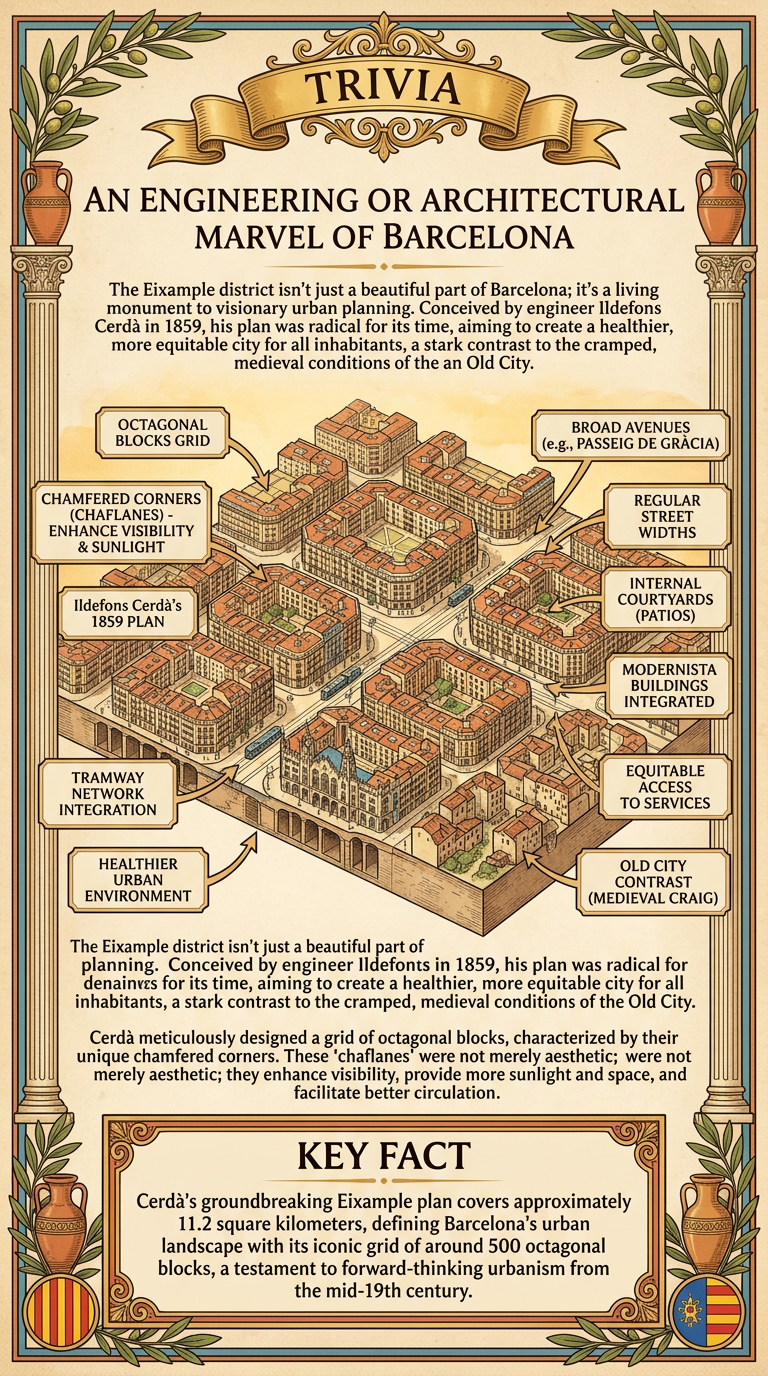
An Engineering or Architectural Marvel of Barcelona
While Gaudi's masterpieces capture global attention, the true structural backbone and social vision of Barcelona lies in the methodical grid of its Eixample district, a revolutionary urban plan that defined modern city living.
- Ildefons Cerdà's 1859 plan for the Eixample ('Expansion') aimed for social equality through uniform blocks and wide, tree-lined streets.
- Each block features distinctive chamfered corners (Cerdà's 'chaflanes') to improve visibility, ventilation, and create larger intersections for public spaces.
- The original design mandated inner courtyards within blocks, ensuring green spaces and natural light for residents, though many were later built upon.
- Cerdà envisioned a complex network of public and private transport, including tramways and tree-lined boulevards, radically ahead of its time for the mid-19th century.
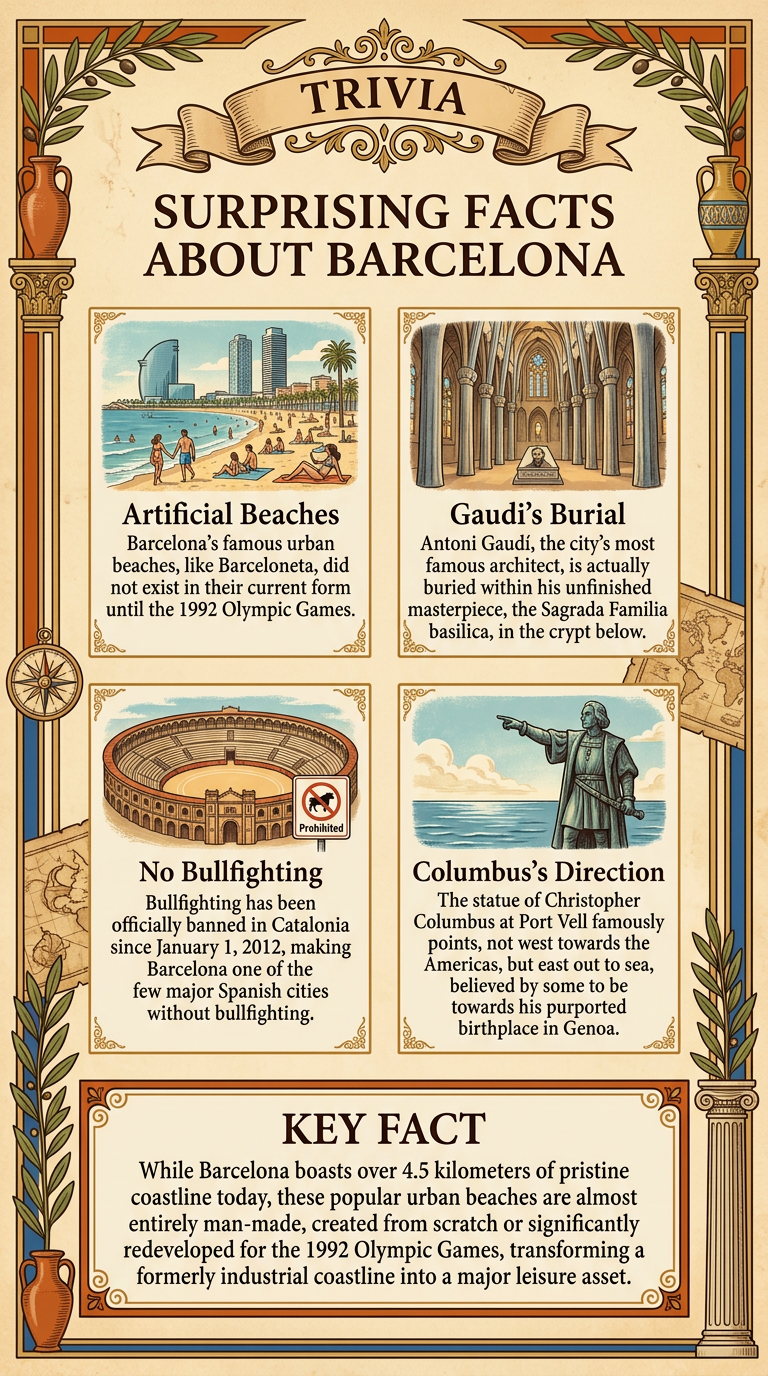
Surprising Facts About Barcelona
Delve into the unexpected quirks and counterintuitive origins that make Barcelona even more fascinating, proving that even its most familiar features hold a hidden story or a surprising secret.
- **Artificial Beaches**: Barcelona's famous urban beaches, like Barceloneta, did not exist in their current form until the 1992 Olympic Games.
- **Gaudi's Burial**: Antoni Gaudí, the city's most famous architect, is actually buried within his unfinished masterpiece, the Sagrada Familia basilica, in the crypt below.
- **No Bullfighting**: Bullfighting has been officially banned in Catalonia since January 1, 2012, making Barcelona one of the few major Spanish cities without bullfighting.
- **Columbus's Direction**: The statue of Christopher Columbus at Port Vell famously points, not west towards the Americas, but east out to sea, believed by some to be towards his purported birthplace in Genoa.
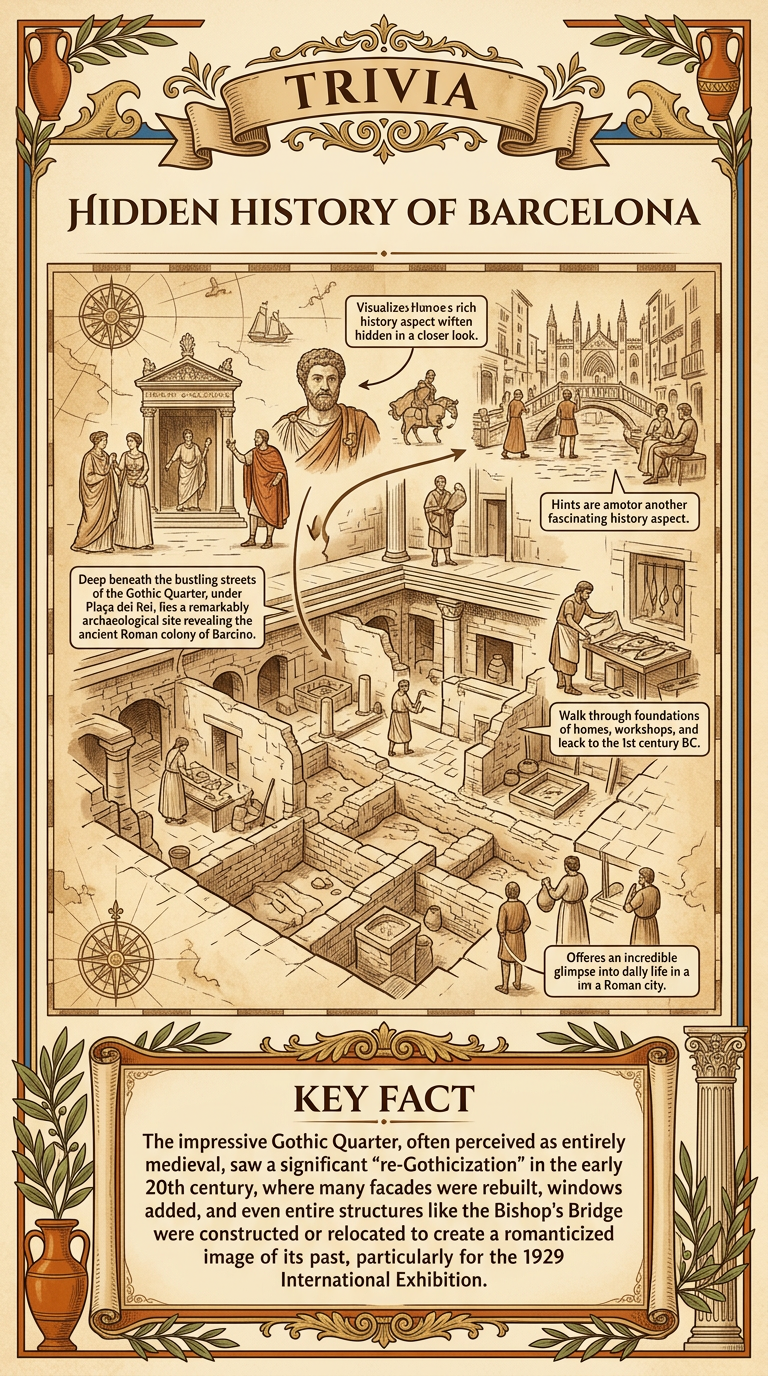
Hidden History of Barcelona
Peel back the layers of Barcelona's vibrant present to uncover its ancient foundations, forgotten conflicts, and the silent witnesses that reveal a city shaped by millennia of tumultuous and transformative events.
- Beneath Plaça del Rei in the Gothic Quarter lies the extensive underground remains of the ancient Roman city of Barcino, including streets, laundries, and a fish salting factory.
- Many of the impressive 'Gothic' buildings in Barcelona's famous Gothic Quarter were significantly restored or even fully reconstructed in the early 20th century, blurring the lines of their true medieval origins.
- The city played a pivotal role during the Spanish Civil War (1936-1939), enduring severe aerial bombardments, and hundreds of public air raid shelters were built beneath its streets.
- A medieval Jewish Quarter (El Call Jueu) once thrived within the present-day Gothic Quarter, its narrow, winding streets still hinting at this vanished community's presence until their expulsion in the late 14th century.
More Barcelona Secrets
The Legacy of Roman Barcino
Barcelona's origins trace back to the Roman colony of Barcino, founded in the 1st century BC by Emperor Augustus. Its strategic location on a small hill, Mons Taber, offered natural defenses and a view of the sea. While much of the Roman city lies buried, its influence is still evident in the urban fabric of the Gothic Quarter.
Visitors can explore remnants of the Roman wall integrated into modern buildings, discover columns from the Temple of Augustus tucked away in a courtyard, and descend into the Museu d'Història de Barcelona (MUHBA) under Plaça del Rei to walk directly among ancient Roman streets, villas, and industrial sites, providing a tangible connection to the city's 2,000-year-old roots.
Barcelona's Unique Street Lamps
Beyond Gaudi, Barcelona boasts a surprising array of beautifully designed street lamps, particularly those by Pere Falqués i Urpí along Passeig de Gràcia. These ornate, cast-iron lamps, featuring integrated benches and intricate mosaic work, often attributed to Gaudi by tourists, are in fact Falqués' creations. They exemplify the Modernisme movement's dedication to integrating art into everyday urban furniture, making even a simple streetlight an object of beauty and function, enhancing the boulevard's architectural grandeur.
The Barcelona Dragon Lore
While St. George (Sant Jordi) is Catalonia's patron saint, known for slaying a dragon, Barcelona is surprisingly full of dragon imagery beyond just churches. From the iconic dragon on Casa Batlló's roof (symbolizing the beast slain by St. George) to numerous other sculptures, fountains, and architectural details across the city, dragons are a pervasive motif. This pervasive imagery connects to Catalan identity, folklore, and the Modernista architects' love for symbolic, fantastical elements in their designs, making dragon-spotting a delightful urban treasure hunt.
More Barcelona Content Coming Soon
We're crafting a complete guide for Barcelona. Stay tuned!
Explore More Trivia