
Darjeeling, often hailed as the "Queen of the Hills," offers more than just stunning views of Kanchenjunga. Delve into its fascinating past and uncover extraordinary engineering feats, surprising cultural tapestries, and hidden historical narratives that truly make this Himalayan gem unique. Prepare to be surprised by the depths of Darjeeling's untold stories.
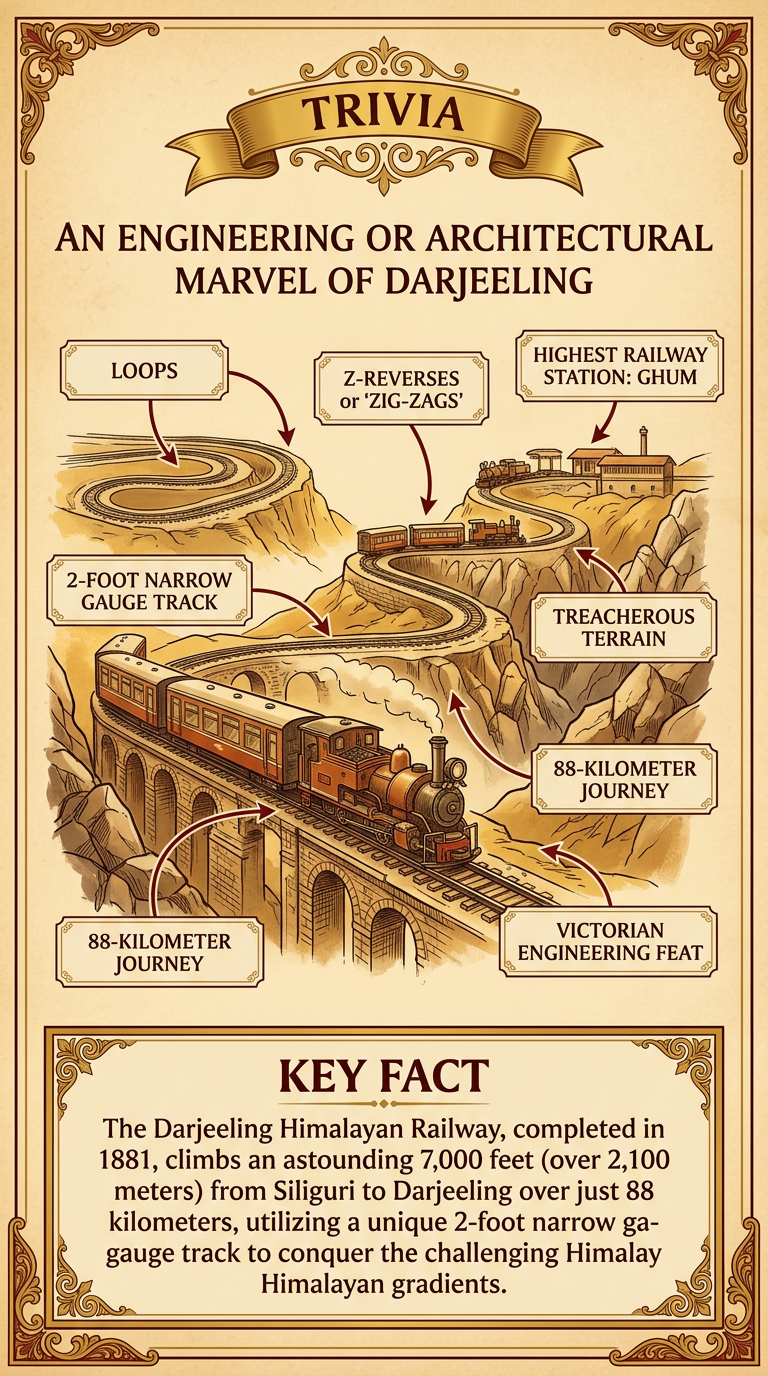
An Engineering or Architectural Marvel of Darjeeling
The Darjeeling Himalayan Railway isn't just a charming train; it's a testament to incredible 19th-century engineering, defying steep gradients and challenging terrain to connect plains to peaks.
- The "Toy Train" operates on a narrow gauge of just 2 feet (610 mm), designed to navigate the sharp curves and steep inclines of the Himalayas.
- Ingenious engineering solutions include four famous 'loops' (like the renowned Batasia Loop) and four 'zig-zags' to gain altitude where gradients were too steep for a continuous track.
- It was declared a UNESCO World Heritage Site in 1999, making it only the second railway in the world to receive such an honor at the time.
- Construction began in 1879 and was completed by 1881, connecting Siliguri to Darjeeling, overcoming a climb of over 7,000 feet.
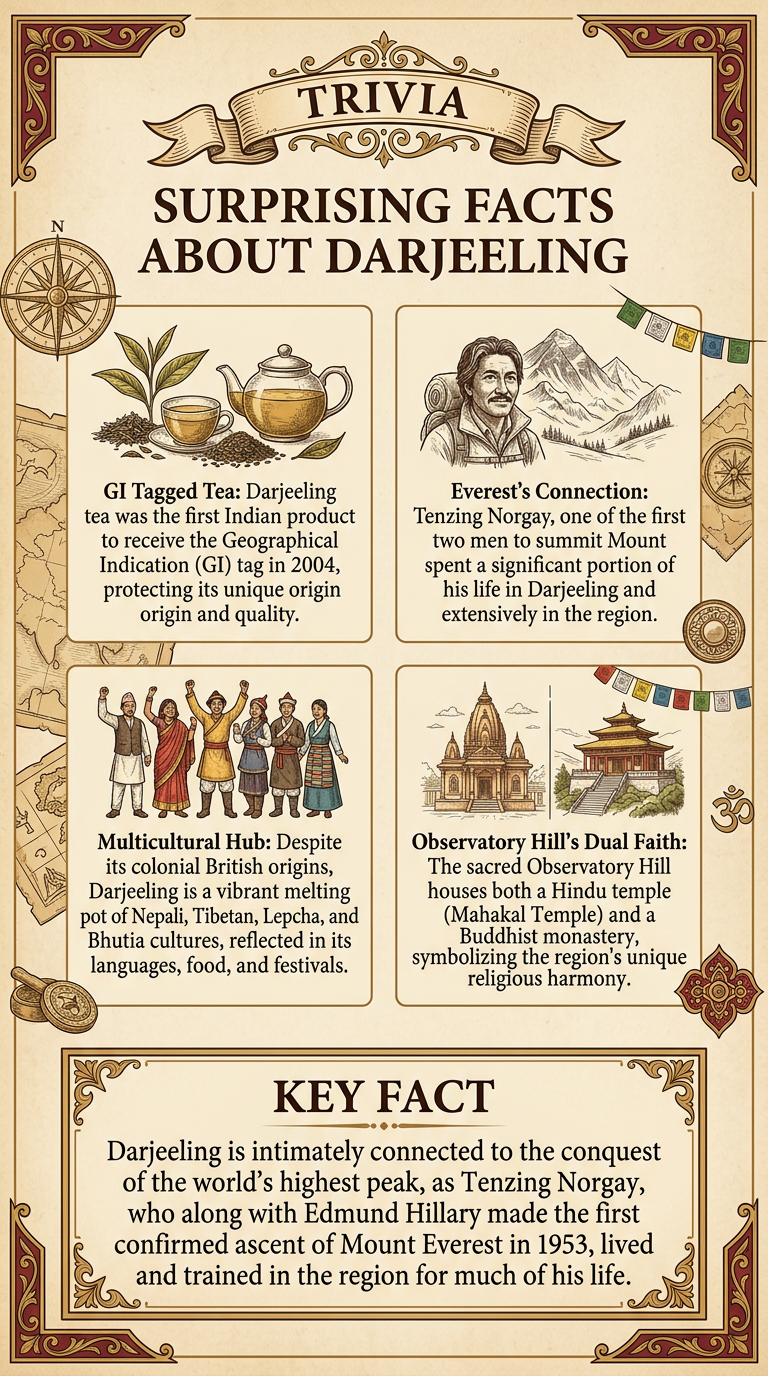
Surprising Facts About Darjeeling
Beyond its iconic tea gardens, Darjeeling holds a fascinating mosaic of surprising facts, from its unexpected cultural influences to its unique place in global history.
- **GI Tagged Tea:** Darjeeling tea was the first Indian product to receive the Geographical Indication (GI) tag in 2004, protecting its unique origin and quality.
- **Everest's Connection:** Tenzing Norgay, one of the first two men to summit Mount Everest, spent a significant portion of his life in Darjeeling and trained extensively in the region.
- **Multicultural Hub:** Despite its colonial British origins, Darjeeling is a vibrant melting pot of Nepali, Tibetan, Lepcha, and Bhutia cultures, reflected in its languages, food, and festivals.
- **Observatory Hill's Dual Faith:** The sacred Observatory Hill houses both a Hindu temple (Mahakal Temple) and a Buddhist monastery, symbolizing the region's unique religious harmony.
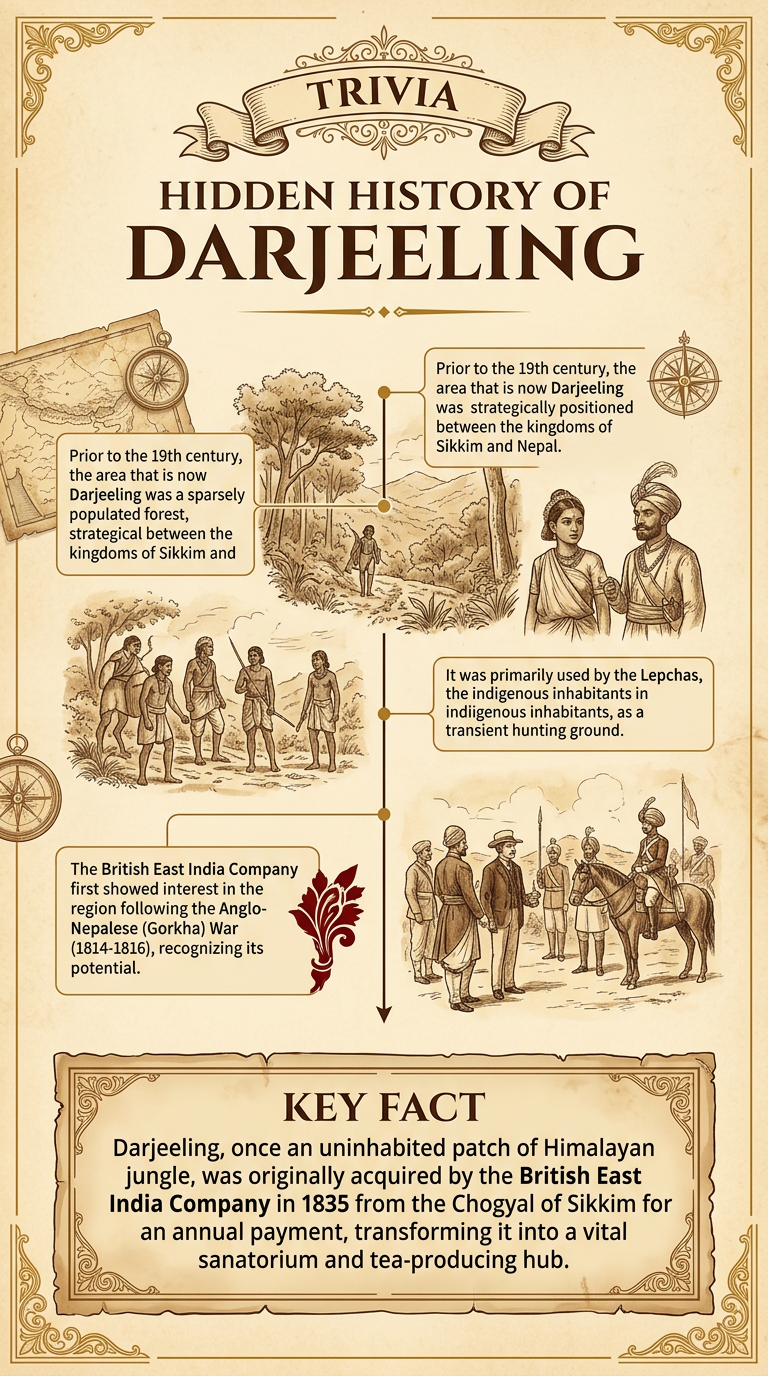
Hidden History of Darjeeling
Scratch beneath the surface of this picturesque hill station, and you'll discover a history far more intricate and dynamic than its tranquil present suggests.
- Darjeeling was originally leased from the Chogyal of Sikkim by the British East India Company in 1835 for use as a sanatorium for soldiers.
- Before British acquisition, the area was largely uninhabited jungle, forming a disputed borderland between Sikkim and Nepal.
- Post-1959 Tibetan uprising, Darjeeling became a significant refuge for Tibetan exiles, profoundly enriching its cultural fabric.
- It served as a key strategic point during the Anglo-Nepalese (Gorkha) War of 1814-1816, leading to its eventual cession to the British.
More Darjeeling Secrets
Darjeeling's Unique Flora & Fauna
Darjeeling is a biodiversity hotspot, nestled within the Eastern Himalayas, home to an astonishing array of plant and animal life. Its humid, temperate climate fosters dense forests where you can find over 4,000 species of flowering plants, including 600 varieties of orchids alone, making it a botanist's paradise.
Keep an eye out for the elusive Red Panda, a charismatic mammal native to this region, along with various species of civets, wild boars, and a vibrant bird population, including numerous migratory species.
The Mystique of Mahakal Temple
Perched atop Observatory Hill, the Mahakal Temple is a unique spiritual site where Hindu and Buddhist deities are worshipped side-by-side. Dedicated to Lord Shiva, the temple stands on the site of the original Bhutia Busty Monastery, established in 1765. After its destruction, a new monastery was built nearby, but the original site evolved into this sacred space where bells and prayer flags coexist, illustrating Darjeeling's profound religious harmony and ancient roots.
A Glimpse into Tibetan Refugee Self Help Centre
Established in 1959, following the Tibetan diaspora, the Tibetan Refugee Self Help Centre in Darjeeling has been instrumental in rehabilitating Tibetan refugees and preserving their rich cultural heritage. Visitors can observe skilled artisans weaving carpets, crafting leather goods, and carving wooden artifacts using traditional Tibetan methods, providing a sustainable livelihood and keeping their ancestral crafts alive.
More Darjeeling Content Coming Soon
We're crafting a complete guide for Darjeeling. Stay tuned!
Explore More Trivia