
Florence, the cradle of the Renaissance, is often admired for its unparalleled art and architecture. But beneath its iconic beauty lies a treasure trove of engineering marvels, surprising everyday traditions, and captivating hidden histories that continue to astound visitors.
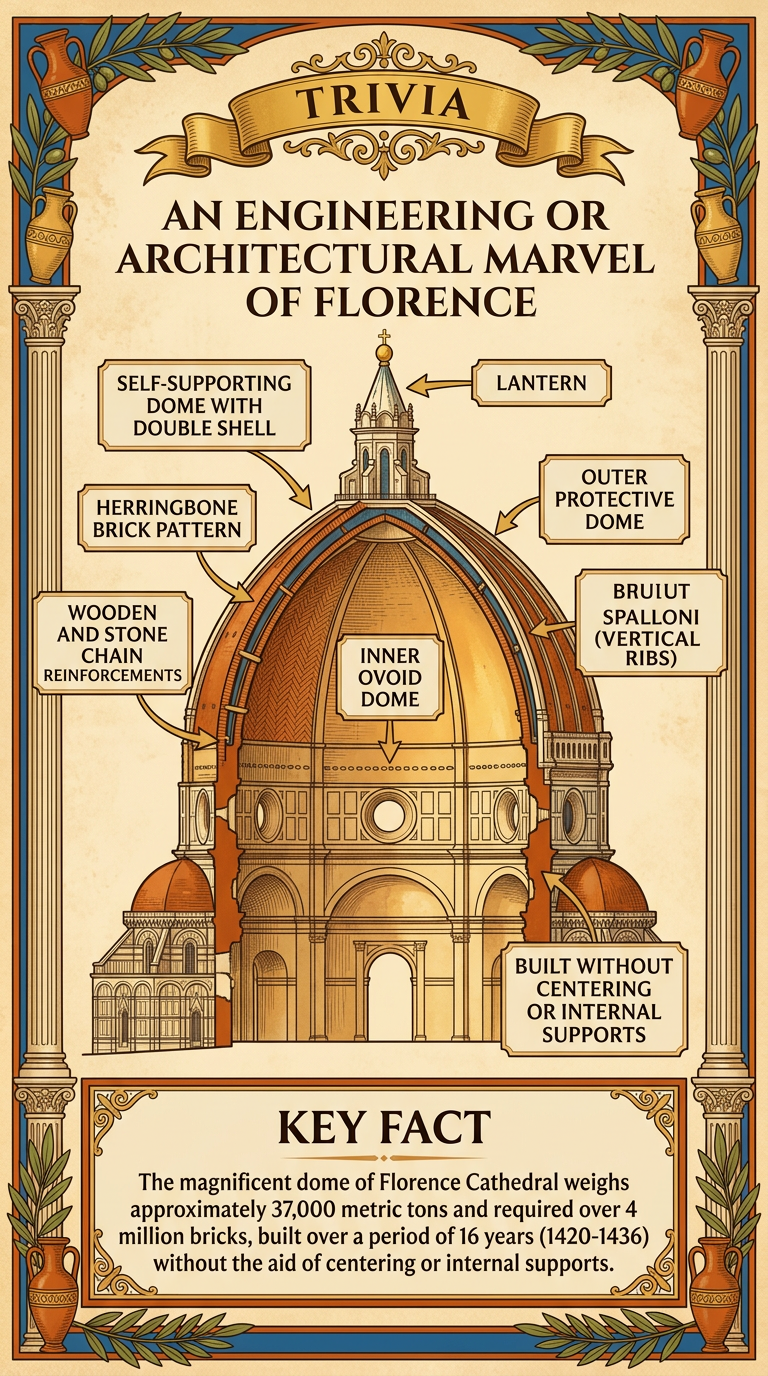
An Engineering or Architectural Marvel of Florence
The Florence Cathedral, Santa Maria del Fiore, dominates the city skyline, but it's not just its aesthetic beauty that's remarkable. Its dome represents a staggering feat of 15th-century engineering that defied all contemporary architectural wisdom.
- Filippo Brunelleschi's dome, completed in 1436, was built without any external scaffolding, a puzzle that baffled architects for centuries.
- It employs an innovative double-shell design: an inner dome of sandstone and brick, and a lighter outer dome, allowing for both structural integrity and a grand appearance.
- Brunelleschi utilized a herringbone brick pattern, known as 'spina di pesce,' to provide interlocking stability as the dome rose, preventing the bricks from sliding inwards.
- He invented groundbreaking hoisting machines and oxen-powered cranes to lift heavy materials hundreds of feet into the air, some of which were capable of reversing direction without turning the oxen.
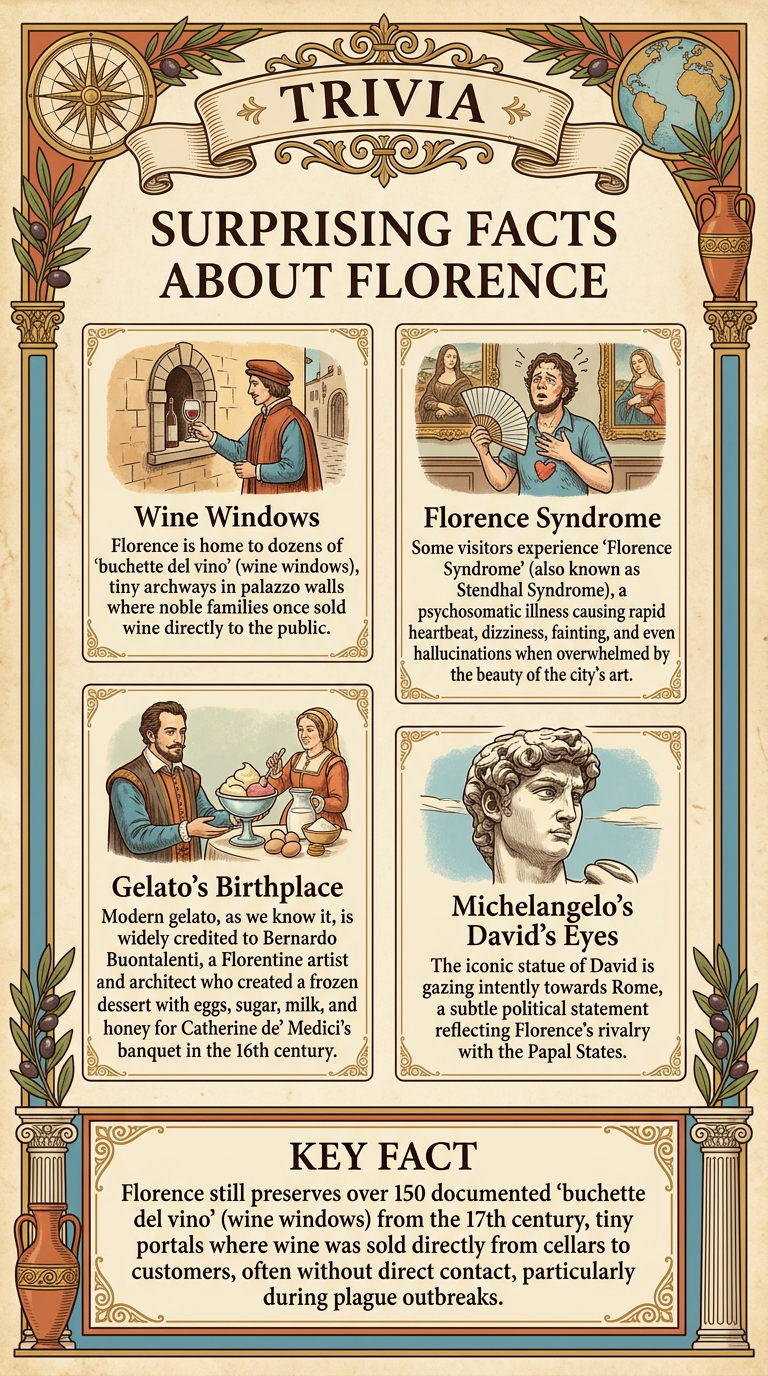
Surprising Facts About Florence
Beyond its world-renowned art, Florence holds many secrets and peculiar customs. From ancient wine vending machines to psychological phenomena, this city never ceases to surprise.
- **Wine Windows**: Florence is home to dozens of 'buchette del vino' (wine windows), tiny archways in palazzo walls where noble families once sold wine directly to the public.
- **Florence Syndrome**: Some visitors experience 'Florence Syndrome' (also known as Stendhal Syndrome), a psychosomatic illness causing rapid heartbeat, dizziness, fainting, and even hallucinations when overwhelmed by the beauty of the city's art.
- **Gelato's Birthplace**: Modern gelato, as we know it, is widely credited to Bernardo Buontalenti, a Florentine artist and architect who created a frozen dessert with eggs, sugar, milk, and honey for Catherine de' Medici's banquet in the 16th century.
- **Michelangelo's David's Eyes**: The iconic statue of David is gazing intently towards Rome, a subtle political statement reflecting Florence's rivalry with the Papal States.
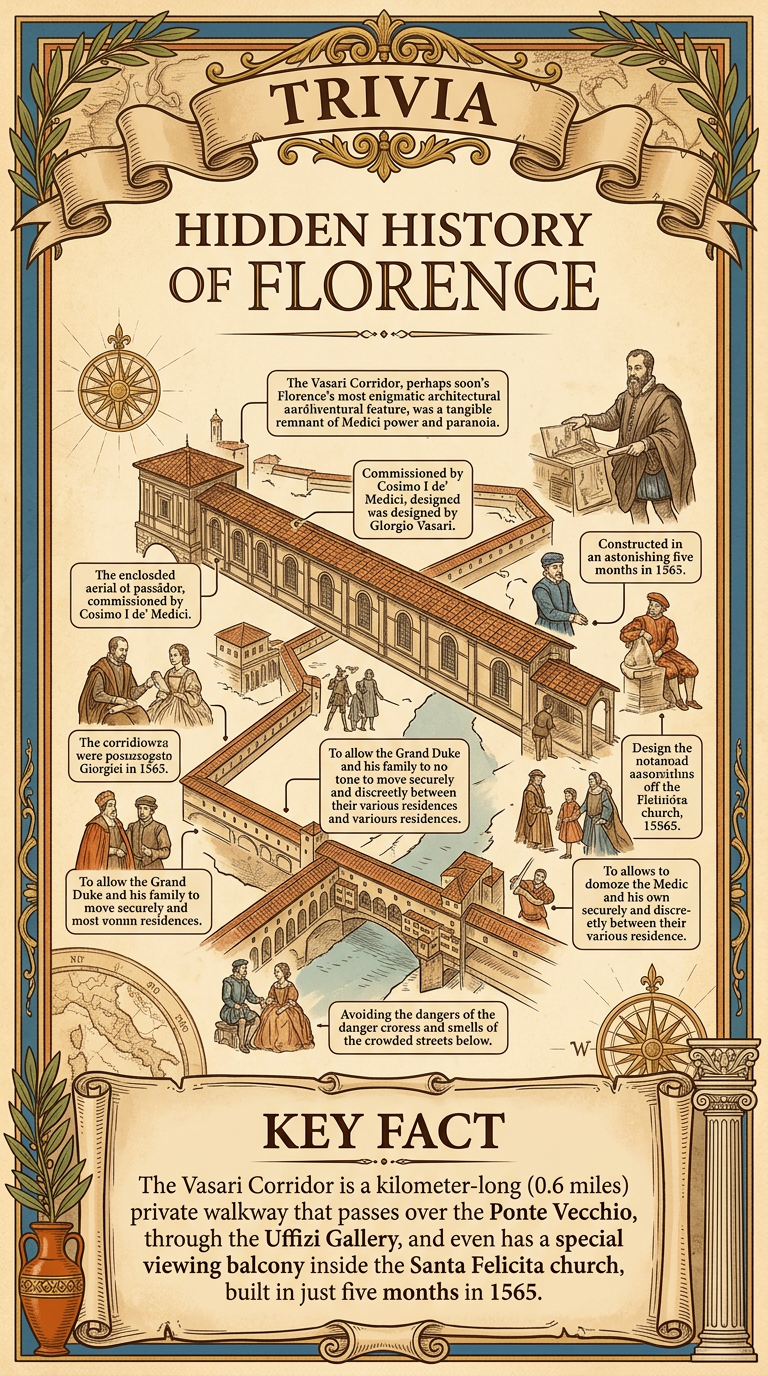
Hidden History of Florence
Florence's glorious past is rich with tales of power, intrigue, and artistic genius, but many fascinating stories remain hidden in plain sight, waiting to be discovered.
- The Vasari Corridor, a secret elevated passageway, was built in 1565 to allow the Grand Duke Cosimo I de' Medici to move safely and privately between Palazzo Vecchio and Palazzo Pitti.
- Michelangelo's alleged graffiti: On the wall of Palazzo Vecchio, near the entrance, a faint profile carved into the stone is said to be a quick portrait by Michelangelo, done on a dare.
- Dante Alighieri, Florence's most famous poet, was exiled from the city in 1302 and never returned alive; his tomb is in Ravenna, not his beloved Florence.
- The 'Devil's Column' in Piazza del Duomo has an intricate carving of two ram's heads that, according to legend, appeared after a heated argument between two masons and the Devil himself.
More Florence Secrets
The Oltrarno: Florence's Artisan Heart
Across the Arno River, the Oltrarno district is where Florence's traditional artisan crafts still thrive. Here, you'll find workshops dedicated to leather goods, jewelry, paper making, shoemaking, and restoration.
Wander through its narrow streets, and you can witness centuries-old techniques being practiced by skilled craftsmen, offering a glimpse into the living heritage that coexists with the city's grand museums.
Bistecca alla Fiorentina: A Culinary Legend
No trip to Florence is complete without experiencing Bistecca alla Fiorentina. This iconic dish is a thick-cut, aged Chianina beef steak, cooked rare over hot coals, seasoned simply with salt and pepper.
Traditionally, it's served very rare, ensuring a tender, flavorful experience that has been a Florentine staple for centuries. Don't ask for it well-done!
The Ponte Vecchio: Bridge of Artisans
The Ponte Vecchio, or 'Old Bridge,' is Florence's oldest bridge, dating back to 1345. It uniquely features shops built directly along its length, originally housing butchers and tanners who discarded their waste into the Arno.
In 1593, Ferdinand I de' Medici replaced the butchers with goldsmiths and jewelers, fearing their smell would offend him in the Vasari Corridor above. This change transformed the bridge into the glittering commercial hub it remains today, and it was the only bridge in Florence spared by the retreating Germans in World War II.
More Florence Content Coming Soon
We're crafting a complete guide for Florence. Stay tuned!
Explore More Trivia