
Kanyakumari, India's southernmost tip, holds a surprising array of wonders beyond its famous sunrise. This extraordinary coastal town is where three mighty oceans converge, ancient history whispers through modern marvels, and spiritual energy intertwines with breathtaking natural beauty, promising an unforgettable journey for the curious traveler.
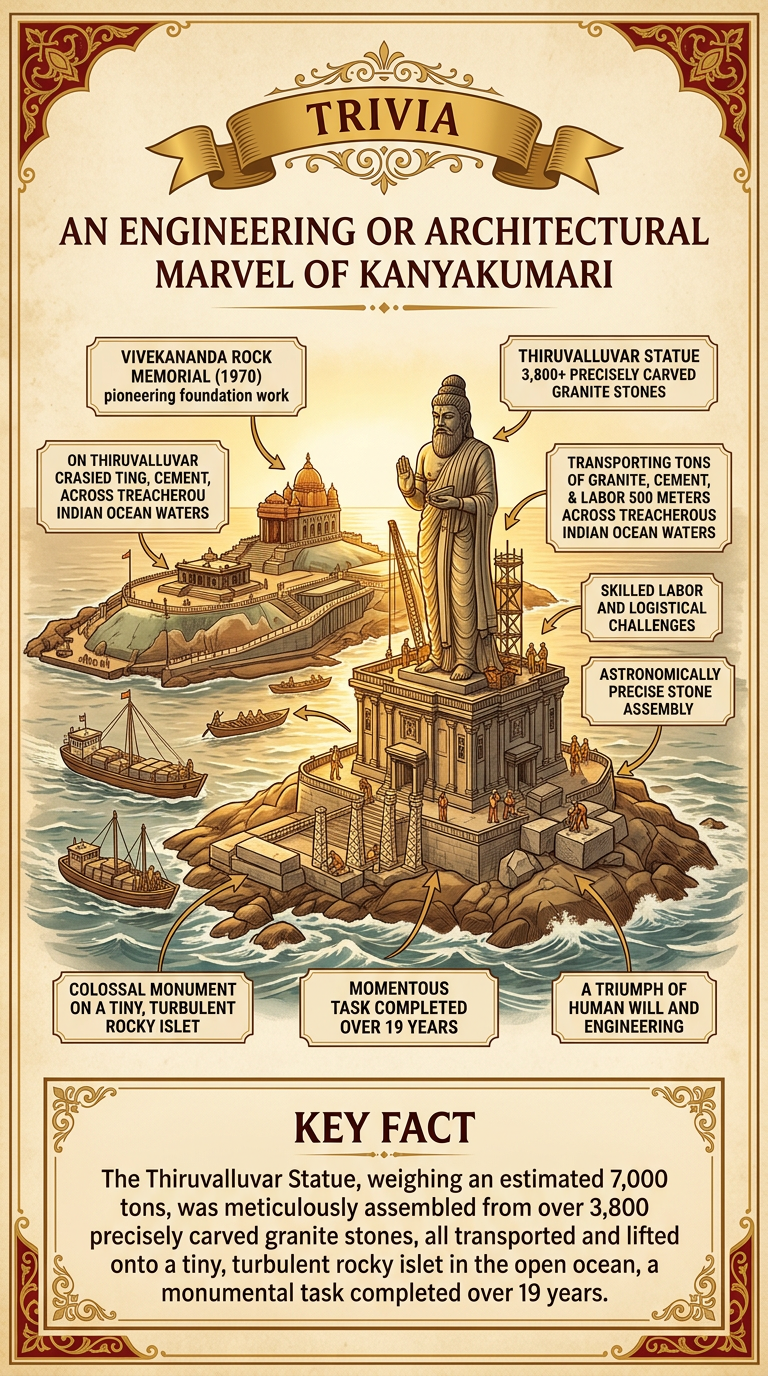
An Engineering or Architectural Marvel of Kanyakumari
Perched majestically amidst the confluence of three oceans, Kanyakumari's offshore monuments are not just spiritual beacons but testaments to incredible engineering feats.
- **Offshore Location:** Both the Vivekananda Rock Memorial and the Thiruvalluvar Statue are located approximately 500 meters (about 1640 feet) offshore in the Indian Ocean, requiring complex marine construction.
- **Massive Scale:** The Thiruvalluvar Statue stands at an impressive 133 feet (40.5 meters) atop a 38-foot pedestal, symbolizing the 133 chapters of the Tirukkural, making its total height 171 feet.
- **Material Transport Challenge:** All construction materials, including granite blocks weighing several tons, had to be ferried by barges and boats through challenging, often unpredictable, sea conditions.
- **Decade-Long Endeavor:** The Thiruvalluvar Statue project, initiated in 1979, involved over 500 sculptors and laborers and took nearly two decades to complete, finally being inaugurated in 2000.
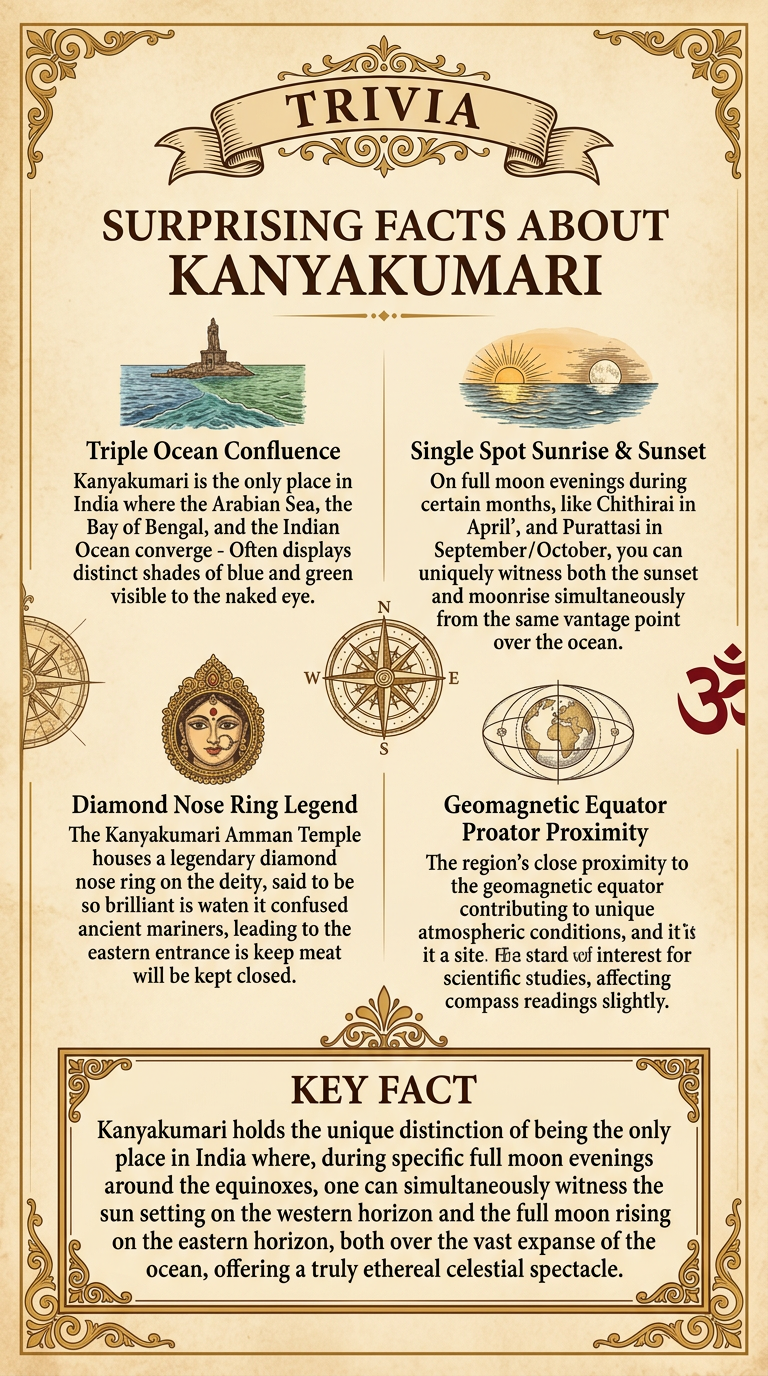
Surprising Facts About Kanyakumari
Beyond its iconic status as India's southern tip, Kanyakumari is a treasure trove of unique phenomena and fascinating cultural quirks that often surprise visitors.
- **Triple Ocean Confluence:** Kanyakumari is the only place in India where the Arabian Sea, the Bay of Bengal, and the Indian Ocean converge, often displaying distinct shades of blue and green, visible to the naked eye.
- **Single Spot Sunrise & Sunset:** On full moon evenings during certain months (like Chithirai in April and Purattasi in September/October), one can uniquely witness both the sunset and moonrise simultaneously from the same vantage point over the ocean.
- **Diamond Nose Ring Legend:** The Kanyakumari Amman Temple houses a legendary diamond nose ring on the deity, said to be so brilliant it confused ancient mariners, leading to the eastern entrance being kept closed.
- **Geomagnetic Equator Proximity:** The region's close proximity to the geomagnetic equator contributes to unique atmospheric conditions and makes it a site of interest for scientific studies, affecting compass readings slightly.
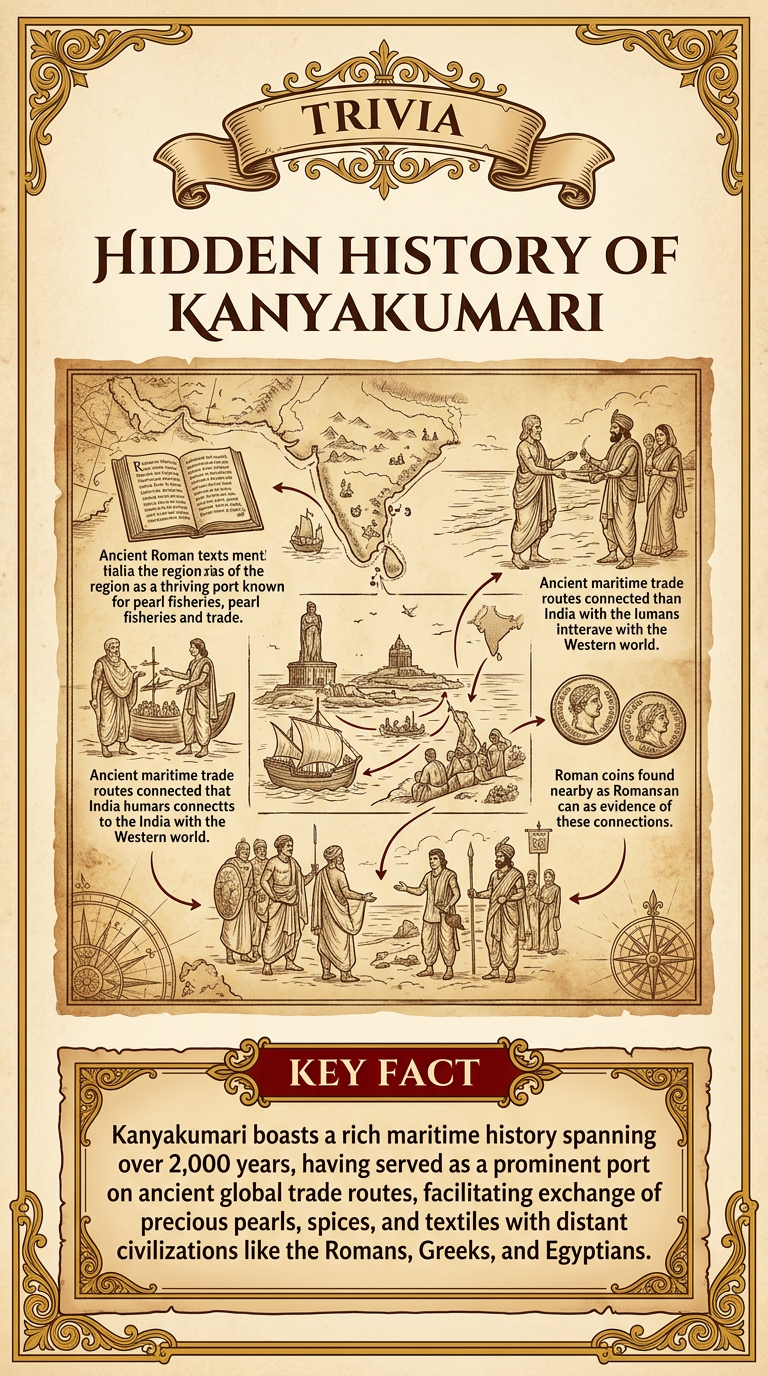
Hidden History of Kanyakumari
Delve beneath Kanyakumari's modern veneer and discover a rich tapestry of ancient trade routes, forgotten empires, and pivotal moments that shaped India's southernmost frontier.
- **Ancient Roman Trade:** Kanyakumari, then known as 'Comari' or 'Cape Comorin,' was a significant port in ancient times, featuring in historical texts like the 'Periplus of the Erythraean Sea' (1st century CE) as a trading hub for pearls and spices with Roman and Greek merchants.
- **Succession of Empires:** The region witnessed the rise and fall of various powerful South Indian dynasties, including the Pandyas, Cheras, Cholas, and later the Vijayanagara Empire, each leaving an indelible mark on its culture and architecture.
- **Part of Travancore Kingdom:** For several centuries, Kanyakumari (then part of the larger Kalkulam principality) was an integral part of the prosperous Travancore Kingdom until its reorganization in 1956.
- **Strategic Naval Base:** Its strategic location made it a coveted point for naval activities and defense; ruins of old fortifications and lighthouses signify its importance as a maritime watchpoint across millennia.
More Kanyakumari Secrets
Triveni Sangam's Unique Color Play
At Kanyakumari's Triveni Sangam, a fascinating natural phenomenon unfolds. The waters where the Arabian Sea, Bay of Bengal, and Indian Ocean meet often display distinct hues. The Arabian Sea tends to be a deeper blue, the Bay of Bengal a lighter, sometimes greenish-blue, and the Indian Ocean a mix. This visual spectacle is attributed to varying depths, sediment loads, and plankton densities in each body of water, creating a vibrant, ever-changing seascape.
Though modern geography recognizes only one continuous Indian Ocean, the traditional understanding and visual experience of three distinct bodies of water meeting here holds powerful cultural and spiritual significance for pilgrims.
The Mysterious Temple of Kanyakumari Amman
The Bhagavathy Amman Temple, dedicated to the virgin goddess Kanya Kumari, is steeped in legend. One of its most intriguing features is the deity's diamond nose ring. This ornament is said to sparkle with such intensity that its brilliant reflection could be seen by ancient sailors far out at sea, potentially causing navigational errors. To prevent such incidents, a local legend claims that the eastern entrance of the temple, facing the sea, is kept permanently closed, allowing only the western gate to be used by devotees. This adds an air of mystique to an already sacred site.
Gandhi Memorial Mandapam's Solar Alignment
The Gandhi Memorial Mandapam in Kanyakumari, built on the spot where Mahatma Gandhi's ashes were kept for public veneration before immersion, features a remarkable architectural design. The central structure is designed in such a way that on October 2nd, Mahatma Gandhi's birthday, the sun's rays directly fall on the precise spot where his urn was placed. This incredible solar alignment is a poignant tribute and a testament to clever architectural planning, creating a powerful, ephemeral moment of remembrance each year for visitors.
More Kanyakumari Content Coming Soon
We're crafting a complete guide for Kanyakumari. Stay tuned!
Explore More Trivia