
Step into a world where turquoise lagoons meet pristine white sands, and ancient traditions whisper through swaying palm trees. Lakshadweep, India's smallest Union Territory, is a mesmerizing archipelago that defies expectations, offering a unique blend of natural beauty and captivating hidden stories.
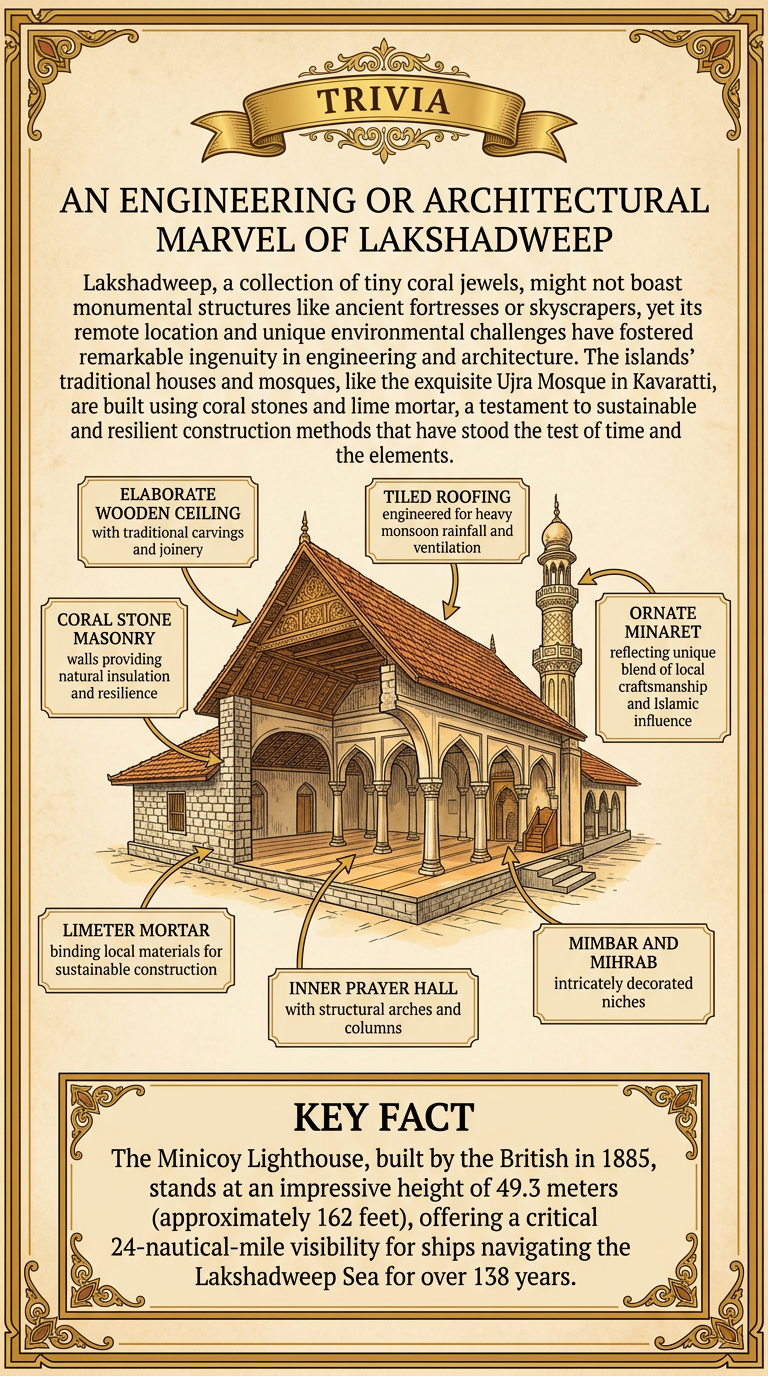
An Engineering or Architectural Marvel of Lakshadweep
Despite its remote location, Lakshadweep showcases remarkable adaptations in its structures, blending traditional wisdom with practical necessity to thrive amidst the ocean.
- Traditional 'Odams' (fishing boats) built with local timber and expertise, crucial for livelihood and unique to the islands.
- Ingenious use of coral stones and lime mortar for building resilient houses and mosques, like the intricate Ujra Mosque in Kavaratti.
- The historic Minicoy Lighthouse, one of the oldest in India, stands as a testament to colonial-era maritime navigation and endurance.
- Jetties and breakwaters constructed across various islands, essential modern engineering for safe harbor and vital connectivity.
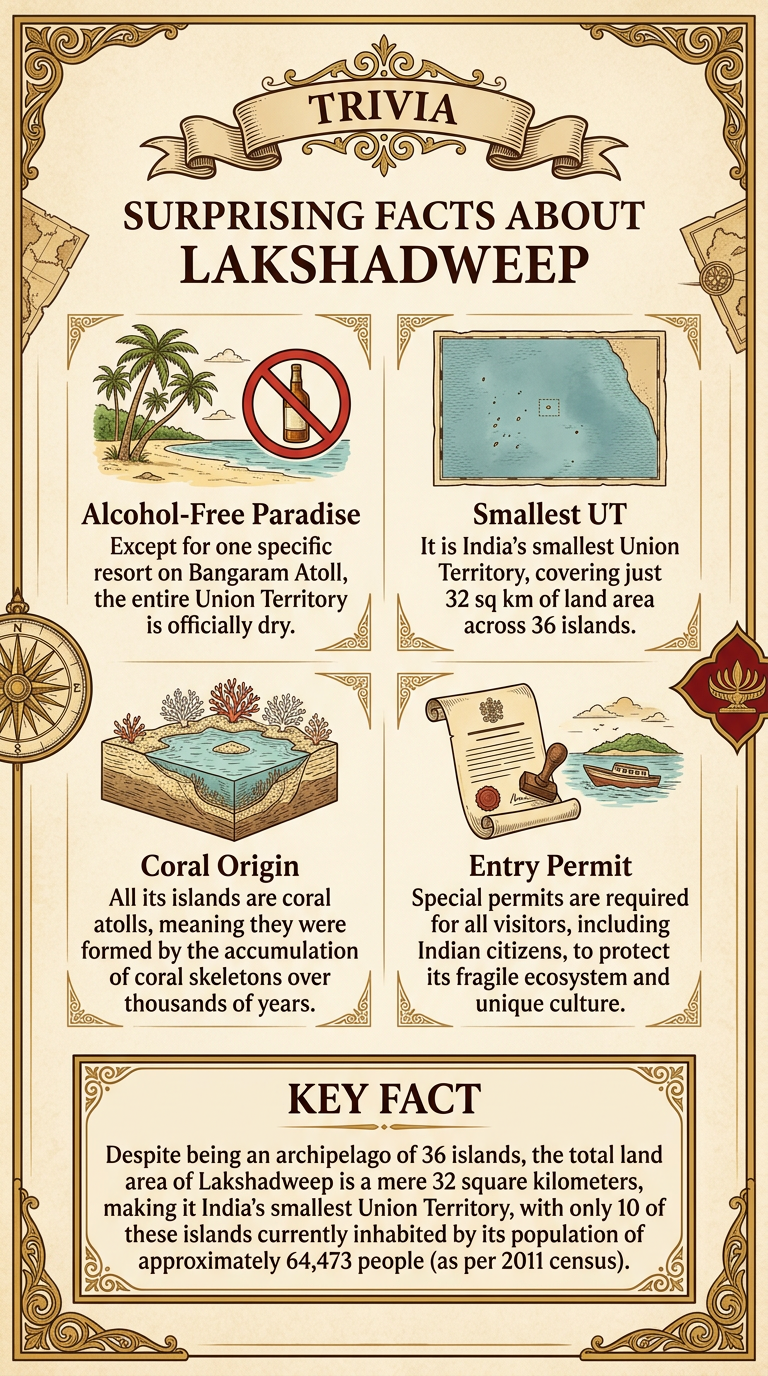
Surprising Facts About Lakshadweep
Beyond its postcard-perfect beaches, Lakshadweep holds a treasure trove of unexpected realities and curious facts that challenge common perceptions.
- **Alcohol-Free Paradise:** Except for one specific resort on Bangaram Atoll, the entire Union Territory is officially dry.
- **Smallest UT:** It is India's smallest Union Territory, covering just 32 sq km of land area across 36 islands.
- **Coral Origin:** All its islands are coral atolls, meaning they were formed by the accumulation of coral skeletons over thousands of years.
- **Entry Permit:** Special permits are required for all visitors, including Indian citizens, to protect its fragile ecosystem and unique culture.
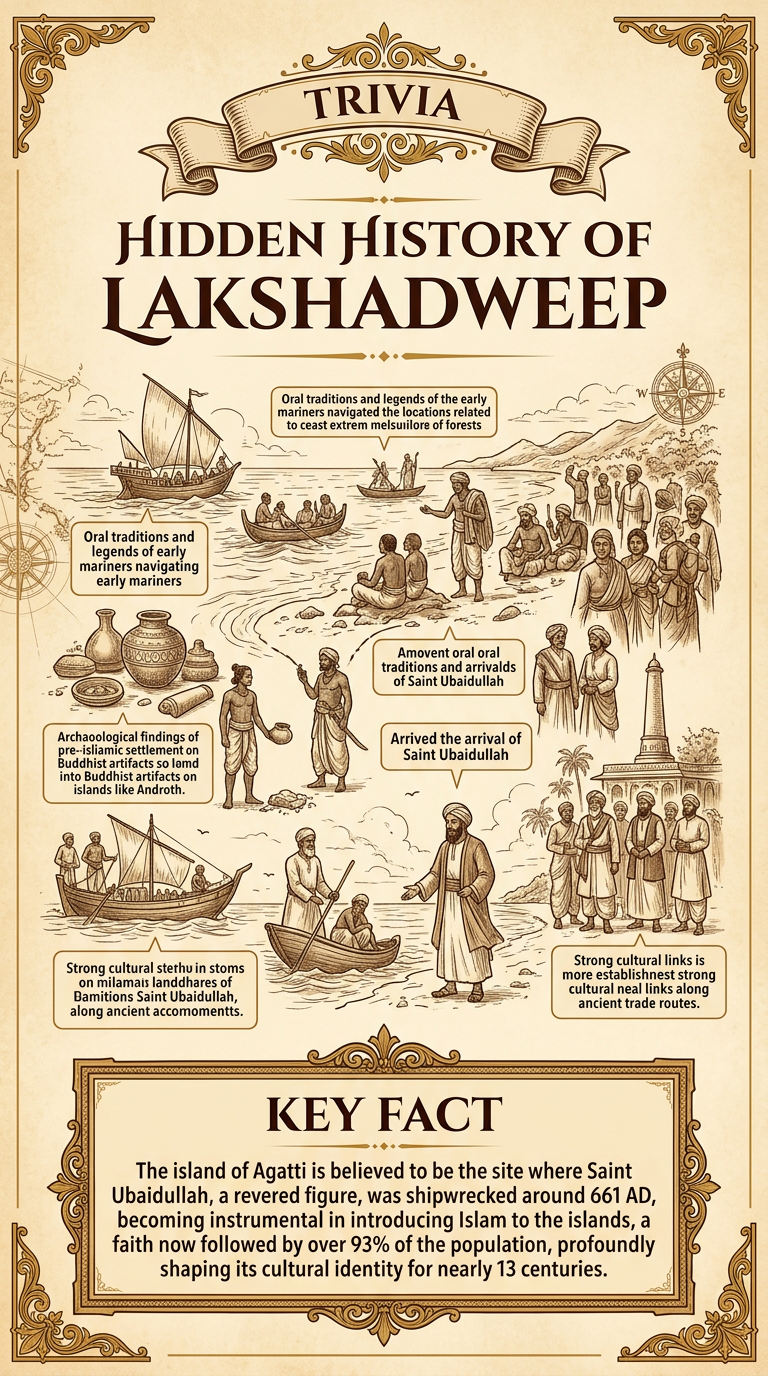
Hidden History of Lakshadweep
Delve beneath the turquoise waters and discover Lakshadweep's captivating past, a tapestry woven with ancient legends, maritime trade, and diverse cultural influences.
- Legend attributes the arrival of Islam to Saint Ubaidullah, who was shipwrecked here in 661 AD, profoundly shaping the islands' religious landscape.
- Portuguese briefly established a presence in the 16th century, primarily drawn by the lucrative coir trade, leading to conflicts with islanders.
- The islands were historically ruled by the Kolathiri Rajas of Kannur and later by the Arakkal House of Cannanore, a Muslim dynasty.
- Ancient Buddhist artifacts discovered on islands like Androth suggest earlier, pre-Islamic inhabitants or strong cultural connections with mainland trade routes.
More Lakshadweep Secrets
Skipjack Tuna: The Island Lifeline
Lakshadweep's economy is deeply intertwined with its rich marine resources, primarily skipjack tuna. Traditional pole and line fishing methods, passed down through generations, are still widely practiced, ensuring sustainable harvests. The islanders process a significant portion of their catch into 'masmeen' – dried tuna – a staple food and export item.
The annual tuna catch contributes substantially to the Union Territory's GDP, highlighting the islanders' profound connection to the sea and their mastery of traditional fishing techniques that have sustained them for centuries.
A Linguistic Mosaic: Jeseri and Mahl
While Malayalam is the official language across most of Lakshadweep, two distinct and fascinating languages are spoken on certain islands. On the northern islands like Kavaratti, Agatti, and Androth, a dialect of Malayalam known as 'Jeseri' (literally 'island language') is prevalent, rich with local idioms. However, the southern island of Minicoy stands out with its own unique language, 'Mahl', which is closely related to Dhivehi, the national language of Maldives, reflecting its distinct cultural heritage and historical ties.
The Vibrant Coral Reef Ecosystem
Lakshadweep is a breathtaking example of a pristine coral atoll ecosystem, boasting some of the most vibrant and healthy coral reefs in the world. These underwater gardens are home to an incredible diversity of marine life, including over 100 species of corals, countless fish species, sea turtles, and even reef sharks. The delicate balance of this ecosystem is crucial, not only for biodiversity but also as a natural barrier protecting the islands from erosion and storm surges, making conservation efforts paramount to preserve this irreplaceable natural heritage.
More Lakshadweep Content Coming Soon
We're crafting a complete guide for Lakshadweep. Stay tuned!
Explore More Trivia