
Leh-Ladakh, often called 'The Land of High Passes,' is a realm where stark, dramatic landscapes meet profound spiritual tranquility. This high-altitude desert surprises visitors not just with its breathtaking beauty, but with ancient secrets, incredible human ingenuity, and a vibrant culture deeply rooted in its challenging environment.
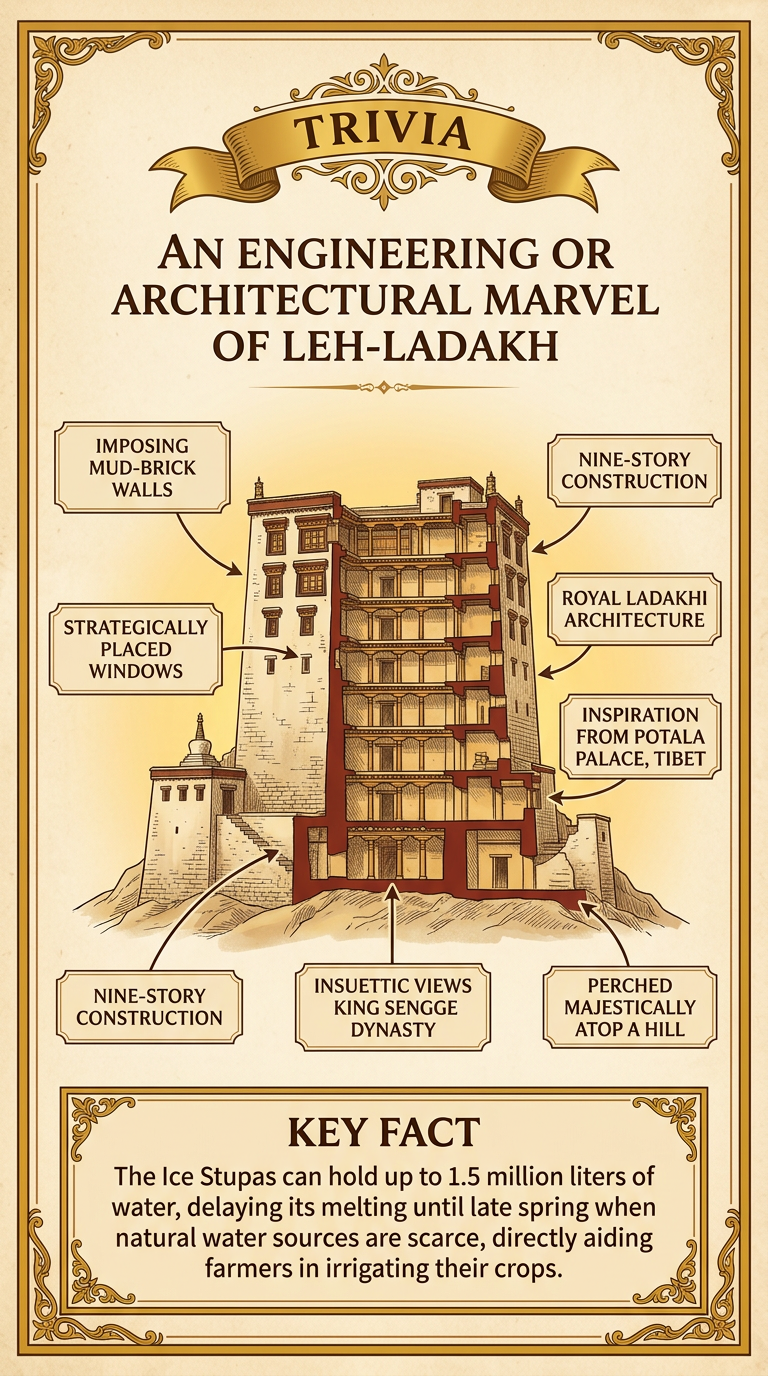
An Engineering or Architectural Marvel of Leh-Ladakh
Beyond its majestic natural beauty, Leh-Ladakh is a testament to the remarkable ingenuity of its people, who have engineered solutions and built structures to thrive in one of the world's most challenging environments.
- The revolutionary Ice Stupas, artificial glaciers conceived by Sonam Wangchuk, store winter water in conical ice mounds for spring irrigation.
- Leh Palace, a 9-story royal residence from the 17th century, mirrors Lhasa's Potala Palace in its imposing architecture and commanding hilltop position.
- Ancient monasteries like Hemis and Thiksey are masterworks of adaptive architecture, often built into cliff faces or on dramatic hilltops, using local materials.
- Traditional Ladakhi homes are often built with mud bricks and poplar wood, featuring thick walls and small windows for insulation against extreme temperatures.
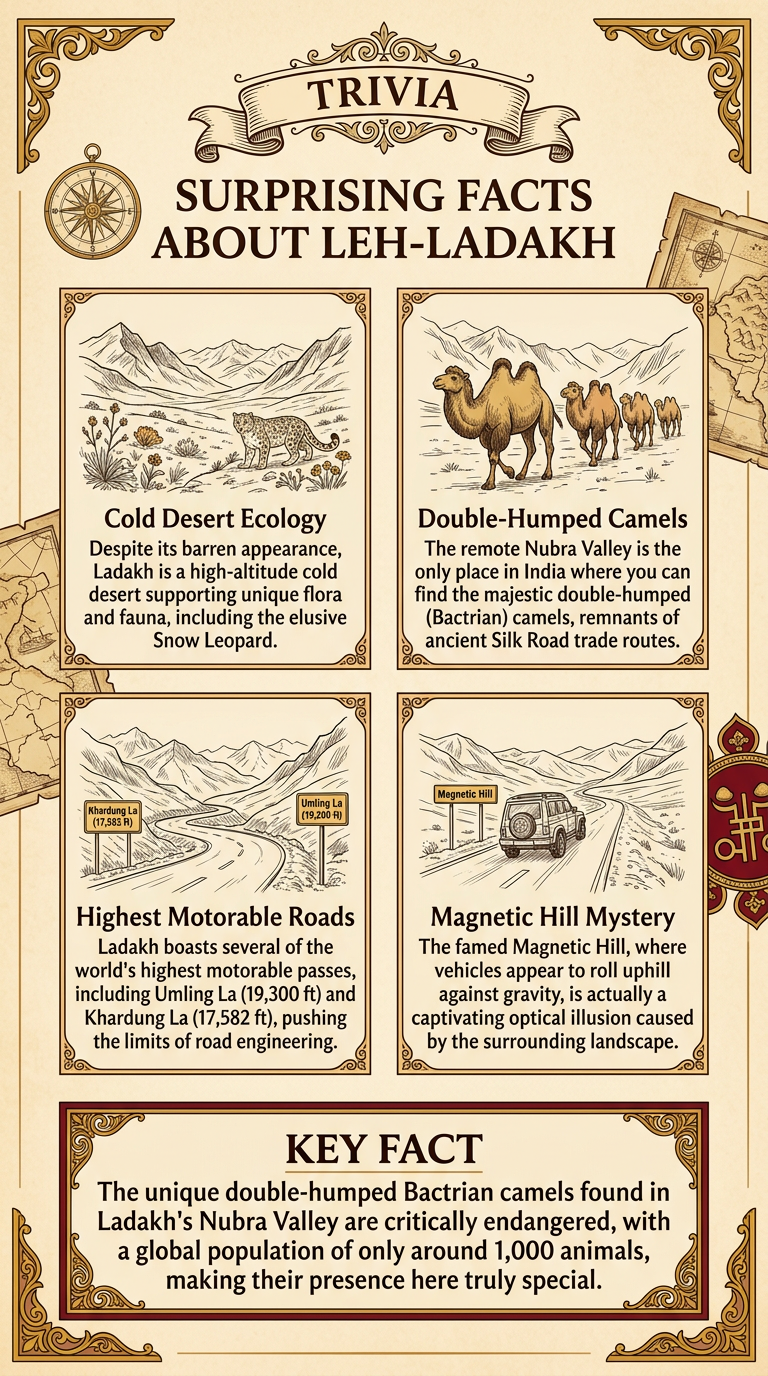
Surprising Facts About Leh-Ladakh
Leh-Ladakh is a land of fascinating contradictions and unexpected wonders. Prepare to have your perceptions challenged by these truly surprising aspects of the Himalayan high desert.
- **Cold Desert Ecology**: Despite its barren appearance, Ladakh is a high-altitude cold desert supporting unique flora and fauna, including the elusive Snow Leopard.
- **Double-Humped Camels**: The remote Nubra Valley is the only place in India where you can find the majestic double-humped (Bactrian) camels, remnants of ancient Silk Road trade routes.
- **Highest Motorable Roads**: Ladakh boasts several of the world's highest motorable passes, including Umling La (19,300 ft) and Khardung La (17,582 ft), pushing the limits of road engineering.
- **Magnetic Hill Mystery**: The famed Magnetic Hill, where vehicles appear to roll uphill against gravity, is actually a captivating optical illusion caused by the surrounding landscape.
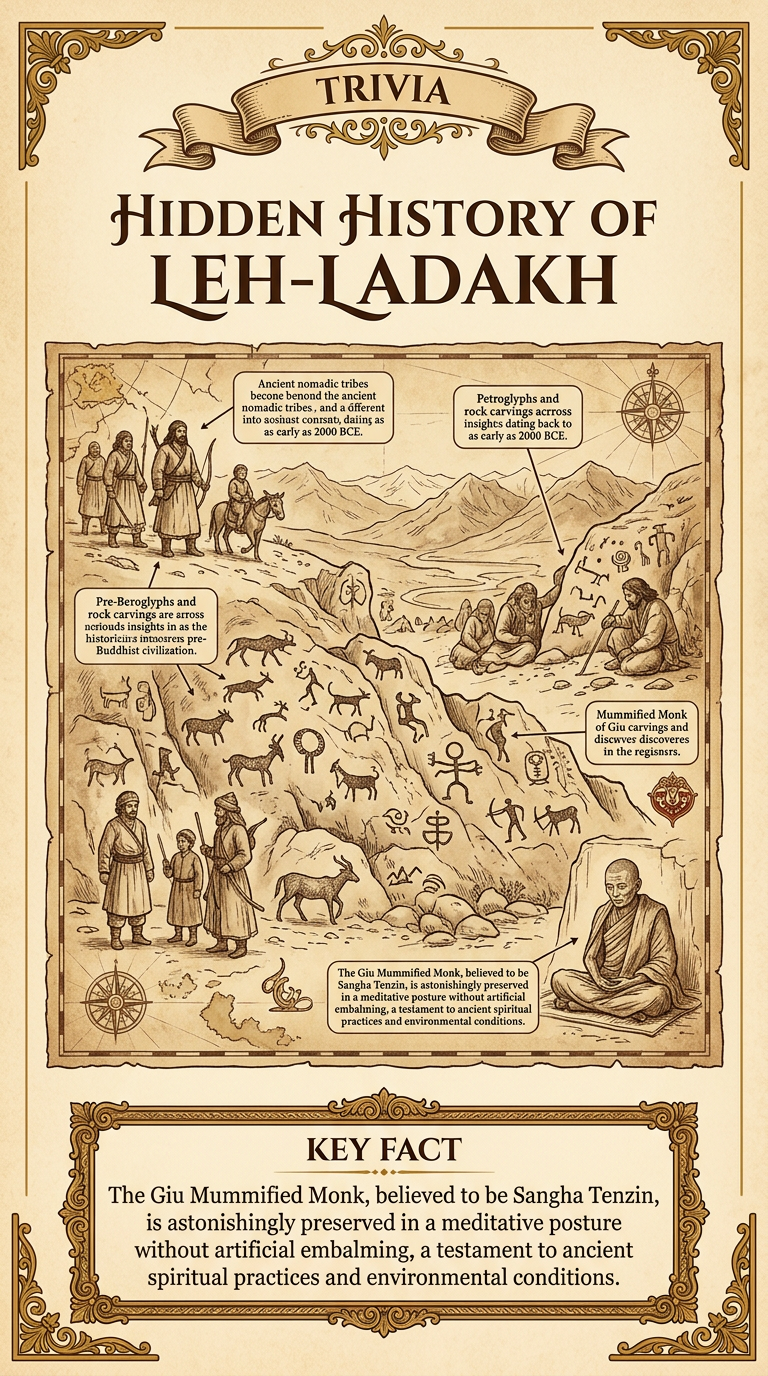
Hidden History of Leh-Ladakh
Beyond the well-trodden paths, Leh-Ladakh harbors a rich tapestry of hidden histories, ancient mysteries, and cultural secrets that tell a deeper story of this secluded Himalayan kingdom.
- Pre-Buddhist Petroglyphs: Scattered across Ladakh are ancient rock carvings, dating back thousands of years, offering glimpses into pre-Buddhist animistic cultures.
- The Mummified Monk of Giu: In the remote Giu village, a naturally preserved, 500-year-old mummified monk sits eerily upright in a glass chamber, a profound historical enigma.
- Silk Route Crossroads: For centuries, Ladakh was a crucial crossroads on the Old Silk Route, connecting Central Asia, Tibet, and India, fostering a unique blend of cultures and traditions.
- The Namgyal Dynasty's Rise and Fall: The Kingdom of Ladakh, established in the 10th century, saw periods of great power under the Namgyal dynasty, resisting Tibetan and Mughal invasions for centuries.
More Leh-Ladakh Secrets
Himalayan Sky-Gazing
With its exceptionally clear skies, high altitude, and minimal light pollution, Ladakh offers some of the best stargazing opportunities on Earth. The absence of city lights creates a pristine canvas for observing nebulae, galaxies, and meteor showers.
Several observatories, including the Indian Astronomical Observatory in Hanle (one of the world's highest optical telescopes), and emerging astro-tourism camps allow visitors to marvel at the Milky Way in unparalleled clarity.
Ladakhi Cuisine: A Taste of the Himalayas
Ladakhi cuisine is a delightful blend of Tibetan, Indian, and Central Asian influences, perfectly adapted to the cold, high-altitude environment. Staples include hearty Thukpa (noodle soup), steamed Momos (dumplings), and Tingmo (steamed bread).
Tsampa, roasted barley flour, is a versatile and energy-rich food, often eaten with butter tea (Gur Gur Chai) – a salted, yak butter-infused beverage crucial for hydration and warmth in the dry, cold climate.
More Leh-Ladakh Content Coming Soon
We're crafting a complete guide for Leh-Ladakh. Stay tuned!
Explore More Trivia