
Lisbon, a city of captivating contrasts, effortlessly blends ancient allure with vibrant modernity. Prepare to be amazed by its rich tapestry of history, ingenious engineering, and surprising cultural quirks that make it unlike any other European capital.
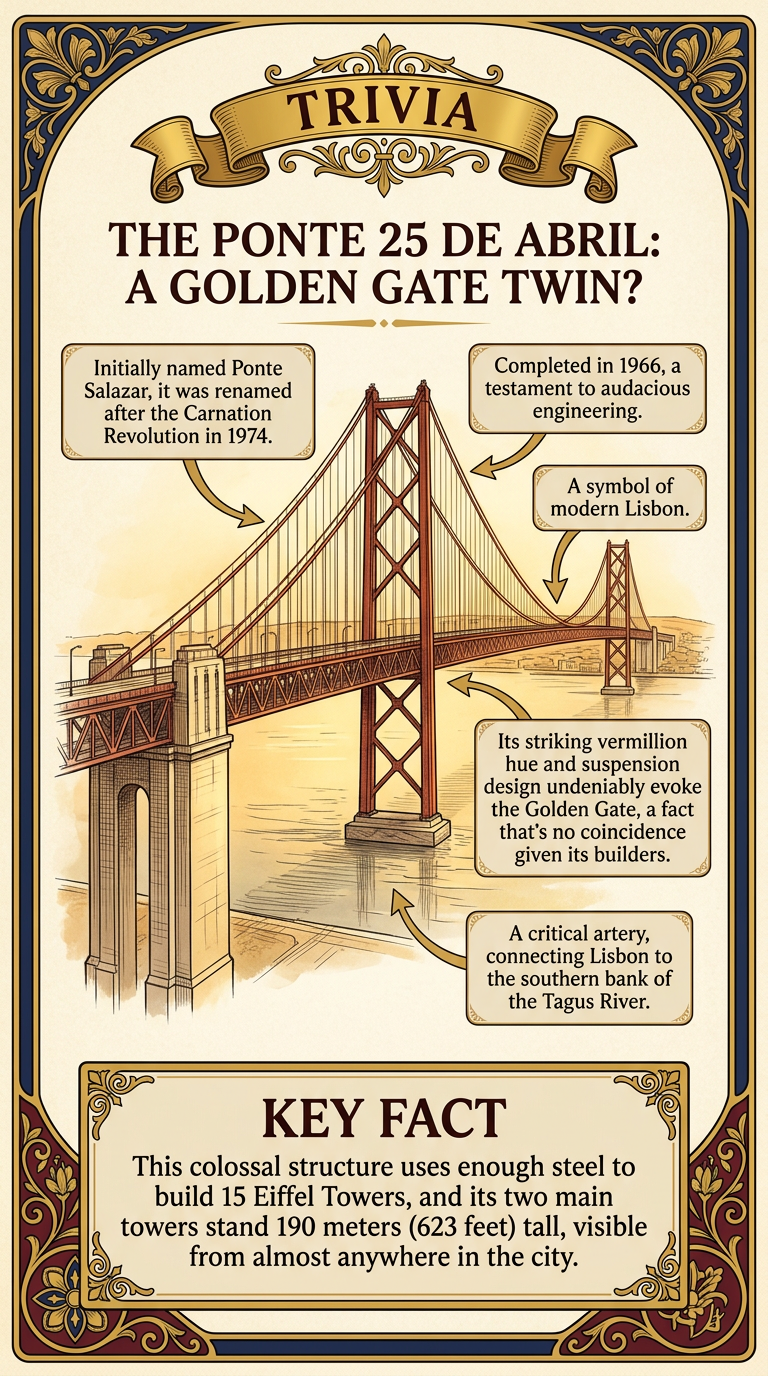
The Ponte 25 de Abril: A Golden Gate Twin?
Lisbon's iconic Ponte 25 de Abril suspension bridge often draws comparisons to San Francisco's Golden Gate. While visually striking, its engineering story holds even more fascinating details than its resemblance.
- The bridge was built by the American Bridge Company, the same consortium that constructed the San Francisco-Oakland Bay Bridge, explaining the structural similarities to its 'cousin' in California.
- It stretches an impressive 2,277 meters (7,470 feet) in length, with a main span of 1,013 meters (3,323 feet), making it one of the longest suspension bridges in Europe.
- Designed to withstand significant seismic activity, the bridge incorporates advanced anti-earthquake engineering, crucial for a city in an active seismic zone.
- Uniquely, the Ponte 25 de Abril is a double-deck bridge, carrying a six-lane road on its upper deck and a two-track railway line on its lower deck, added later in 1999.
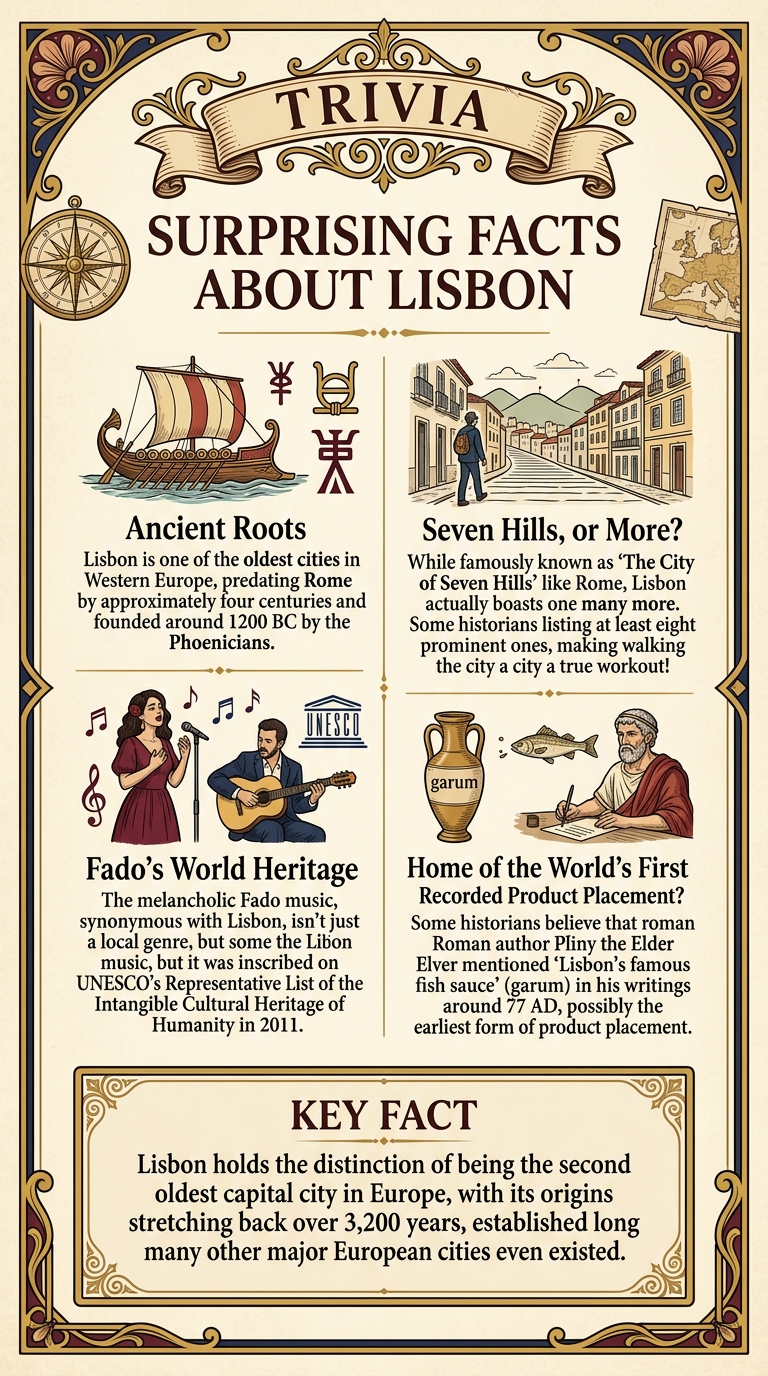
Surprising Facts About Lisbon
Beyond its famous trams and delicious pastel de nata, Lisbon hides a wealth of surprising facts that often catch even seasoned travelers off guard. Prepare to uncover some truly unique aspects of this ancient city.
- **Ancient Roots**: Lisbon is one of the oldest cities in Western Europe, predating Rome by approximately four centuries. It was founded around 1200 BC by the Phoenicians.
- **Seven Hills, or More?**: While famously known as 'The City of Seven Hills' (like Rome), Lisbon actually boasts many more, with some historians listing at least eight prominent ones, making walking the city a true workout!
- **Fado's World Heritage**: The melancholic Fado music, synonymous with Lisbon, isn't just a local genre; it was inscribed on UNESCO's Representative List of the Intangible Cultural Heritage of Humanity in 2011.
- **Home of the World's First Recorded Product Placement?**: Some historians suggest that the Roman author Pliny the Elder mentioned 'Lisbon's famous fish sauce' (garum) in his writings around 77 AD, possibly the earliest form of product placement.
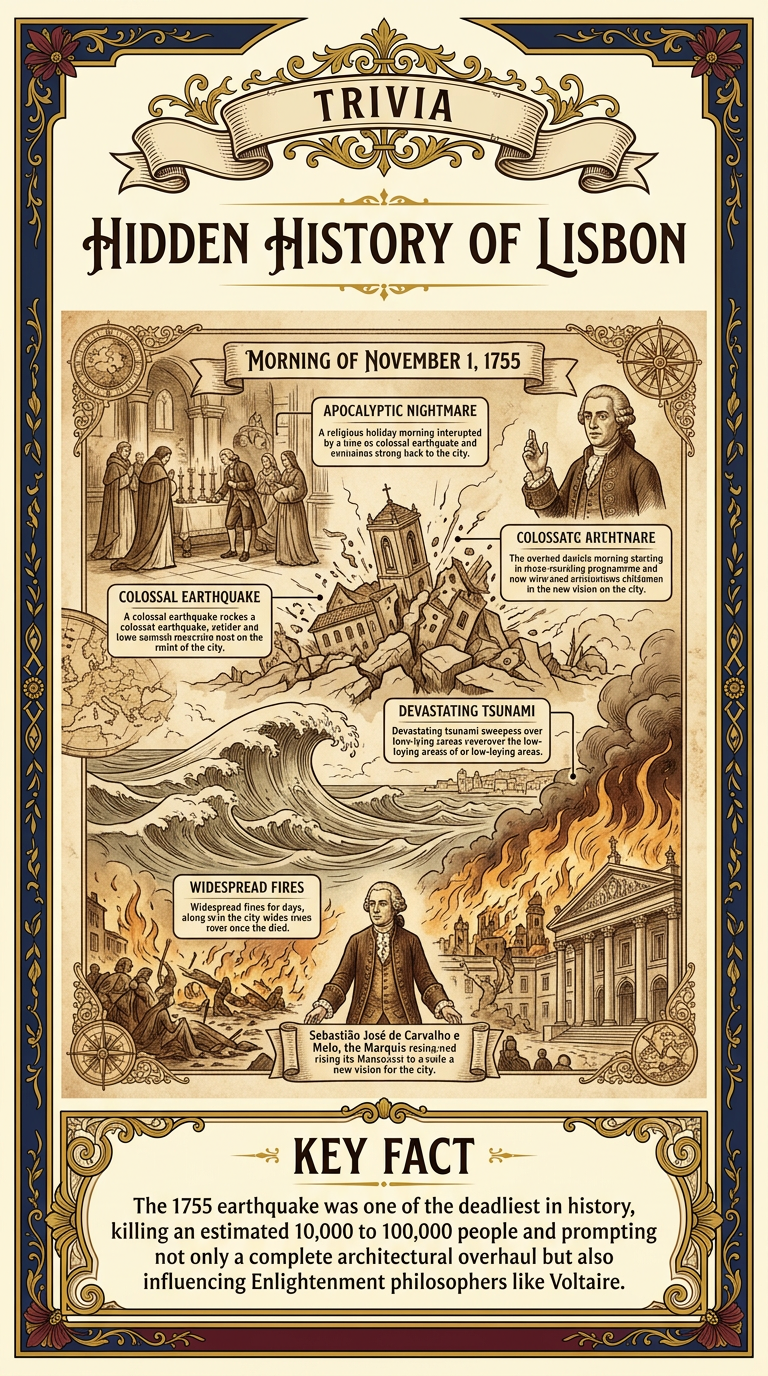
Hidden History of Lisbon
Beneath the charming facades and bustling squares, Lisbon harbors secrets from its tumultuous past, none more impactful than the catastrophic events of the 18th century that reshaped its very essence.
- The Great Lisbon Earthquake of 1755, estimated at magnitude 8.5–9.0, struck on All Saints' Day, followed by a tsunami and widespread fires, devastating 85% of the city's buildings.
- This disaster led to the world's first modern urban planning and anti-seismic construction under the Marquis of Pombal, who famously ordered, 'Bury the dead and heal the living, then close the port and rebuild the city.'
- The reconstructed Baixa district featured innovative 'Pombaline cages' – flexible wooden frameworks embedded within the walls, designed to absorb seismic shocks, a revolutionary concept for its time.
- Prior to the earthquake, Lisbon was a labyrinth of medieval streets; the new grid-like layout of the Baixa was a radical departure, creating wide avenues and symmetrical squares that define downtown Lisbon today.
More Lisbon Secrets
The Cult of Sardines and Santos Populares
June in Lisbon means one thing: the smell of grilled sardines fills the air! During the 'Santos Populares' (Popular Saints) festivals, particularly the Feast of Saint Anthony on June 12-13, the city transforms into a vibrant street party.
Thousands gather to eat freshly grilled sardines on bread, drink wine, dance, and celebrate. It's a beloved tradition, where the humble sardine becomes a symbol of communal joy and Portuguese culture.
Lisbon's Ancient Roman Theatre
Tucked away near the Sé Cathedral, lies the unassuming remains of Lisbon's Roman Theatre. Built in the 1st century AD, it was only rediscovered in 1798 during reconstruction after the 1755 earthquake and subsequently excavated over various periods.
Today, a small museum accompanies the ruins, offering a glimpse into Olisipo (Lisbon's Roman name) and the entertainment of its Roman inhabitants, a surprising historical layer beneath the modern city.
The City of Tram 28's Iconic Journey
Lisbon's bright yellow Tram 28 isn't just public transport; it's a legendary journey through the city's most historic and picturesque neighborhoods, including Graça, Alfama, Baixa, and Estrela.
These classic Remodelado trams, dating back to the 1930s, navigate incredibly narrow streets and steep hills, offering a unique, rattling, and charmingly authentic way to experience Lisbon's soul.
More Lisbon Content Coming Soon
We're crafting a complete guide for Lisbon. Stay tuned!
Explore More Trivia