
Marrakesh, often called the 'Red City,' is a vibrant tapestry woven from ancient traditions and bustling modernity. Yet beneath its shimmering surface and legendary souks lie fascinating secrets and engineering marvels that surprise even the most seasoned travelers, revealing a depth far beyond its captivating exterior.
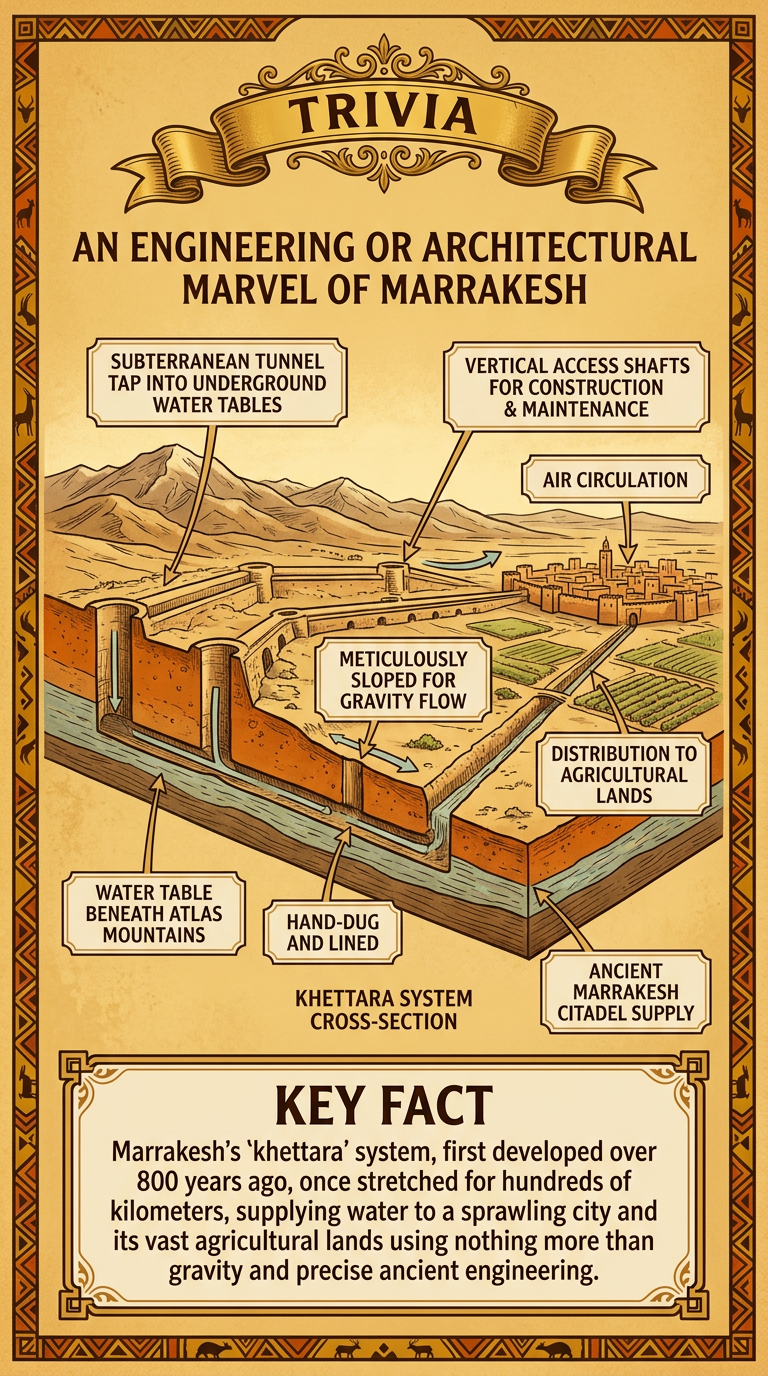
An Engineering or Architectural Marvel of Marrakesh
Long before modern plumbing, Marrakesh thrived thanks to an ingenious ancient water supply system, showcasing advanced hydrological engineering that continues to amaze experts today.
- The city's vital water supply relied on a network of underground channels called `khettaras`, fed by aquifers in the Atlas Mountains.
- These `khettaras` utilized gravity to transport water over tens of kilometers, often dropping only a few centimeters per kilometer.
- The Menara Gardens' massive central basin, covering 150 meters by 200 meters, is fed by an ancient `khettara` system from the Atlas foothills, dating back to the 12th century.
- Many of these ancient `khettara` systems, some over 800 years old, are still partially operational, irrigating the city's famous palm groves and gardens.
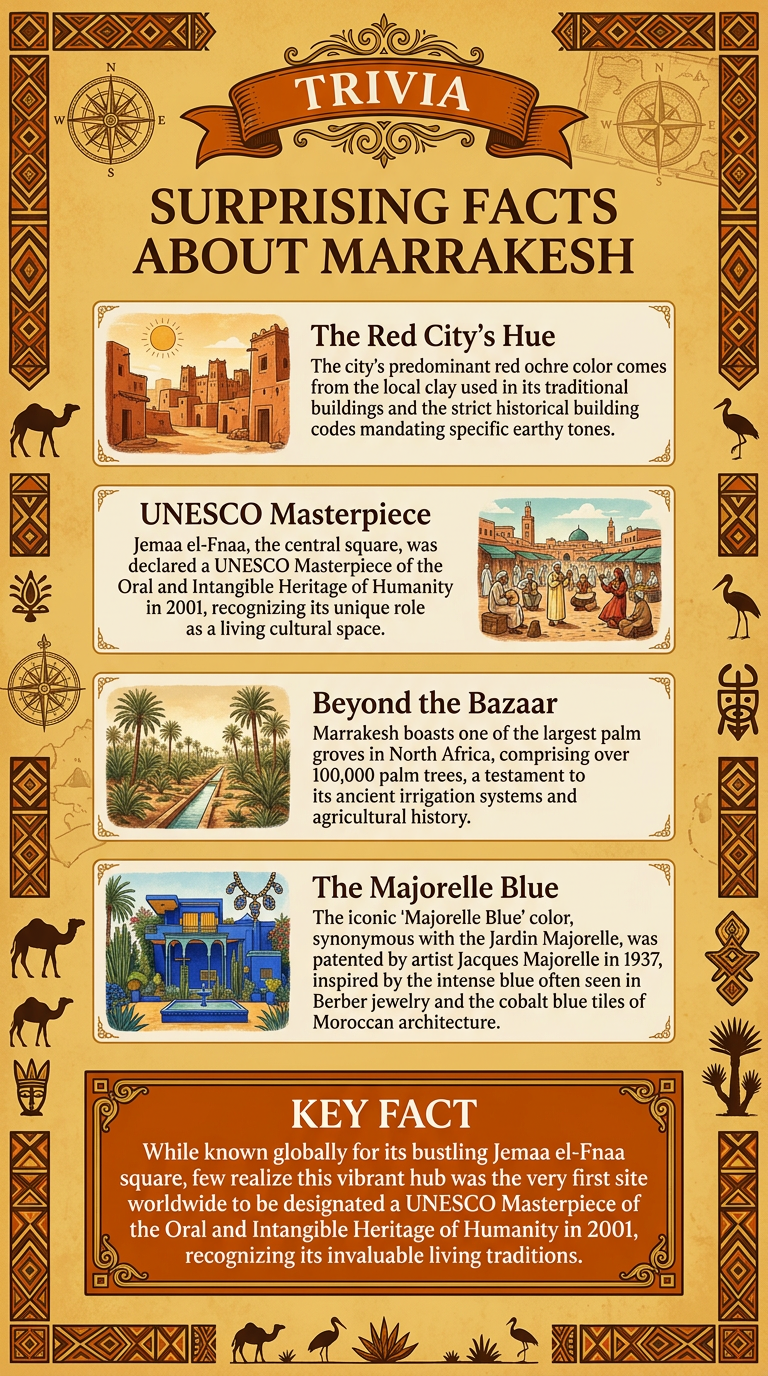
Surprising Facts About Marrakesh
Beyond its iconic souks and snake charmers, Marrakesh holds many unexpected truths, from its unique moniker to the origins of its famous landmarks.
- **The Red City's Hue:** The city's predominant red ochre color comes from the local clay used in its traditional buildings and the strict historical building codes mandating specific earthy tones.
- **UNESCO Masterpiece:** Jemaa el-Fnaa, the central square, was declared a UNESCO Masterpiece of the Oral and Intangible Heritage of Humanity in 2001, recognizing its unique role as a living cultural space.
- **Beyond the Bazaar:** Marrakesh boasts one of the largest palm groves in North Africa, comprising over 100,000 palm trees, a testament to its ancient irrigation systems and agricultural history.
- **The Majorelle Blue:** The iconic 'Majorelle Blue' color, synonymous with the Jardin Majorelle, was patented by artist Jacques Majorelle in 1937, inspired by the intense blue often seen in Berber jewelry and the cobalt blue tiles of Moroccan architecture.
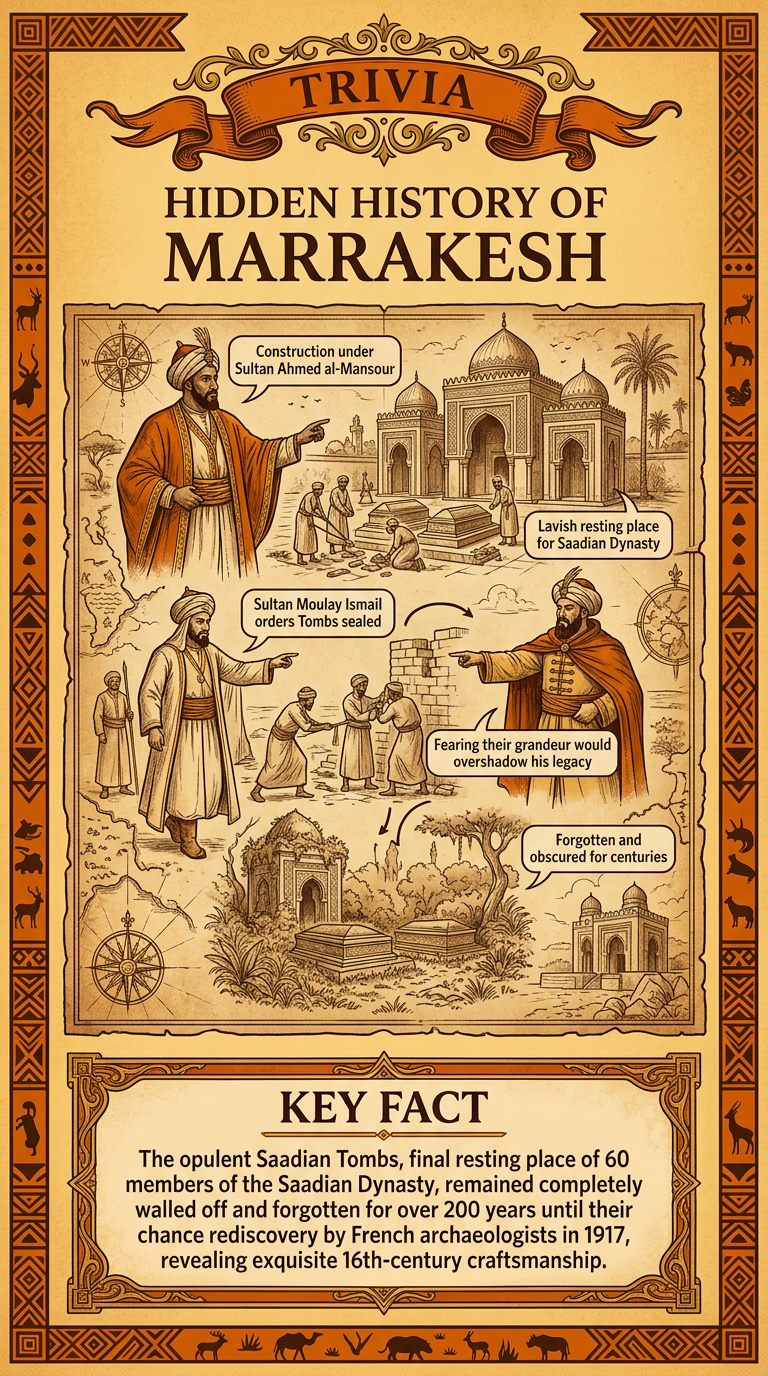
Hidden History of Marrakesh
Delve into the lesser-known annals of Marrakesh, where forgotten dynasties, secret discoveries, and unexpected influences shaped the city's enduring legacy.
- The Saadian Tombs, a magnificent necropolis, lay hidden and forgotten beneath a layer of earth for centuries until their rediscovery in 1917 during an aerial survey.
- Marrakesh was founded in 1070 by Abu Bakr ibn Umar, leader of the Almoravid dynasty, making it an imperial city for over 950 years.
- The city's historic Jewish Quarter, known as the Mellah, was established in 1558 by the Saadian Sultan Abdallah al-Ghalib, providing protection for the Jewish community and boosting the city's trade ties.
- Winston Churchill famously frequented Marrakesh, often staying at La Mamounia hotel, describing it as 'the most lovely spot in the world' and painting its landscapes during WWII.
More Marrakesh Secrets
The Timeless Art of Tanning in Marrakesh
Step back in time at the Chouara Tannery, the oldest and largest tannery in Fes, but also reflected in smaller operations in Marrakesh's own medina. Here, the ancient craft of leather production unfolds before your eyes, a process unchanged for centuries. Workers toil in vibrant vats filled with natural dyes—poppy for red, indigo for blue, henna for orange, and saffron for yellow—transforming raw hides into supple leather for bags, shoes, and poufs.
The pungent aroma is an unavoidable part of the experience, often mitigated by sprigs of mint offered by guides. This labor-intensive tradition is not merely a tourist spectacle but a crucial economic backbone, preserving a living piece of Marrakesh's industrial heritage.
Marrakesh's Signature Scent: Spices and Sensory Overload
Marrakesh is a city of intoxicating aromas, and none are more potent than those emanating from its spice souks. Piles of vibrant turmeric, cumin, paprika, ginger, and saffron create a visual and olfactory feast. These aren't just for cooking; traditional apothecaries within the souks offer ancient remedies, cosmetic ingredients, and aphrodisiacs, blending the culinary with the medicinal in a truly Moroccan fashion.
From Madrasa to Masterpiece: Ben Youssef's Legacy
The Ben Youssef Madrasa, once the largest Islamic college in North Africa, stood as a beacon of learning for over five centuries, educating thousands of students in theology, law, and literature. Founded in the 14th century and magnificently rebuilt in the 16th by the Saadian Sultan Abdallah al-Ghalib, its architecture is a breathtaking symphony of Andalusian-Moorish design. Its tranquil courtyards, adorned with intricate stucco, cedarwood carvings, and vibrant zellij tiles, once housed up to 900 students. Today, it stands as a testament to Marrakesh's rich intellectual and artistic heritage.
More Marrakesh Content Coming Soon
We're crafting a complete guide for Marrakesh. Stay tuned!
Explore More Trivia