
The land of Krishna holds mysteries that blend mythology with archaeology. From the prison cell where Krishna was born to the hill that floated on a finger, Mathura-Vrindavan's stories transcend time and belief.
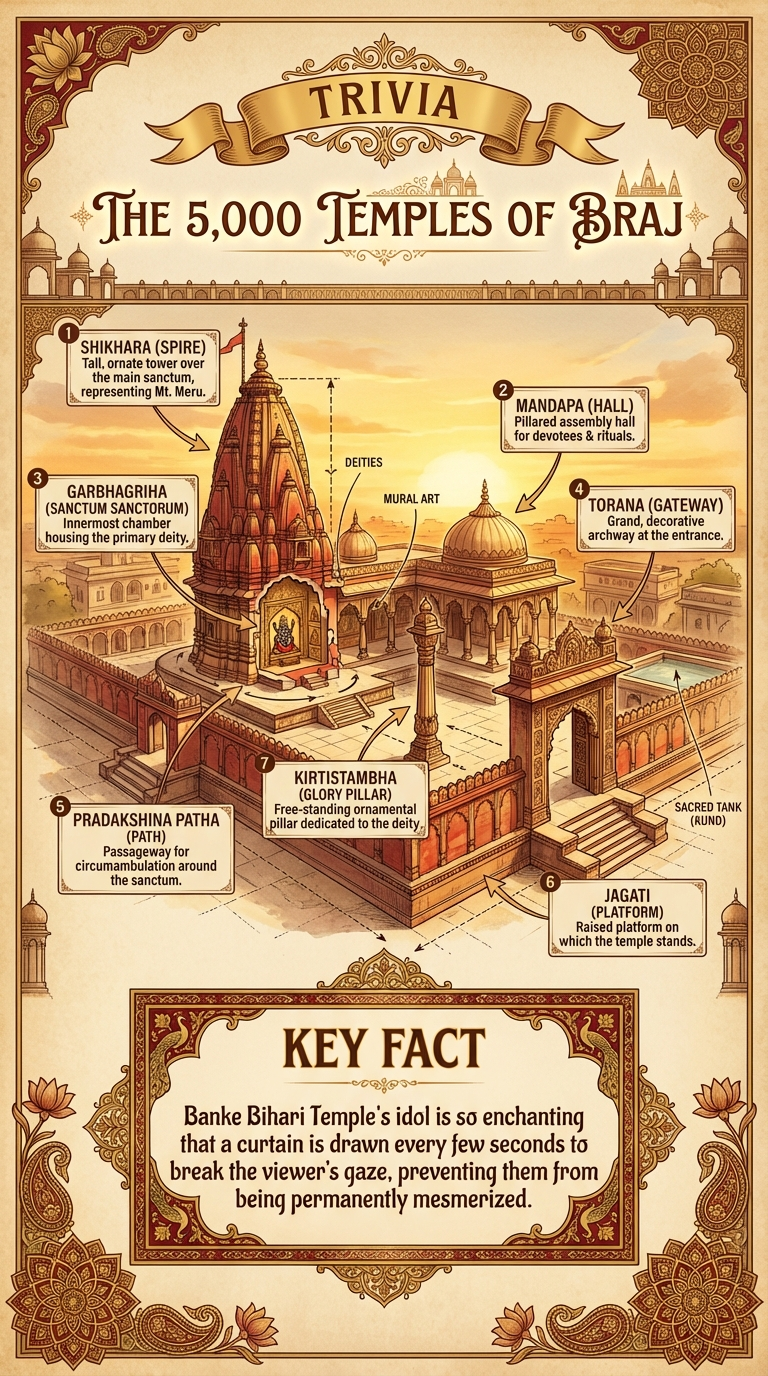
The 5,000 Temples of Braj
The Braj region (Mathura-Vrindavan-Gokul-Govardhan) houses over 5,000 temples, making it one of the densest temple regions in the world. Many date back 5,000 years, while new ones are still being built. Each temple has a unique story connected to Krishna's leelas (divine play).
- 5,000+ temples in 1,500 sq km area
- Banke Bihari Temple sees 20-25 lakh visitors annually
- Some temples have idols self-manifested (Swayambhu)
- 84 Kos Parikrama covers all Krishna sites in 270 km
- Temples from all Hindu sects: Vaishnav, Shaiva, Shakti
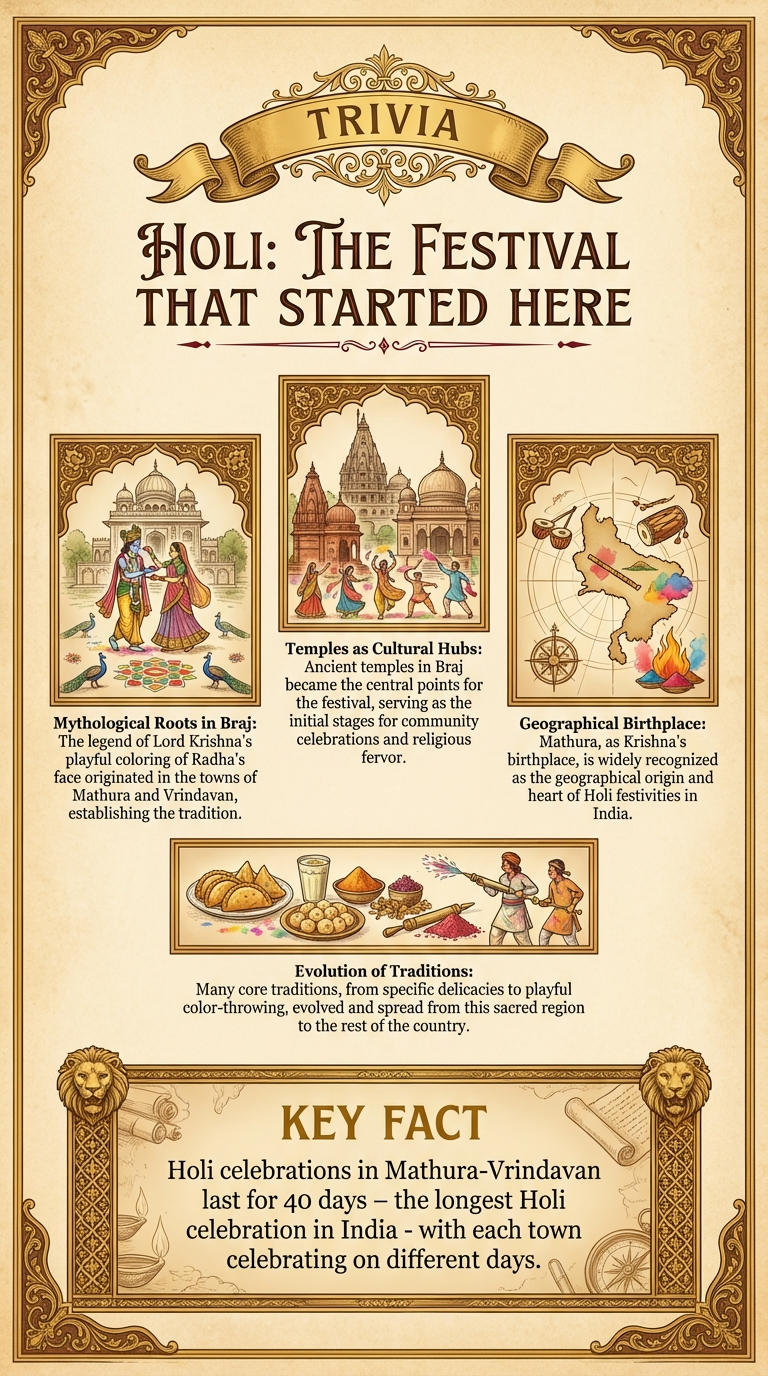
Holi: The Festival That Started Here
Mathura-Vrindavan is the birthplace of Holi celebrations. Legend says Krishna, insecure about his dark skin, playfully colored Radha, starting the tradition. The Lathmar Holi of Barsana, where women beat men with sticks, recreates this playful battle.
- Celebrations start 40 days before main Holi
- Barsana's Lathmar Holi attracts 10,000+ tourists
- Natural colors made from flowers used traditionally
- Widows in Vrindavan now participate, breaking centuries of taboo
- Holi songs (Hori) originated in Braj region
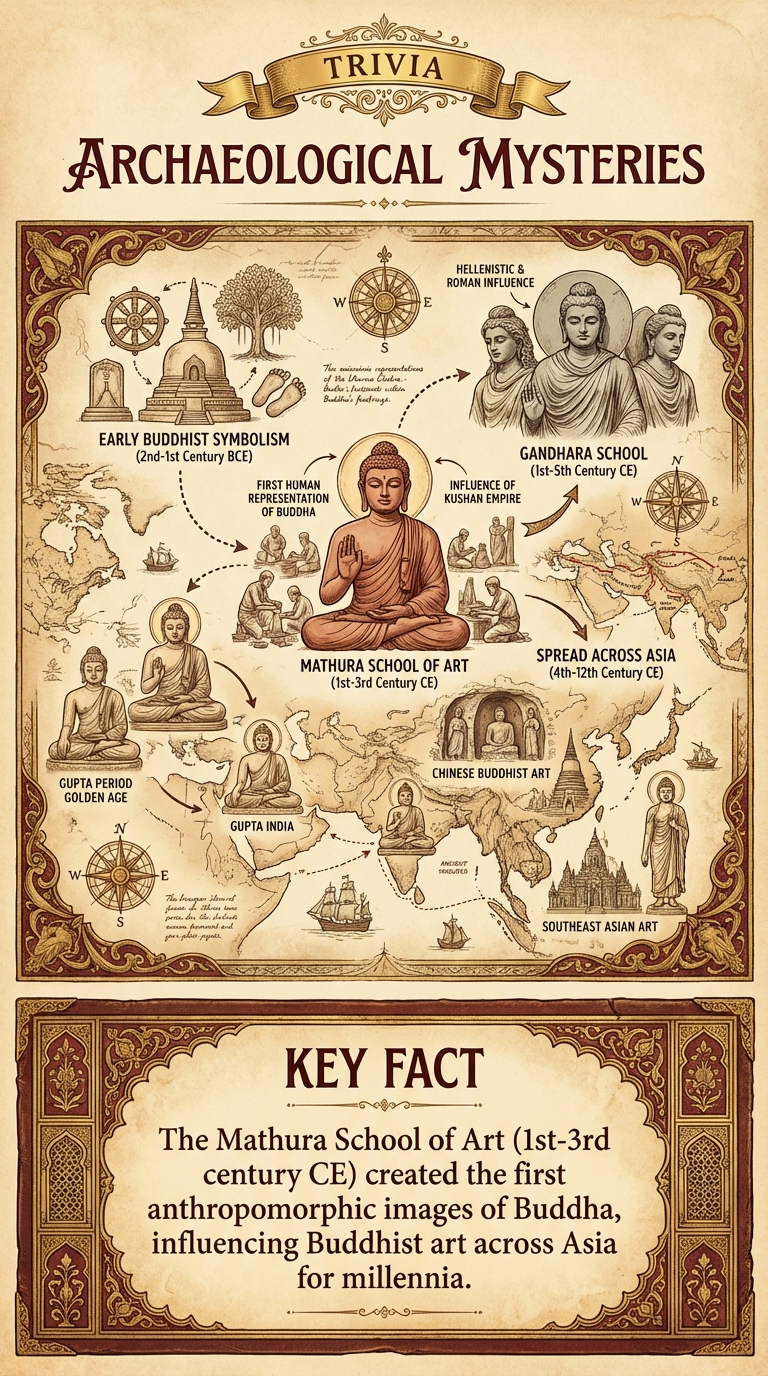
Archaeological Mysteries
Recent excavations around Mathura have uncovered evidence of habitation dating back 6,000 years. The region was a major Buddhist center before Hindu temples, and artifacts from Kushan period (1st-3rd century CE) show a sophisticated urban civilization.
- Mathura Museum has 50,000+ artifacts including rare Buddha statues
- Kushan capital was Mathura (1st-3rd century CE)
- Greek, Roman coins found indicating trade routes
- Ancient port on Yamuna River discovered
- Krishna Janmasthan excavations ongoing since 1950s
More Mathura-Vrindavan Secrets
The Floating Deity
During the Yamuna floods of 2010, the ancient idol at Nidhi Van temple remained untouched by water while the entire area was submerged. Scientists couldn't explain the phenomenon.
Where Widows Found Color
In 2012, widows in Vrindavan (traditionally barred from celebrations) played Holi for the first time in centuries, starting a revolutionary movement against social taboos.
The Railway Connection
The Mathura Junction railway station is uniquely positioned equidistant from Delhi, Agra, and Jaipur, making it the most connected pilgrimage point in North India.
Want More Mathura-Vrindavan Stories?
Get our complete 80+ page ebook with all the trivia, attractions, and insider tips.
Ebook Coming Soon