
Mexico City is a place where ancient civilizations, colonial grandeur, and modern innovation collide, creating an urban landscape unlike any other. Built upon the ruins of a mighty Aztec empire and constantly evolving, it's a metropolis that never ceases to surprise, challenge, and delight its visitors with its profound history and vibrant contemporary pulse.
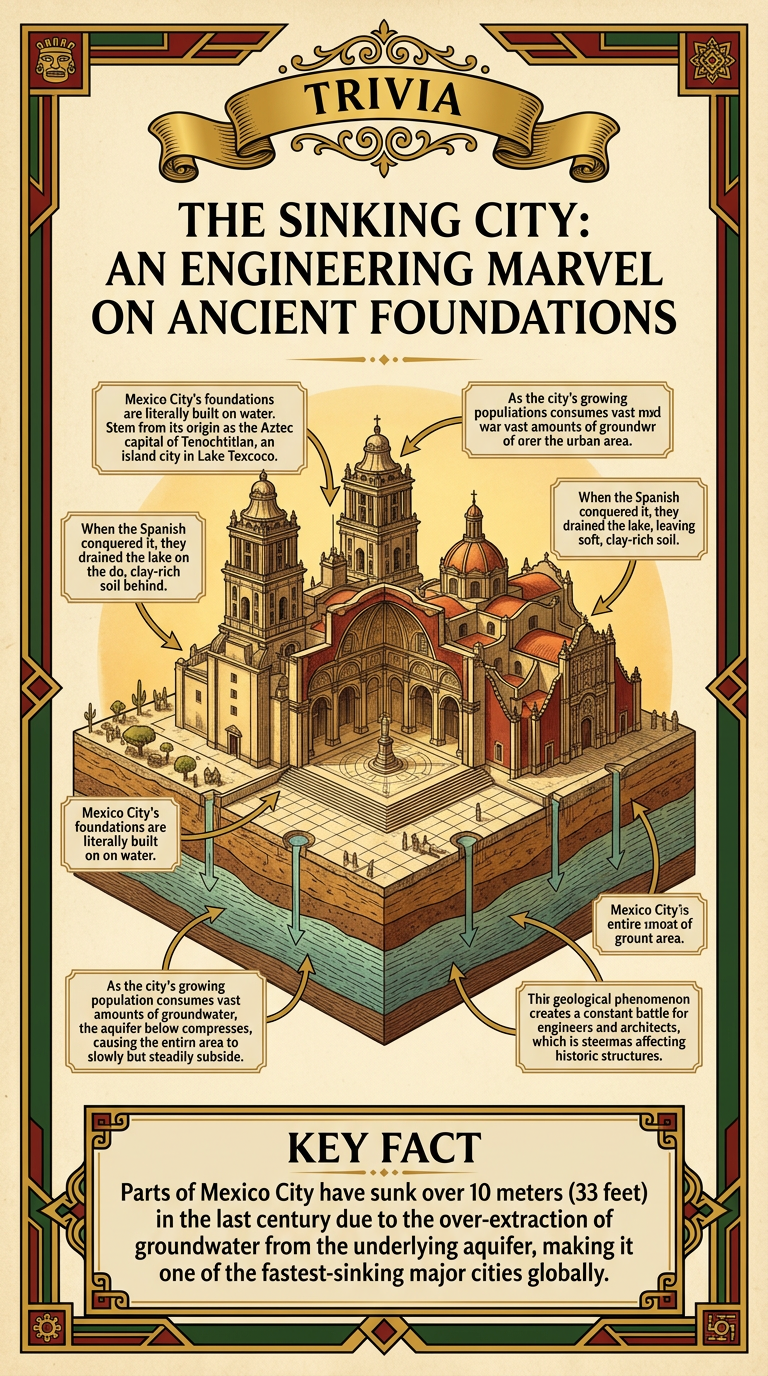
The Sinking City: An Engineering Marvel on Ancient Foundations
Mexico City is built on a former lakebed, leading to unique engineering challenges and fascinating architectural adaptations. Its very existence is a testament to human ingenuity constantly battling the natural environment.
- Mexico City is sinking by an average of 10 to 40 centimeters (4 to 16 inches) per year in some areas due to excessive groundwater extraction.
- The iconic Metropolitan Cathedral has required extensive structural stabilization work since the 1990s, including a complex system of 32 jacks and controlled excavation to correct its tilt.
- The city's massive deep drainage system, including the Gran Canal and the Eastern Emisor Tunnel (Tunnel Emisor Oriente), is one of the largest civil engineering projects globally, designed to manage floodwaters.
- Many historic buildings, such as the Palacio de Bellas Artes, have sunk several meters below original street level since their construction in the early 20th century, altering their grand entrances.
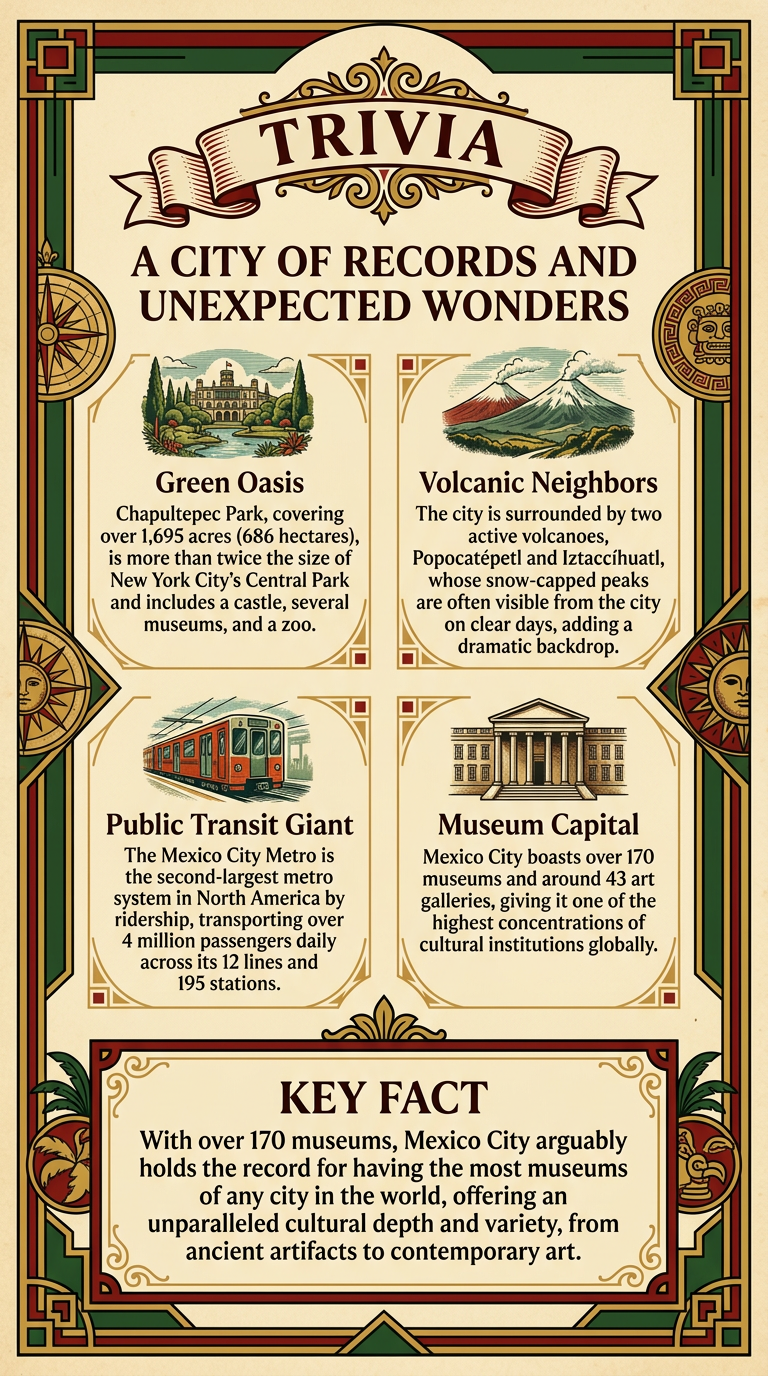
A City of Records and Unexpected Wonders
Beyond its bustling markets and revered historic sites, Mexico City holds a surprising array of records and boasts facets many travelers never anticipate. Prepare to have your perceptions challenged by its unexpected wonders.
- **Green Oasis**: Chapultepec Park, covering over 1,695 acres (686 hectares), is more than twice the size of New York City's Central Park and includes a castle, several museums, and a zoo.
- **Volcanic Neighbors**: The city is surrounded by two active volcanoes, Popocatépetl and Iztaccíhuatl, whose snow-capped peaks are often visible from the city on clear days, adding a dramatic backdrop.
- **Public Transit Giant**: The Mexico City Metro is the second-largest metro system in North America by ridership, transporting over 4 million passengers daily across its 12 lines and 195 stations.
- **Museum Capital**: Mexico City boasts over 170 museums and around 43 art galleries, giving it one of the highest concentrations of cultural institutions globally.
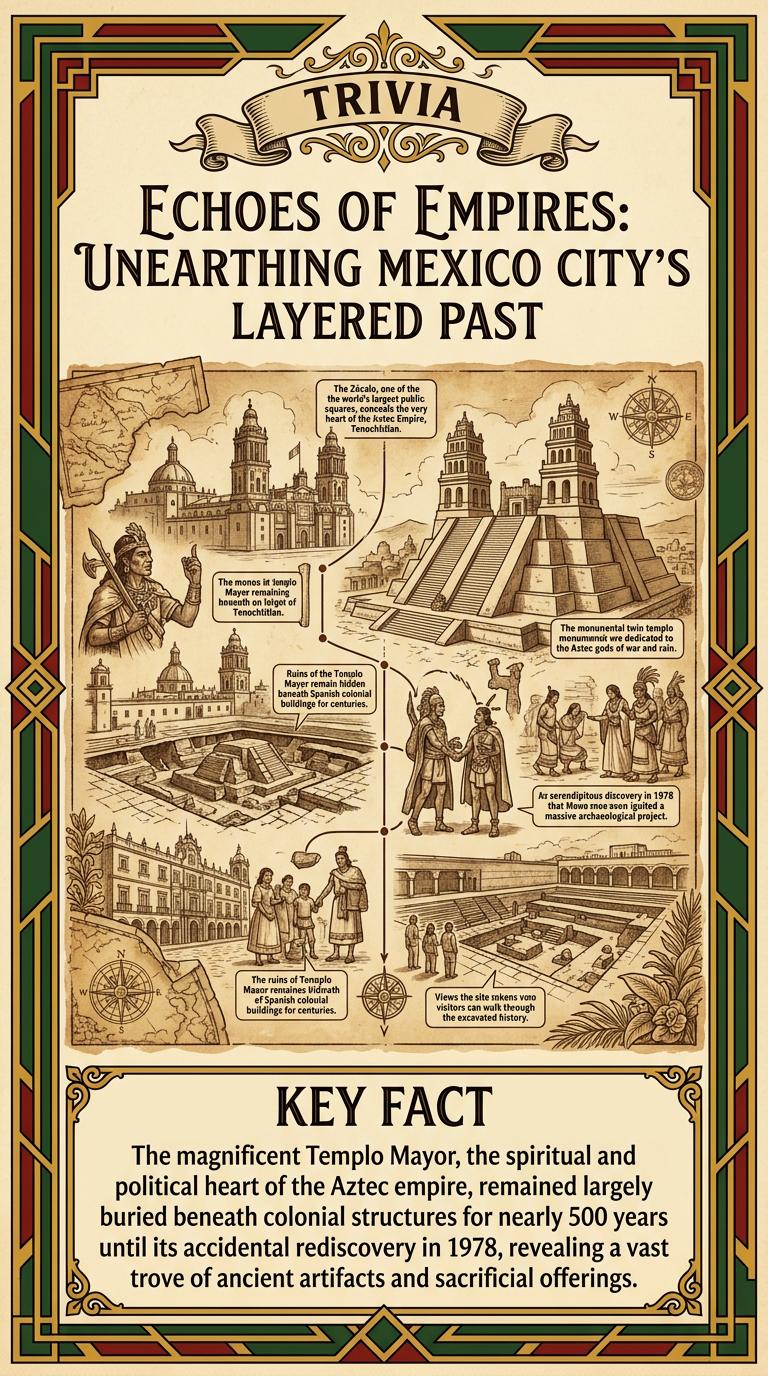
Echoes of Empires: Unearthing Mexico City's Layered Past
Beneath the modern bustle of Mexico City lies a rich tapestry of forgotten empires, revolutionary secrets, and ancient mysteries waiting to be uncovered. Dig deeper than the surface to reveal its extraordinary historical layers.
- The Zócalo, Mexico City's main square, sits directly atop the ceremonial center of the Aztec capital, Tenochtitlan, with significant ruins still visible and excavated.
- The ruins of Templo Mayor, the Aztecs' principal temple, were only fully excavated starting in 1978 after an electrical worker accidentally discovered a large stone disc of Coyolxauhqui.
- The 'House of the First Print Shop in America' (Casa de la Primera Imprenta de América) opened in 1539, nearly a century before the first printing press in the English North American colonies.
- For 300 years, Mexico City served as the capital of the vast Viceroyalty of New Spain, governing territories that stretched from modern-day North America down to Central America and across to the Philippines.
More Mexico City Secrets
Xochimilco: A Pre-Hispanic Water World
Xochimilco, a UNESCO World Heritage site, is a vibrant remnant of the ancient lake system upon which Mexico City was founded. It’s famous for its 'chinampas,' or floating gardens, an ingenious agricultural system developed by the Aztecs.
Visitors can explore this network of canals on colorful 'trajineras' (gondola-like boats), complete with mariachi bands, food vendors, and traditional Mexican fiestas creating an unforgettable, lively atmosphere.
Palacio de Bellas Artes: A Confluence of Styles
The Palacio de Bellas Artes, Mexico City’s premier cultural center, is an architectural masterpiece blending Art Nouveau, Art Deco, and Neoclassical styles. Its construction spanned 30 years (1904-1934) due to the Mexican Revolution and the soft, sinking ground.
Inside, it houses breathtaking murals by Diego Rivera, David Alfaro Siqueiros, and José Clemente Orozco, along with a spectacular Tiffany stained-glass curtain depicting the Popocatépetl and Iztaccíhuatl volcanoes.
Coyoacán: A Charming Colonial Enclave
Meaning 'place of coyotes' in Nahuatl, Coyoacán is a picturesque colonial neighborhood that feels like a tranquil village within the bustling metropolis. Its cobblestone streets, vibrant plazas (Jardín Centenario and Plaza Hidalgo), and bohemian atmosphere have attracted artists and intellectuals for centuries.
It was famously home to Frida Kahlo and Diego Rivera (whose Blue House is now a museum) and Leon Trotsky, making it a pivotal site for cultural and political history.
More Mexico City Content Coming Soon
We're crafting a complete guide for Mexico City. Stay tuned!
Explore More Trivia