
Milan, often perceived solely as a fashion capital, hides layers of astounding history, engineering marvels, and surprising cultural quirks. Beyond the runways and designer boutiques, discover a city rich with ancient Roman roots, revolutionary artistic legacies, and architectural feats that have shaped centuries, waiting to surprise even the most seasoned traveler.
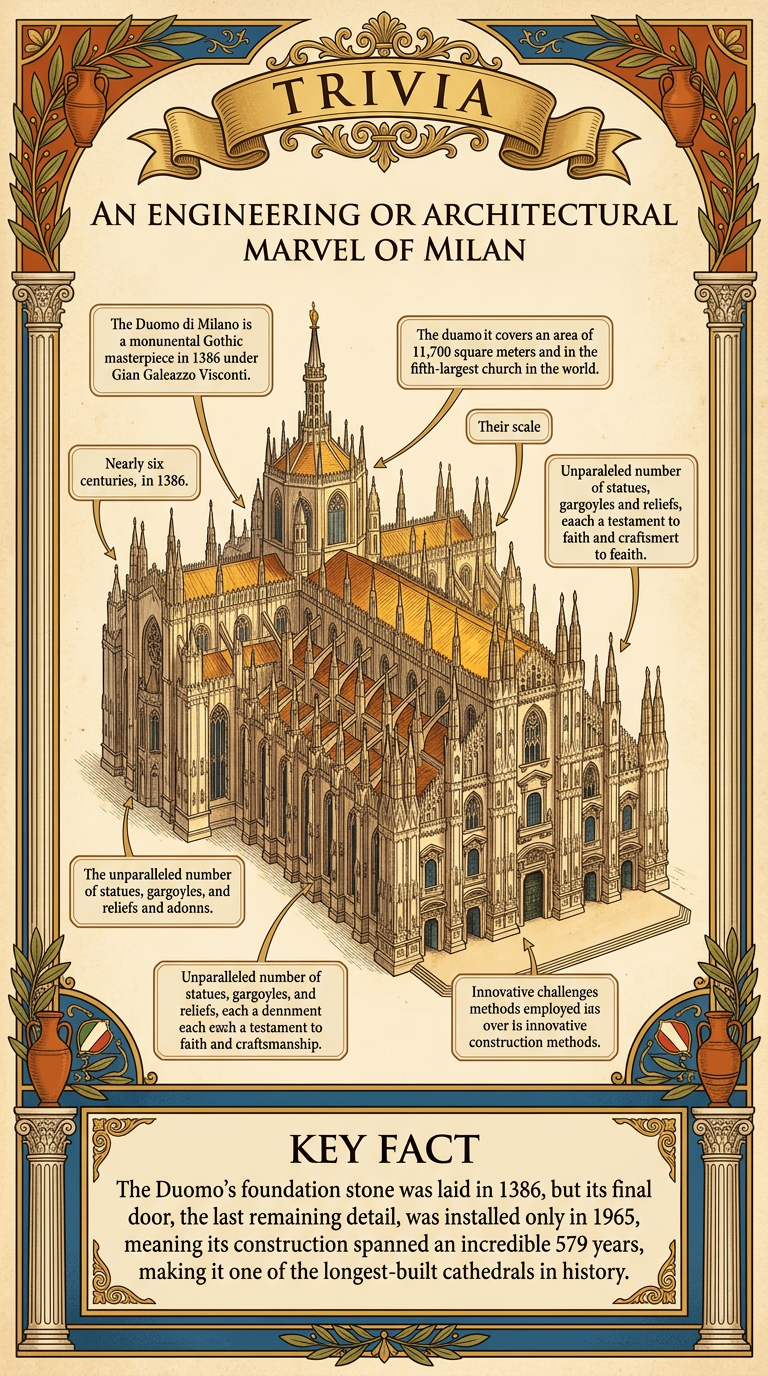
An Engineering or Architectural Marvel of Milan
The majestic Duomo di Milano isn't just a church; it's a testament to centuries of engineering ambition, artistic dedication, and an ongoing architectural saga that continues to this day.
- Its construction began in 1386 and wasn't officially completed until 1965, spanning nearly six centuries of continuous work.
- The Duomo features an astonishing 3,400 statues, 135 gargoyles, and over 700 figures adorning its intricate facade and roof.
- The main spire, known as the 'Madonnina,' stands 108.5 meters (356 feet) tall, topped by a golden statue of the Virgin Mary.
- The roof terrace offers unparalleled panoramic views and allows visitors to walk among the spires and flying buttresses, a truly unique architectural experience.
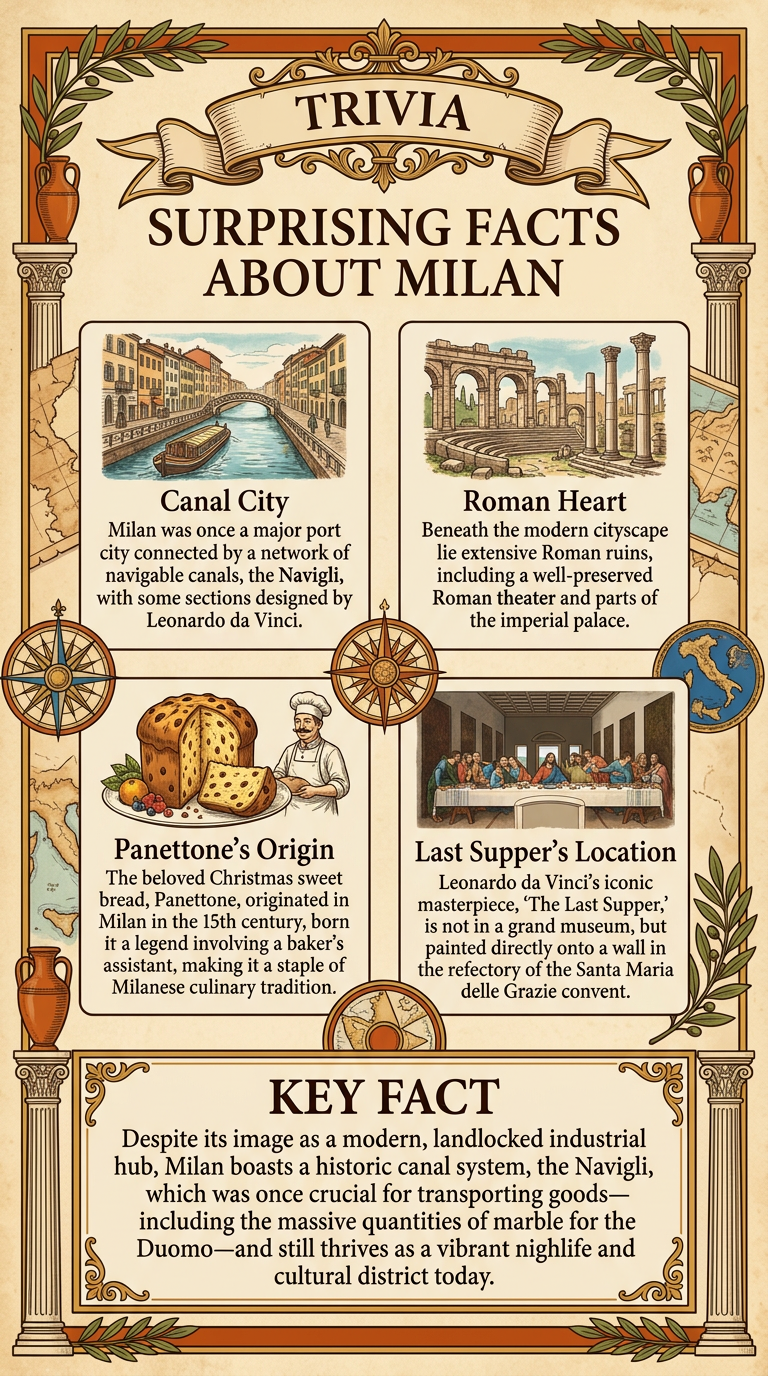
Surprising Facts About Milan
Milan is more than just fashion; it's a city of delightful contradictions and unexpected historical layers that often surprise first-time visitors, revealing a depth beyond its glamorous surface.
- **Canal City**: Milan was once a major port city connected by a network of navigable canals, the Navigli, with some sections designed by Leonardo da Vinci.
- **Roman Heart**: Beneath the modern cityscape lie extensive Roman ruins, including a well-preserved ancient Roman theater and parts of the imperial palace.
- **Panettone's Origin**: The beloved Christmas sweet bread, Panettone, originated in Milan in the 15th century, born from a legend involving a baker's assistant, making it a staple of Milanese culinary tradition.
- **Last Supper's Location**: Leonardo da Vinci's iconic masterpiece, 'The Last Supper,' is not in a grand museum, but painted directly onto a wall in the refectory of the Santa Maria delle Grazie convent.
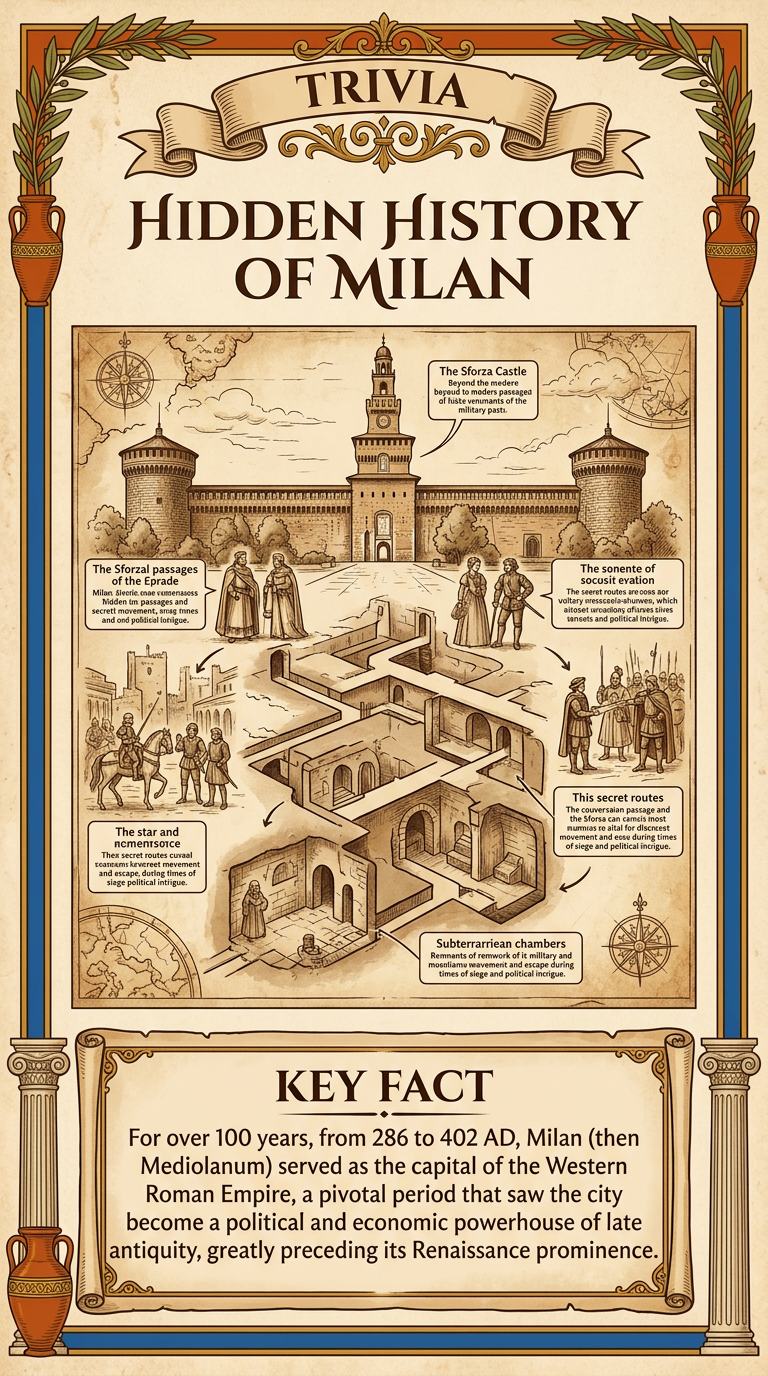
Hidden History of Milan
Delve into the lesser-known annals of Milan's past, uncovering secrets and stories that shaped this influential city far beyond its most famous landmarks and widely known historical facts.
- **The Ambrosiana Library's Secrets**: Founded in 1609, this library houses a vast collection of ancient manuscripts, including Leonardo da Vinci's 'Codex Atlanticus,' the largest collection of his drawings and writings.
- **Roman Emperor's Palace**: Piazza San Giorgio al Palazzo hides remnants of the Roman Imperial Palace, which served as a residence for emperors when Mediolanum was the capital of the Western Roman Empire from 286 to 402 AD.
- **Sforza Castle's Hidden Passages**: Beneath the imposing Sforza Castle, a medieval fortress, lie secret tunnels and escape routes used by dukes and duchesses during sieges and political turmoil.
- **San Bernardino alle Ossa**: This macabre chapel is adorned with thousands of human skulls and bones, transferred from an adjacent cemetery in the 17th century, creating a chilling yet historically significant ossuary.
More Milan Secrets
The Quintessential Milanese Aperitivo
The aperitivo isn't just a happy hour; it's a cherished Milanese ritual, a social institution that bridges the gap between work and dinner. Typically enjoyed from 6 PM to 9 PM, it involves ordering a drink (often a Spritz, Negroni, or a local wine) which comes with access to an often elaborate buffet of complimentary appetizers, ranging from small sandwiches and olives to pasta, pizza, and cured meats.
This pre-dinner custom is less about pre-gaming and more about unwinding, socializing, and enjoying a light meal that often negates the need for a full dinner. It's an essential part of the Milanese lifestyle and a fantastic way to experience local culture.
Leonardo da Vinci's Secret Vineyard
Behind the Santa Maria delle Grazie church, home to 'The Last Supper,' lies a surprising historical treasure: Leonardo da Vinci's Vineyard. This vineyard was gifted to Leonardo by Ludovico Sforza, the Duke of Milan, in 1498, as payment for his numerous works. Thought lost to history, it was meticulously recreated using DNA analysis of ancient root fragments found during excavations in 2015, allowing visitors to walk through a living piece of the master's personal life in the heart of the city.
Galleria Vittorio Emanuele II: Europe's Oldest Shopping Gallery
Often dubbed 'Il Salotto di Milano' (Milan's Drawing Room), the Galleria Vittorio Emanuele II, inaugurated in 1877, is not just a high-fashion shopping arcade but a breathtaking architectural marvel. It stands as one of the world's oldest active shopping malls, featuring an impressive glass and iron roof and a stunning mosaic floor. Legend has it that spinning on the bull's testicles in the central mosaic brings good luck – a tradition that has worn a significant hole in the mosaic over the years due to countless hopeful visitors.
More Milan Content Coming Soon
We're crafting a complete guide for Milan. Stay tuned!
Explore More Trivia