
Beyond its idyllic beaches and charming French Quarter, Pondicherry is a treasure trove of unexpected stories and engineering marvels. This former French colony is a destination that constantly surprises, blending ancient trade routes with futuristic communities, and colonial elegance with vibrant Indian life. Prepare to uncover the fascinating layers of this unique Union Territory!
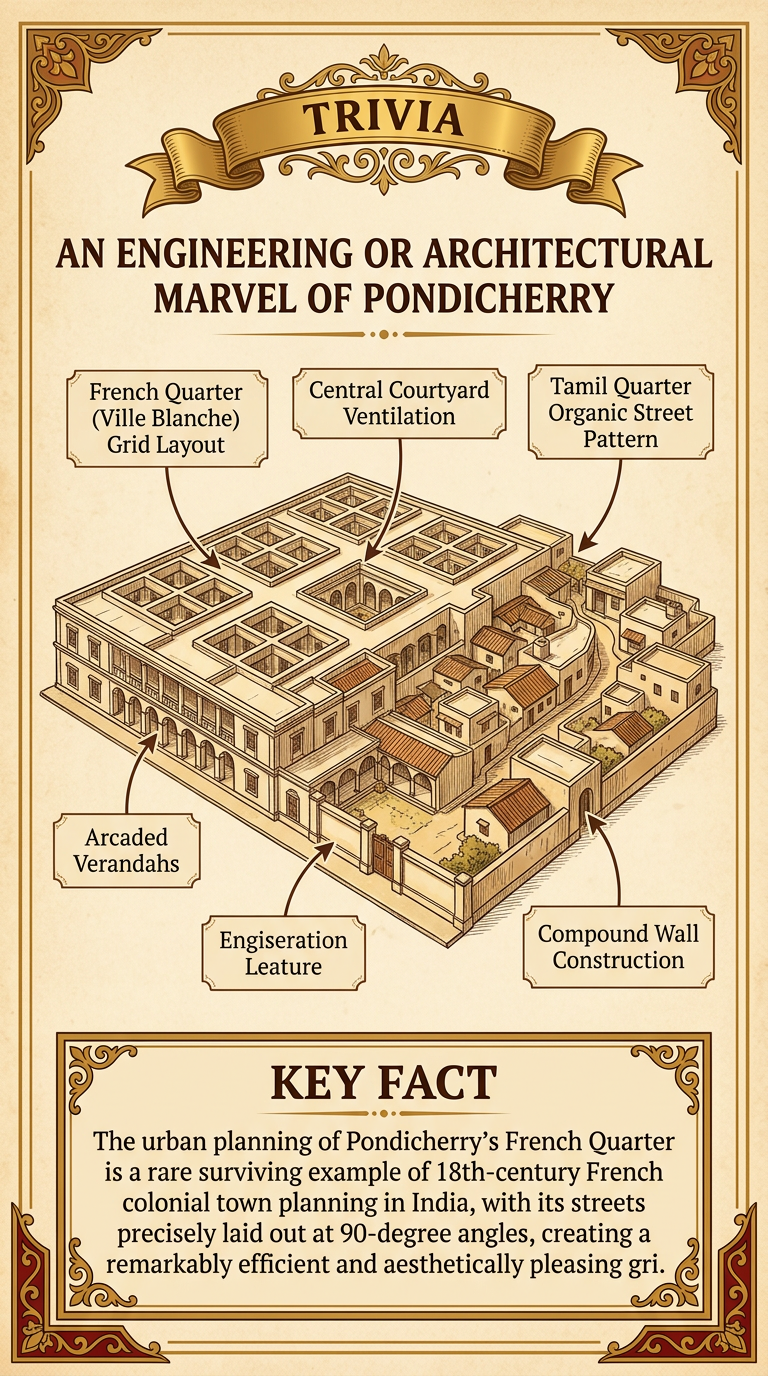
An Engineering or Architectural Marvel of Pondicherry
Pondicherry's architectural landscape is a captivating blend of French colonial grandeur and traditional Tamil design, meticulously planned and remarkably preserved. Delve into the intricate details that make its urban fabric a true marvel.
- The French Quarter (Ville Blanche) boasts a distinctive grid-patterned layout, designed with an orthogonal street system in the 18th century, a stark contrast to the organic sprawl of most Indian towns.
- An ingenious underground drainage system, dating back to the French colonial era, still serves parts of the town, designed to manage heavy monsoon rains and prevent waterlogging.
- The iconic Pondicherry Promenade, stretching 1.5 kilometers along the Bay of Bengal, is protected by a massive seawall constructed from granite boulders, a testament to resilient coastal engineering.
- Architectural features like arched doorways, high ceilings, large windows, and 'porte cochères' (carriage porches) are common in the French Quarter, designed to adapt to the tropical climate while retaining European aesthetics.
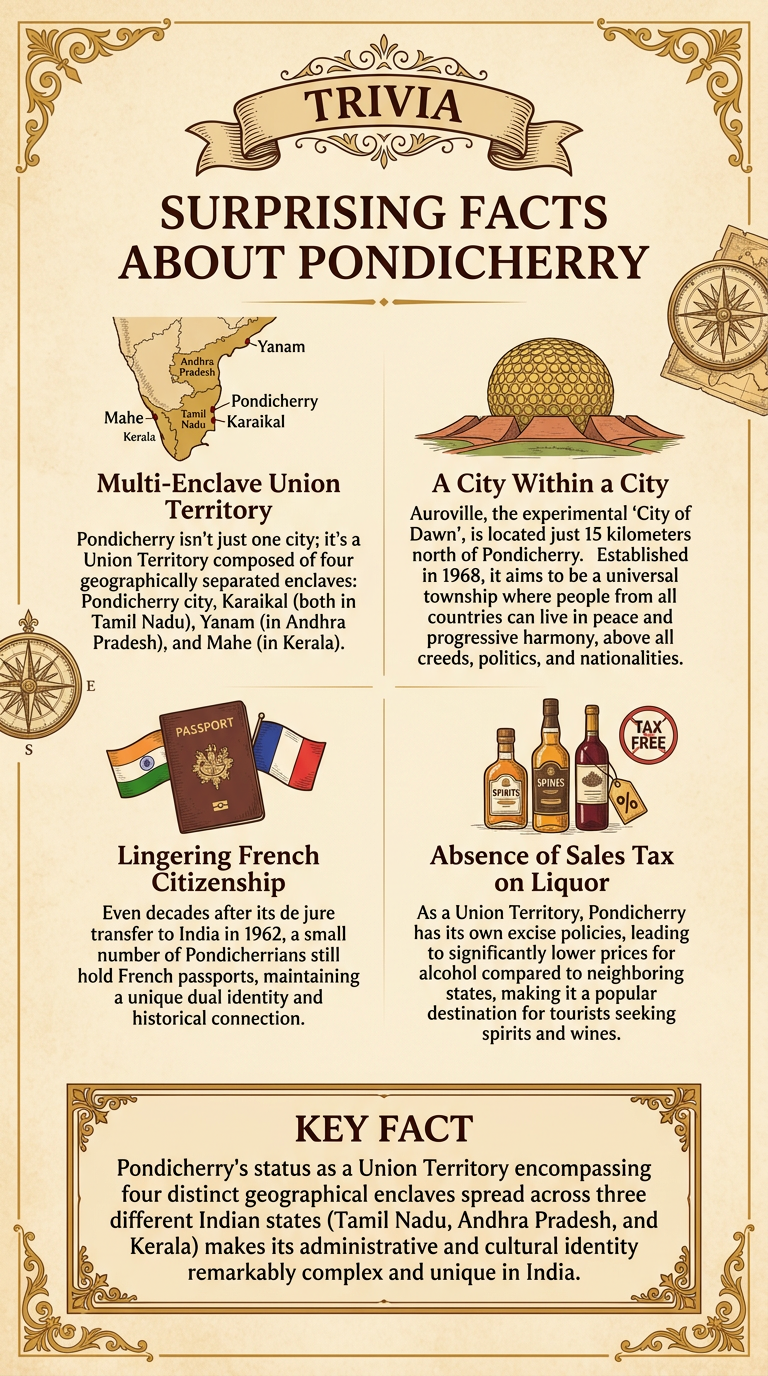
Surprising Facts About Pondicherry
Pondicherry is full of charming contradictions and unexpected realities that often catch first-time visitors off guard. Prepare to have your perceptions challenged by these unique facets of the 'French Riviera of the East'.
- **Multi-Enclave Union Territory**: Pondicherry isn't just one city; it's a Union Territory composed of four geographically separated enclaves: Pondicherry city, Karaikal (both in Tamil Nadu), Yanam (in Andhra Pradesh), and Mahe (in Kerala).
- **A City Within a City**: Auroville, the experimental 'City of Dawn', is located just 15 kilometers north of Pondicherry. Established in 1968, it aims to be a universal township where people from all countries can live in peace and progressive harmony, above all creeds, politics, and nationalities.
- **Lingering French Citizenship**: Even decades after its de jure transfer to India in 1962, a small number of Pondicherrians still hold French passports, maintaining a unique dual identity and historical connection.
- **Absence of Sales Tax on Liquor**: As a Union Territory, Pondicherry has its own excise policies, leading to significantly lower prices for alcohol compared to neighboring states, making it a popular destination for tourists seeking spirits and wines.
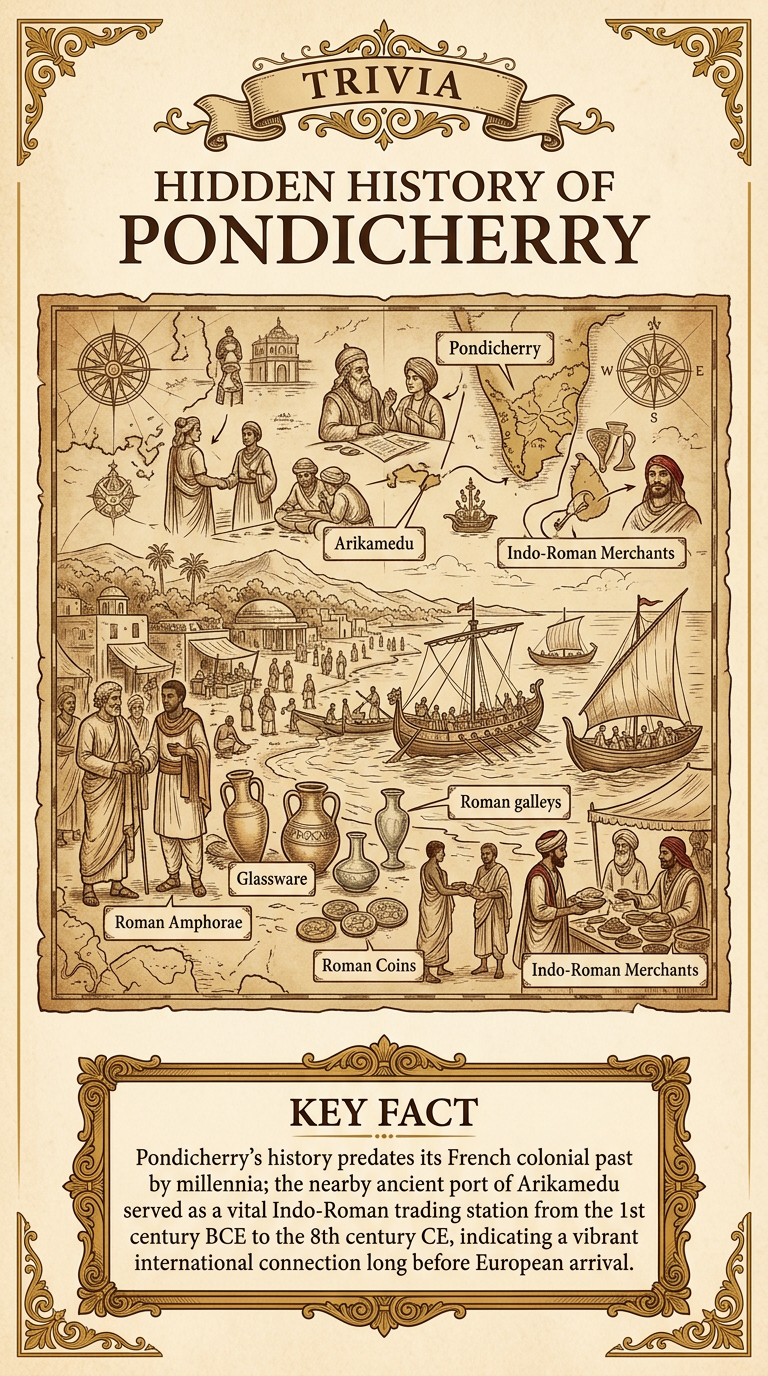
Hidden History of Pondicherry
Beneath its tranquil facade, Pondicherry harbors a rich tapestry of history far older and more complex than its French colonial chapter. Unearth the lesser-known sagas that shaped this captivating coastal town.
- Pondicherry's historical roots stretch back to ancient times, evidenced by the archaeological site of Arikamedu, just 4 kilometers away, which was a major Roman trading post as early as the 1st century BCE, exchanging goods like pottery and textiles.
- Before the French, Pondicherry was a significant port and a site of contestation between various powerful South Indian dynasties, including the Pallavas, Cholas, Pandyas, and the Vijayanagara Empire.
- During India's freedom struggle, Pondicherry served as a strategic haven for many Indian nationalists and revolutionaries seeking refuge from British rule, offering a safe haven due to its French sovereignty.
- The transfer of Pondicherry from French to Indian rule in 1954 was remarkably peaceful, culminating in a 'de facto' transfer on November 1, 1954, and a 'de jure' transfer only in 1962, marking a unique chapter in post-colonial history.
More Pondicherry Secrets
The Culinary Crossroads
Pondicherry's cuisine is a delicious melting pot, seamlessly blending traditional South Indian flavors with sophisticated French culinary techniques. Expect to find authentic French bakeries offering croissants and baguettes alongside vibrant Tamil thalis and seafood curries.
Don't miss the opportunity to try unique 'Creole' dishes, a fusion cuisine born from the intermingling of French and Indian palates, often featuring local spices with European cooking methods.
Auroville: The City of Dawn
Auroville, founded by Mirra Alfassa (The Mother) as a living experiment in human unity, is located just 15 km from Pondicherry. This universal township attracts residents from over 50 countries, all working towards spiritual evolution and sustainable living.
The Matrimandir, often referred to as the 'soul of Auroville', is an architectural marvel and a place for individual silent concentration, surrounded by 12 Gardens of the Soul, embodying peace and enlightenment.
The Historic Boulevard Town Planning
The city of Pondicherry is uniquely divided by a canal, separating the French Quarter (Ville Blanche) from the Tamil Quarter (Ville Noire). The French Quarter is characterized by wide boulevards, planned streets, and pastel-colored colonial buildings, while the Tamil Quarter features narrower lanes, vibrant homes, and traditional architecture with inner courtyards.
This distinct urban planning offers a fascinating visual and cultural journey as you move from one side of the canal to the other, revealing the layered identities of the city.
More Pondicherry Content Coming Soon
We're crafting a complete guide for Pondicherry. Stay tuned!
Explore More Trivia