
Rio de Janeiro, the 'Cidade Maravilhosa,' is much more than its iconic beaches and vibrant Carnival. It's a city where breathtaking natural beauty converges with a rich tapestry of engineering feats, hidden histories, and surprising cultural quirks, promising an endless journey of discovery for the curious traveler.
An Engineering or Architectural Marvel of Rio de Janeiro
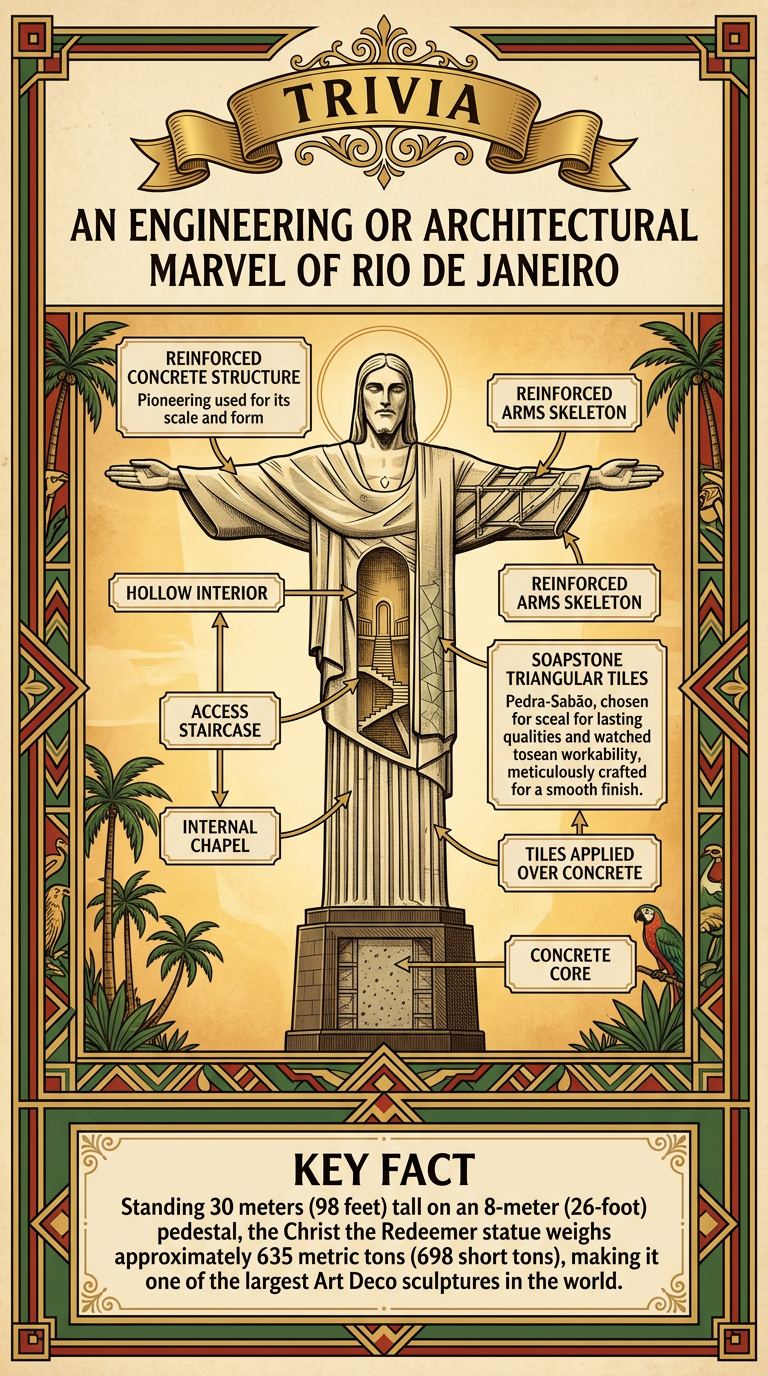
Perched atop Corcovado mountain, the Christ the Redeemer statue stands as a global icon and a remarkable testament to human ingenuity and faith. But beyond its stunning visage, it holds fascinating engineering secrets.
- The statue is made of reinforced concrete, chosen for its durability and cost-effectiveness, and covered in a mosaic of thousands of soapstone tiles, applied by local artisans.
- French sculptor Paul Landowski designed the figure, while Brazilian engineer Heitor da Silva Costa oversaw construction, with French engineer Albert Caquot providing structural calculations.
- Construction took nine years, from 1922 to 1931, requiring materials to be transported up the steep Corcovado mountain via a cog train, followed by manual labor to hoist and assemble.
- The statue is frequently struck by lightning, sometimes needing repairs. It's equipped with lightning rods, especially around its head and arms, to protect its structure.
Surprising Facts About Rio de Janeiro
Beyond its postcard-perfect beaches and vibrant Carnival, Rio de Janeiro harbors a wealth of surprising facts that challenge common perceptions and reveal its unique character.
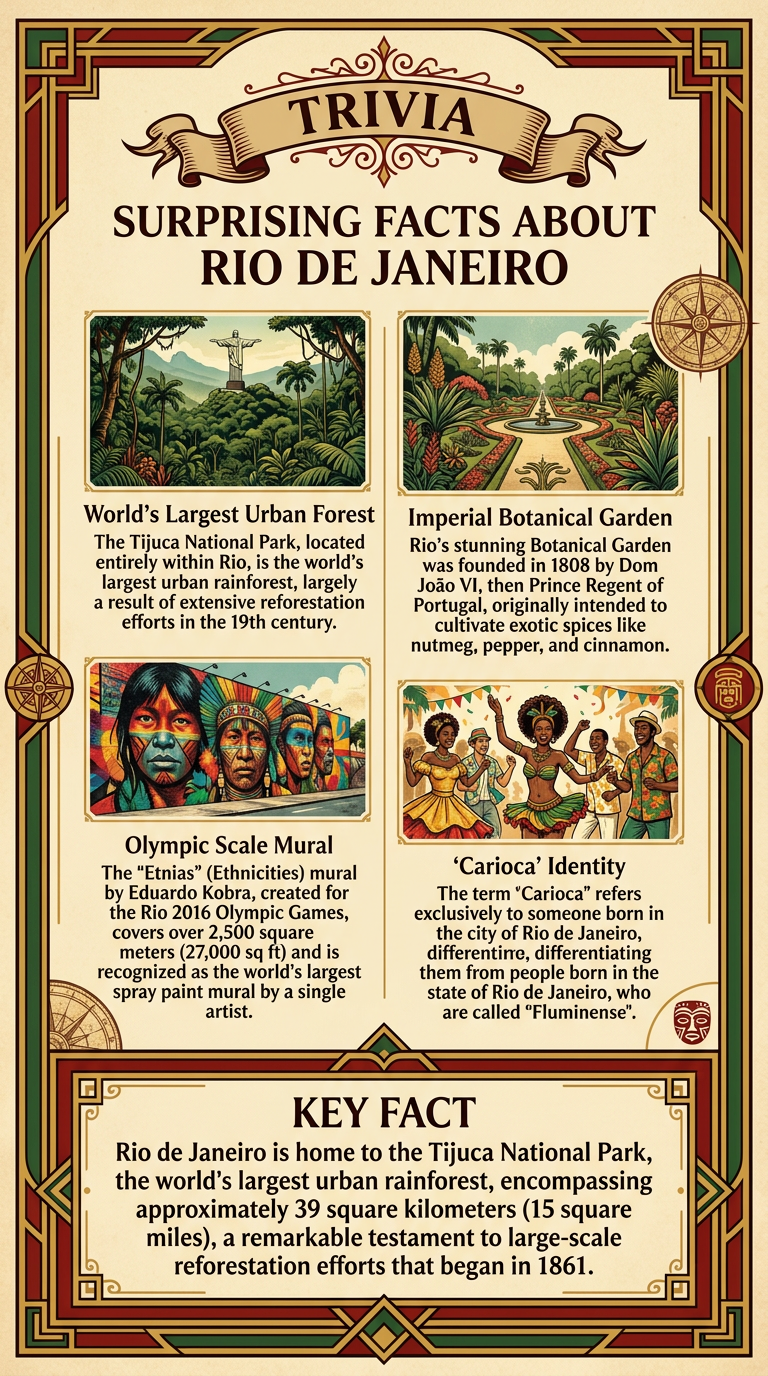
- **World's Largest Urban Forest:** The Tijuca National Park, located entirely within Rio, is the world's largest urban rainforest, largely a result of extensive reforestation efforts in the 19th century.
- **Imperial Botanical Garden:** Rio's stunning Botanical Garden was founded in 1808 by Dom João VI, then Prince Regent of Portugal, originally intended to cultivate exotic spices like nutmeg, pepper, and cinnamon.
- **Olympic Scale Mural:** The 'Etnias' (Ethnicities) mural by Eduardo Kobra, created for the Rio 2016 Olympic Games, covers over 2,500 square meters (27,000 sq ft) and is recognized as the world's largest spray paint mural by a single artist.
- **'Carioca' Identity:** The term 'Carioca' refers exclusively to someone born in the city of Rio de Janeiro, differentiating them from people born in the state of Rio de Janeiro, who are called 'Fluminense'.
Hidden History of Rio de Janeiro
Beneath the surface of Rio's vibrant modernity lies a deep, often challenging, history that reveals the city's complex past and its enduring legacies.
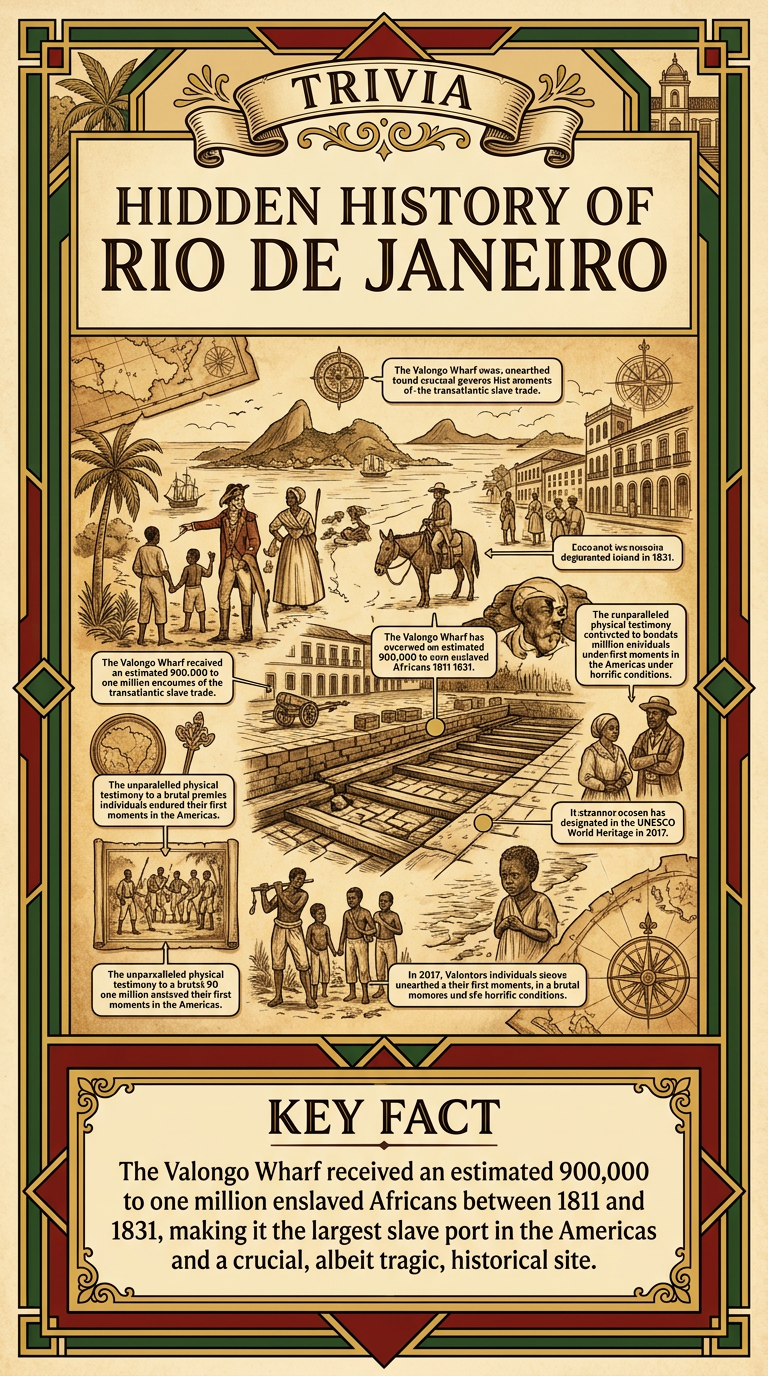
- The Valongo Wharf, a UNESCO World Heritage site, served as the primary entry point for enslaved Africans into Brazil, and indeed the Americas, between 1811 and 1831.
- Rio de Janeiro briefly became the capital of the Portuguese Empire from 1808 to 1821, after the Portuguese royal family fled Napoleon's invasion of Europe, making it the only European capital outside of Europe.
- The Arcos da Lapa (Lapa Arches), now a famous landmark for the Santa Teresa tram, were originally built in the mid-18th century as an aqueduct to bring fresh water from the Carioca River to the city center.
- Praça XV, a central square, was once the primary port and landing site for monarchs, emperors, and significant historical figures, marking the arrival point for the Portuguese royal family in 1808.
More Rio de Janeiro Secrets
The Sambódromo: A Stage for Passion
Designed by the legendary architect Oscar Niemeyer, the Sambódromo is a permanent parade ground where samba schools compete during Carnival. It's a marvel of urban planning, specifically created to host the spectacle, stretching for 700 meters.
Beyond Carnival, the Sambódromo is occasionally used for concerts, religious events, and other large-scale gatherings, though its true magic comes alive during the four days of intense samba parades in February or March.
Churrascaria: The Rodízio Experience
Brazilian churrascarias offer a unique dining style known as 'rodízio,' where an endless procession of waiters circulates with various cuts of grilled meat on skewers, slicing them directly onto your plate. You signal your preference with a two-sided card (green for 'more, please!' and red for 'I need a break').
This culinary tradition originated in the gaucho culture of Southern Brazil, where ranchers would cook large cuts of meat over open fires, and it has evolved into a sophisticated, all-you-can-eat feast that includes extensive salad bars and side dishes.
Escadaria Selarón's Colorful Legacy
The Escadaria Selarón, or Selarón Steps, is a vibrant, iconic staircase in Rio de Janeiro, meticulously adorned with over 2,000 colorful tiles from more than 60 countries. This masterpiece was the life's work of Chilean-born artist Jorge Selarón, who began renovating the dilapidated steps in 1990 as a tribute to the Brazilian people.
Selarón lived at the foot of the steps and worked on them tirelessly until his passing in 2013, funding his passion by selling paintings. The steps, connecting the Lapa and Santa Teresa neighborhoods, have become a symbol of creativity and cultural exchange, attracting visitors from around the globe.
More Rio de Janeiro Content Coming Soon
We're crafting a complete guide for Rio de Janeiro. Stay tuned!
Explore More Trivia