
Venice, the 'Floating City,' defies architectural logic and captivates with its unparalleled beauty. Built on a lagoon, this UNESCO World Heritage site is a testament to human ingenuity, where water isn't a barrier but an integral part of its identity, revealing surprising secrets at every turn.

An Engineering or Architectural Marvel of Venice
Beneath Venice's stunning palaces and churches lies an astonishing feat of ancient engineering. The entire city stands on a hidden forest of wooden piles, driven deep into the lagoon's soft clay.
- Millions of wooden piles, primarily made from resilient alder trees, form the foundational support for Venice's buildings.
- These piles are driven through layers of mud and sand until they reach a solid clay base, often 5-10 meters below the surface.
- Submerged in oxygen-deprived saltwater, the wood doesn't rot but petrifies, transforming into a stone-like substance over centuries.
- The Rialto Bridge, a testament to this engineering, stands on an estimated 6,000 wooden piles.
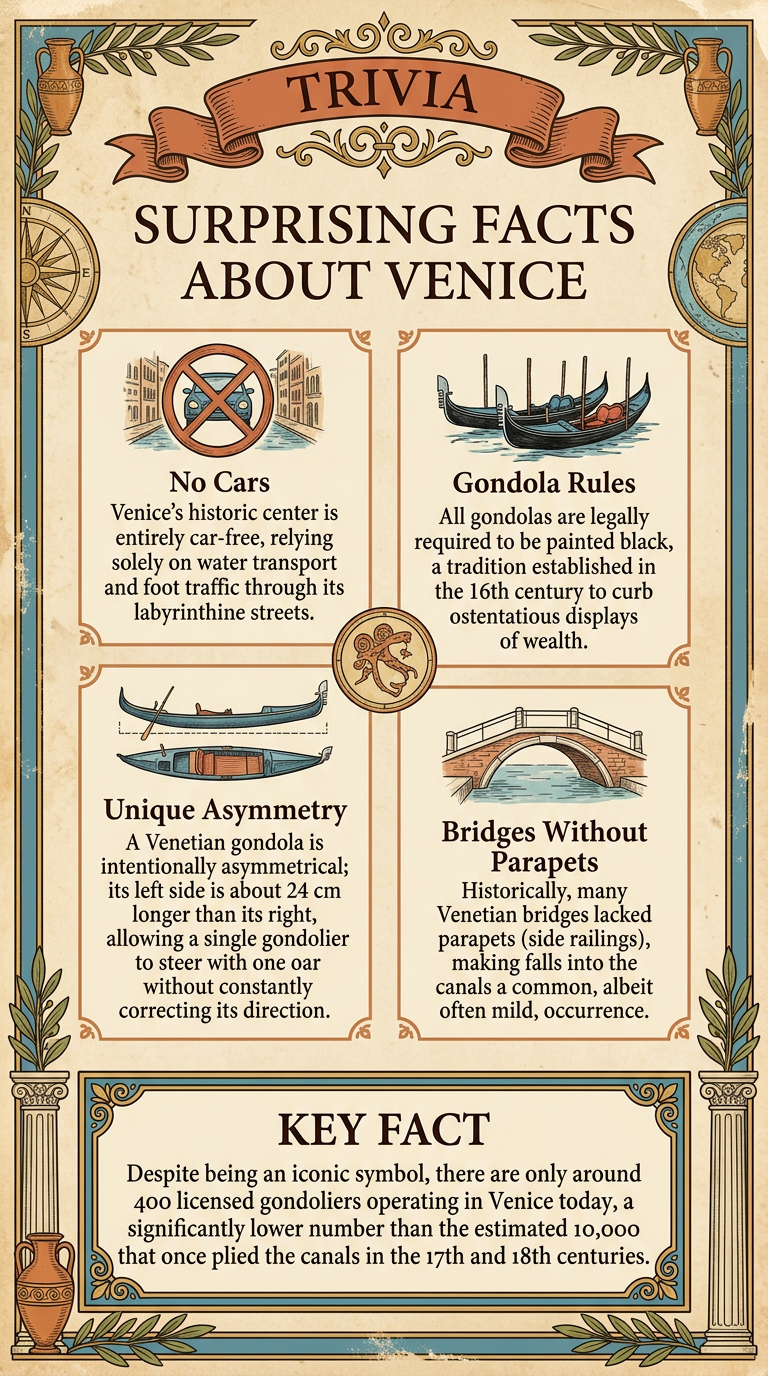
Surprising Facts About Venice
Beyond its postcard-perfect canals and piazzas, Venice holds numerous surprising facts that reveal its unique character and way of life. Prepare to have your perceptions challenged by these lesser-known quirks.
- **No Cars**: Venice's historic center is entirely car-free, relying solely on water transport and foot traffic through its labyrinthine streets.
- **Gondola Rules**: All gondolas are legally required to be painted black, a tradition established in the 16th century to curb ostentatious displays of wealth.
- **Unique Asymmetry**: A Venetian gondola is intentionally asymmetrical; its left side is about 24 cm longer than its right, allowing a single gondolier to steer with one oar without constantly correcting its direction.
- **Bridges Without Parapets**: Historically, many Venetian bridges lacked parapets (side railings), making falls into the canals a common, albeit often mild, occurrence.
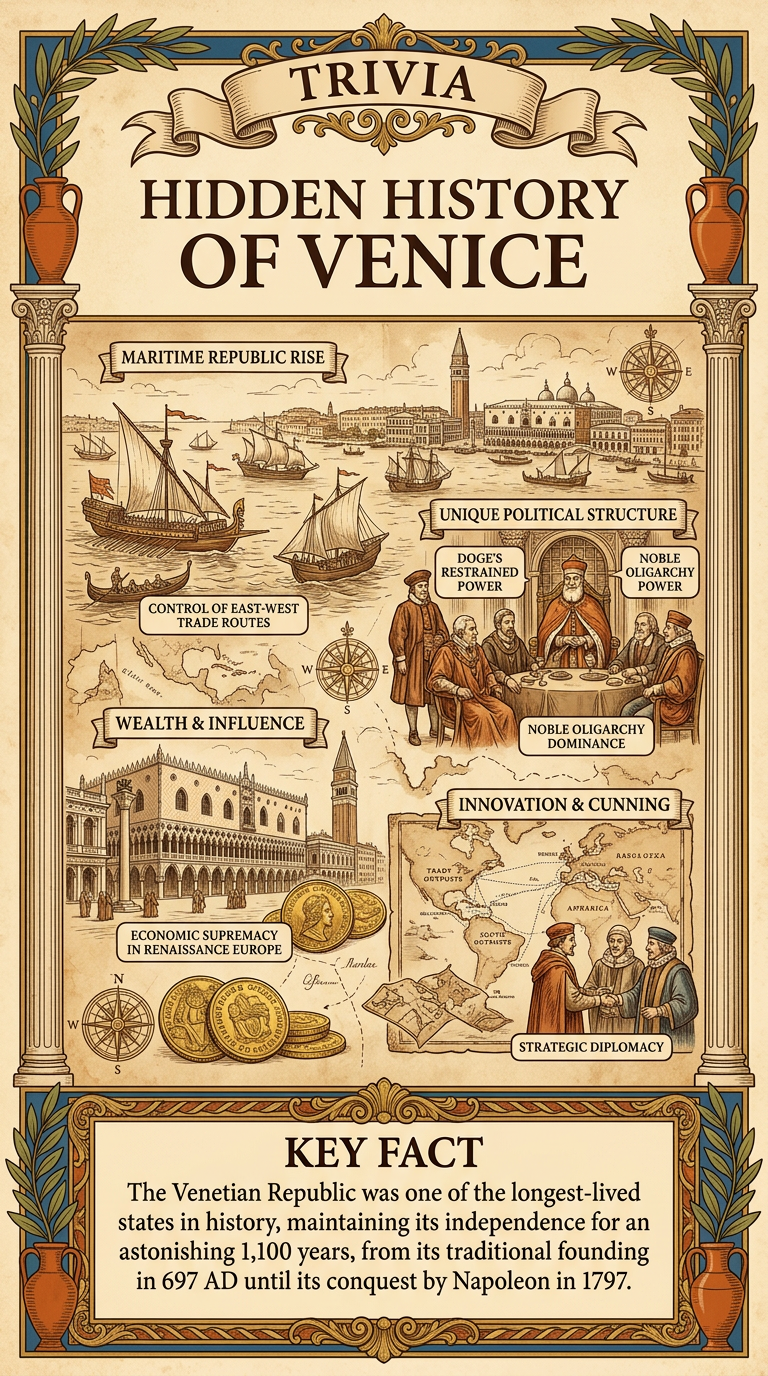
Hidden History of Venice
The Venetian Republic, a powerful maritime empire for over a millennium, harbored countless secrets, political intrigues, and cultural innovations that shaped the course of European history.
- Venice famously invented the concept of 'quarantine' during the Black Death, requiring ships to isolate for 'quaranta giorni' (forty days) on the island of Lazzaretto.
- The Doge of Venice, though head of state, was effectively a figurehead, with his power meticulously checked by a complex system of councils and committees.
- The city was a pioneer in intellectual property, enacting the world's first patent law in 1474 to protect inventors and foster innovation.
- Venice had a sophisticated and often feared secret police force, the 'Inquisitors of State,' who used a network of informants and even anonymous denunciation boxes ('Boche de Leon' - Lion's Mouths) to maintain control.
More Venice Secrets
The Sinking City Myth
While Venice is indeed experiencing subsidence (a natural geological settling) and is affected by rising sea levels, the dramatic notion of it 'sinking' into the sea is often exaggerated. The city's rate of subsidence has been measured at approximately 1-2 millimeters per year.
Modern engineering, including the MOSE flood barrier project, actively works to protect the city from high tides and ensures its preservation for future generations, indicating a proactive approach rather than imminent doom.
Acqua Alta and Venetian Life
Acqua Alta, or 'high water,' is a recurring phenomenon in Venice, particularly during autumn and winter, where exceptional tides flood low-lying areas. It's caused by a combination of astronomical tides, low atmospheric pressure, and strong scirocco winds pushing water into the Adriatic.
Venetians have developed ingenious ways to adapt, including elevated walkways (passerelle) for pedestrians and waterproof barriers for shops and homes. The massive MOSE barrier system, operational since 2020, now actively protects the lagoon from severe floods, significantly reducing the impact of acqua alta.
The Lion of Venice
The iconic winged lion of St. Mark is the enduring symbol of Venice. It represents the patron saint of the city and symbolizes Venetian power, independence, and evangelism.
Often depicted holding an open book (Pax tibi Marce, evangelista meus – 'Peace be with you Mark, my evangelist'), it signifies a time of peace, while a closed book and a sword symbolize a time of war or justice.
More Venice Content Coming Soon
We're crafting a complete guide for Venice. Stay tuned!
Explore More Trivia