
Vienna, the imperial capital of Austria, often evokes images of grand palaces, classical music, and elegant coffee houses. Yet, beneath its polished, aristocratic facade lies a city brimming with astonishing engineering feats, surprising contemporary facts, and a hidden history waiting to be unearthed.
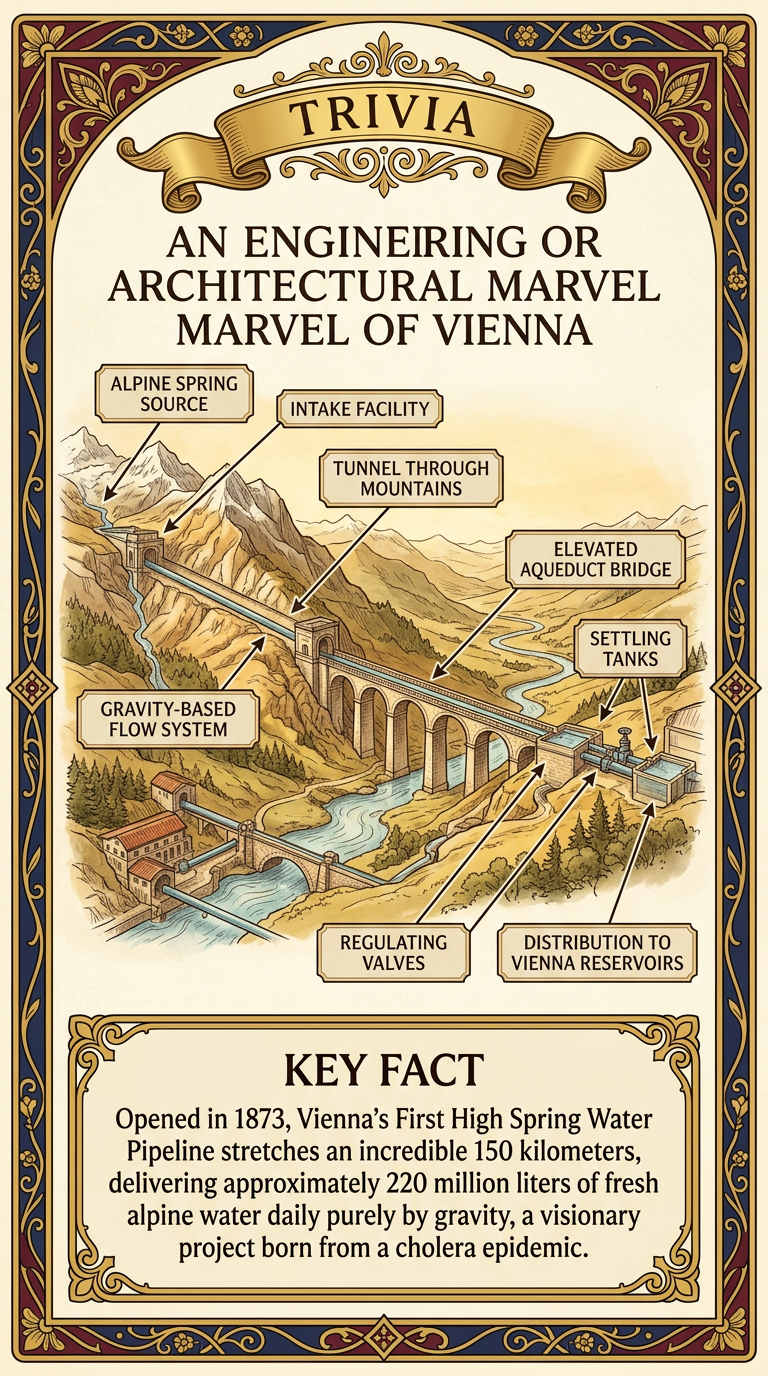
An Engineering or Architectural Marvel of Vienna
While Schönbrunn Palace and St. Stephen's Cathedral are architectural masterpieces, Vienna's most vital engineering marvel is often unseen but felt in every refreshing sip of water. Discover the incredible system that quenches the city's thirst.
- **Alpine Source:** Vienna's drinking water comes directly from the pristine Hochschwab and Rax-Schneeberg mountain regions in the Alps, some 150 kilometers away.
- **Gravity-Fed System:** The city's two main high spring water pipelines (Erste and Zweite Wiener Hochquellenwasserleitung) rely solely on gravity, with no pumps required, a marvel of 19th-century engineering.
- **Impressive Length:** The first pipeline, completed in 1873, spans 150 kilometers, while the second, finished in 1910, stretches an even longer 183 kilometers.
- **Purity & Taste:** This direct mountain source ensures Vienna's tap water is famously pure, cold, and delicious, often considered among the best in the world.
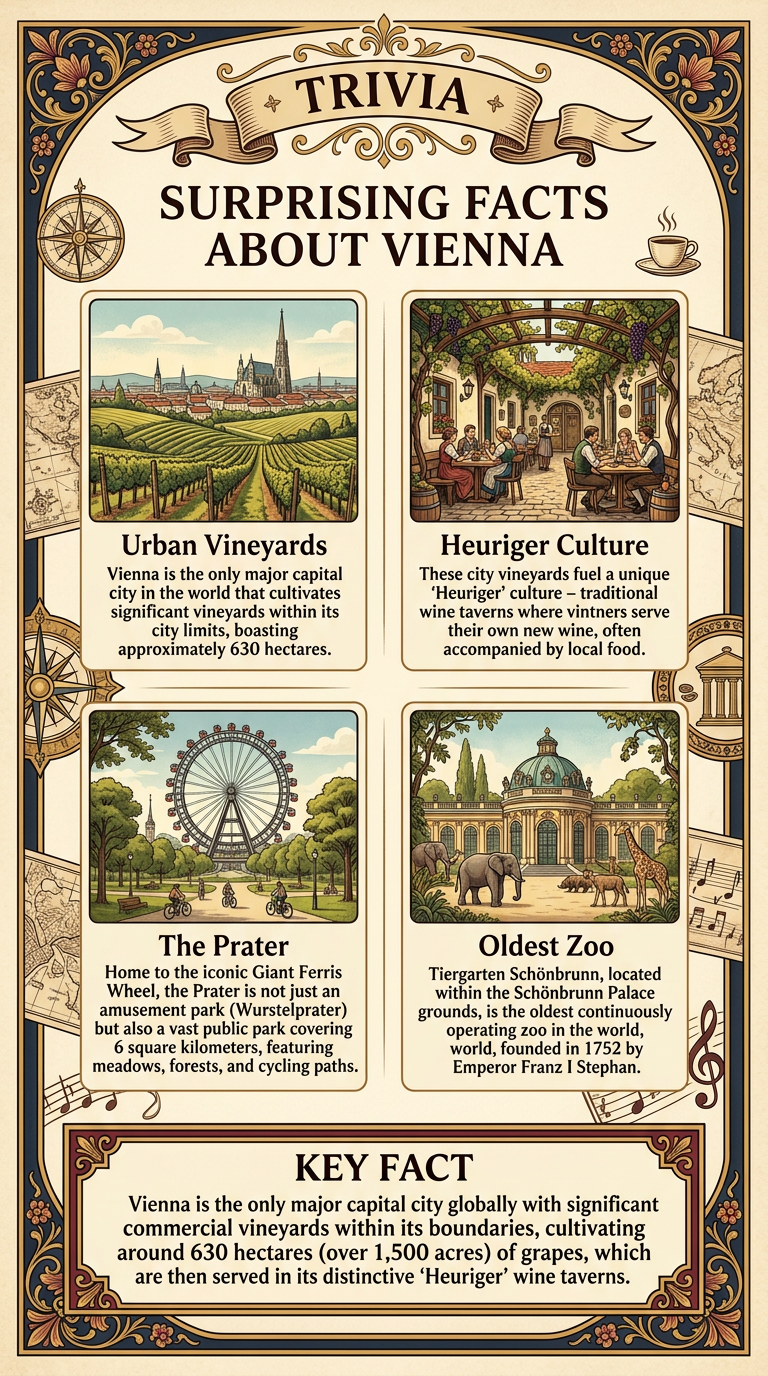
Surprising Facts About Vienna
Step beyond the waltz and schnitzel to uncover aspects of Vienna that defy expectations, revealing a city of unexpected green spaces, unique culinary traditions, and a surprisingly high quality of life.
- **Urban Vineyards:** Vienna is the only major capital city in the world that cultivates significant vineyards within its city limits, boasting approximately 630 hectares.
- **Heuriger Culture:** These city vineyards fuel a unique 'Heuriger' culture – traditional wine taverns where vintners serve their own new wine, often accompanied by local food.
- **The Prater:** Home to the iconic Giant Ferris Wheel, the Prater is not just an amusement park (Wurstelprater) but also a vast public park covering 6 square kilometers, featuring meadows, forests, and cycling paths.
- **Oldest Zoo:** Tiergarten Schönbrunn, located within the Schönbrunn Palace grounds, is the oldest continuously operating zoo in the world, founded in 1752 by Emperor Franz I Stephan.
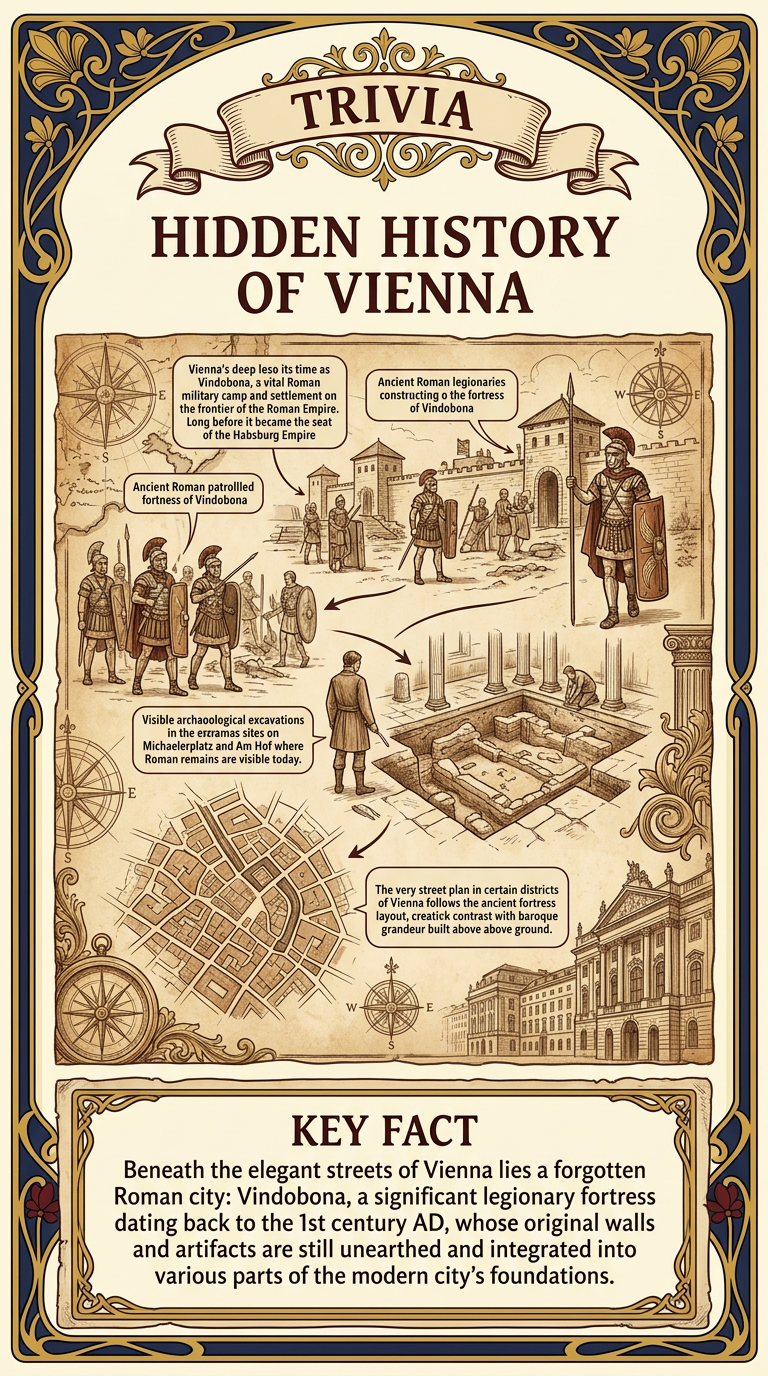
Hidden History of Vienna
Peel back the layers of Vienna's elegant present to uncover its deeper, more mysterious past, from ancient Roman roots to clandestine Cold War tales and the secrets held within its venerable crypts.
- **Roman Vindobona:** Beneath modern Vienna lie the remnants of Vindobona, a significant Roman legionary fortress dating back to the 1st century AD, with archaeological sites visible throughout the city.
- **'The Third Man' Sewers:** The city's extensive historic sewer system, famously featured in the 1949 film 'The Third Man,' is not only functional but also offers public tours, revealing a gritty underworld.
- **Imperial Crypt:** The Capuchin Crypt (Kaisergruft) houses the remarkably preserved remains of 149 Habsburgs, including 12 emperors and 19 empresses, in elaborate sarcophagi, a hidden necropolis beneath the city.
- **Cold War Espionage:** As a neutral city bordering the Iron Curtain during the Cold War, Vienna became a hotbed for spies, earning it the nickname 'City of Spies' and inspiring countless thrillers.
More Vienna Secrets
Vienna's Imperial Palaces and Gardens
Vienna is synonymous with imperial splendor, boasting an unparalleled collection of palaces and their expansive gardens. The Hofburg Palace, once the winter residence of the Habsburgs, now houses the Federal President's office, several museums including the Imperial Apartments and the Sisi Museum, and the Spanish Riding School. Its vast complex reflects centuries of architectural styles.
Beyond the city center lies Schönbrunn Palace, the magnificent former summer residence, famed for its Baroque architecture, sprawling formal gardens, the Gloriette, and the world's oldest zoo. Belvedere Palace, a stunning Baroque ensemble, showcases Klimt's 'The Kiss' and a significant collection of Austrian art.
The World of Viennese Coffee Houses
More than just establishments serving coffee, Viennese coffee houses are cultural institutions recognized by UNESCO as intangible cultural heritage. They serve as an 'extended living room' for many, providing newspapers, comfortable seating, and an atmosphere conducive to conversation, contemplation, and creativity. Historically, they were gathering places for artists, intellectuals, and revolutionaries.
From the grand Café Central with its vaulted ceilings to the traditional Café Hawelka, each coffee house has its own distinct charm and history. Enjoying a 'Melange' (Viennese cappuccino) with a slice of Sachertorte while reading the newspaper is an essential Viennese experience.
A City of Music: Beyond the Classics
Vienna's legacy as the 'City of Music' is undeniable, having nurtured greats like Mozart, Beethoven, Strauss, and Schubert. Its opera houses, concert halls (like the Musikverein and Konzerthaus), and the Vienna Boys' Choir continue to uphold this classical tradition with world-class performances nightly. The city is a pilgrimage site for classical music lovers.
However, Vienna's musical scene is also vibrant and diverse beyond the classics, offering a rich array of jazz clubs, contemporary music venues, and thriving electronic music scenes. From traditional folk music to cutting-edge performances, Vienna proves that its musical heart beats to many rhythms.
More Vienna Content Coming Soon
We're crafting a complete guide for Vienna. Stay tuned!
Explore More Trivia