
Perched on a rocky plateau in the Vindhya Range of Madhya Pradesh, Mandu (also spelled Mandav) is a sprawling fortress city where romance and ruin blur into one. Once the capital of the Malwa Sultanate, this 13th-to-16th-century citadel sprawls across roughly 20 square kilometres of plateau, its sandstone palaces, mosques, pavilions and step-wells scattered among baobab trees, lily ponds and grazing fields. Mandu is forever linked to the legend of Baz Bahadur and the singer-queen Rupmati, whose love story plays out across its hilltop pavilions. The architecture is striking for its restraint and proportion, an early Afghan-influenced style that later inspired the Mughals; the Jahaz Mahal seems to float between two lakes, while the Jami Masjid borrows its grandeur from Damascus. Mandu is at its most magical in the monsoon, when clouds roll over the ramparts and the parched plateau erupts in green. With far fewer crowds than Rajasthan's forts, it rewards slow exploration on foot or cycle. An easy weekend escape from Indore (about 90 km away), Mandu offers history, sweeping valley views and the kind of unhurried calm that has all but vanished from India's better-known heritage towns.
Top Attractions
Jahaz Mahal (Ship Palace)
Mandu's signature monument, a graceful 120-metre-long pavilion wedged between the Munj and Kapur lakes so it appears to sail on water during the rains. Built in the late 15th century, it has airy terraces, bathing pools, water channels and rooftop kiosks designed to catch the breeze. Climb to the roof for reflections of the domes in the lakes below, especially atmospheric at sunset.
Visitor Information
- Entry Fee: INR 25 (Indians), INR 300 (foreigners), part of the Royal Enclave ticket
- Hours: Sunrise to sunset (approx 8 AM to 6 PM)
- Best Time: Late afternoon for golden light and lake reflections
- Tip: The same ticket covers Hindola Mahal and the wider Royal Enclave, so budget at least two hours here.
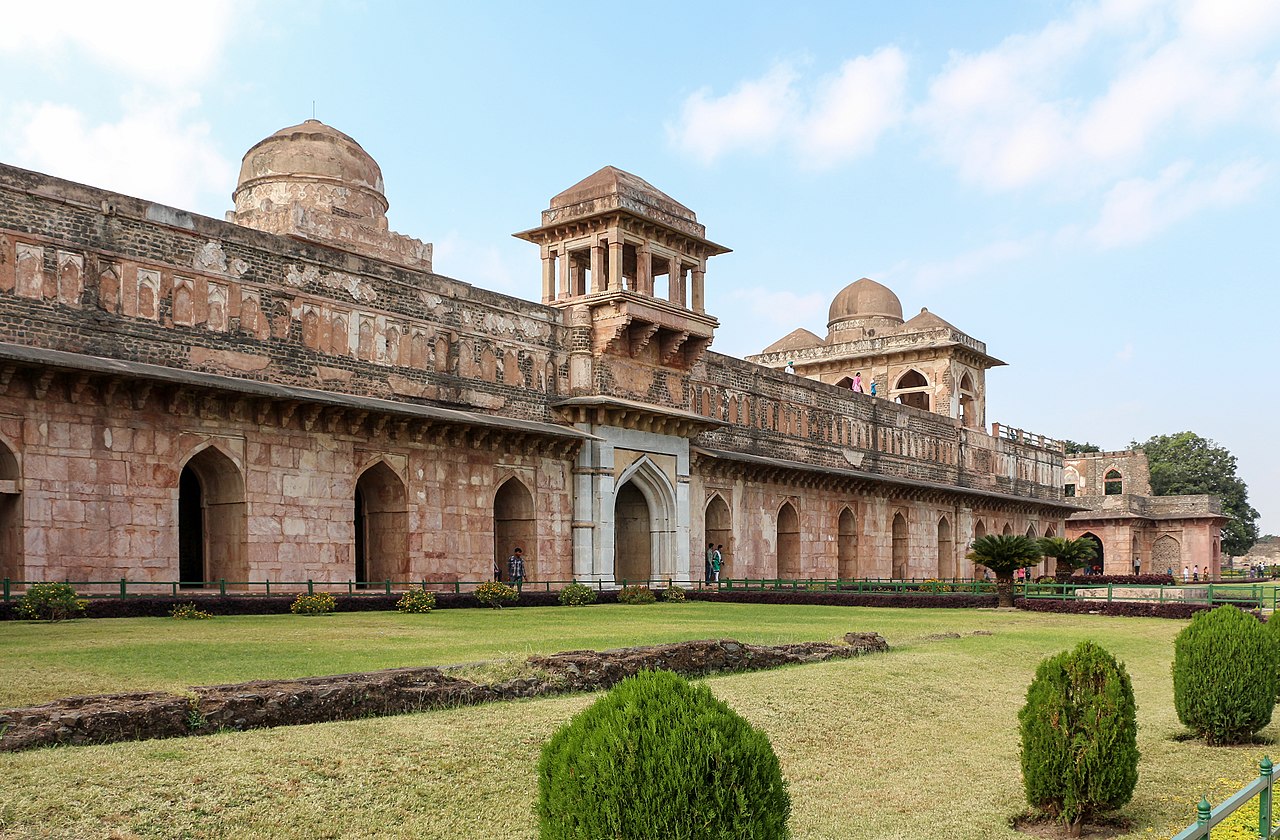
Hindola Mahal (Swinging Palace)
Named for its dramatically sloping buttressed walls that create the illusion of a swing, this T-shaped audience hall sits within the Royal Enclave. The thick battered walls and tall arched openings make it one of Mandu's most photogenic and structurally curious buildings. Once used for durbars and ceremonies, its bare, echoing interior is a fine spot to appreciate the engineering of the Malwa sultans.
Visitor Information
- Entry Fee: Included in Royal Enclave ticket (INR 25 Indians / INR 300 foreigners)
- Hours: Sunrise to sunset
- Best Time: Morning, when light rakes across the sloping walls
- Tip: Stand at the base and look up the angled walls for the classic 'leaning' photograph.
Jami Masjid & Hoshang Shah's Tomb
The grand Jami Masjid, modelled on the great mosque of Damascus, is a vast red-sandstone congregational mosque with a huge courtyard, rows of domes and a finely proportioned prayer hall. Just behind it stands Hoshang Shah's Tomb, India's earliest marble structure, whose latticed screens and dome are said to have inspired the architects of the Taj Mahal, who reportedly studied it.
Visitor Information
- Entry Fee: INR 25 (Indians), INR 300 (foreigners)
- Hours: Sunrise to sunset
- Best Time: Mid-morning for soft light in the courtyard
- Tip: Look for the inscription where Shah Jahan's craftsmen recorded their visit to study the marble tomb.
Rupmati's Pavilion & Baz Bahadur's Palace
Perched at the southern edge of the plateau, Rupmati's Pavilion offers Mandu's most sweeping view, a sheer drop to the Narmada valley far below. According to legend, the singer-queen Rupmati gazed at the distant river from here. The adjacent Baz Bahadur's Palace, with its broad terraces and courtyards, completes the romantic setting of one of India's most enduring love stories.
Visitor Information
- Entry Fee: Nominal, around INR 25 (Indians) / INR 300 (foreigners)
- Hours: Sunrise to sunset
- Best Time: Sunrise or sunset for the valley panorama
- Tip: On clear monsoon mornings you can sometimes glimpse the Narmada river glinting in the valley below.
Rewa Kund & the Lakes
Rewa Kund is a sacred tank near Rupmati's Pavilion, traditionally believed to have supplied water to Rupmati's quarters through an ingenious lift system. Together with Mandu's other reservoirs and step-wells, it reflects the medieval engineering that allowed a whole city to thrive on a waterless plateau. The surrounding fields and ponds, dotted with lotus, are peaceful and largely tourist-free.
Visitor Information
- Entry Fee: Free
- Hours: Open access, best in daylight
- Best Time: Monsoon and post-monsoon, when the tanks brim with water
- Tip: Combine it with the Rupmati-Baz Bahadur cluster, as they sit close together at the plateau's edge.
Darwaza Gates & the Fort Ramparts
Mandu is ringed by a 37-km fortification wall pierced by a series of monumental gateways, the grandest being Delhi Darwaza. Driving or cycling between the city's monument clusters takes you through these soaring stone arches and past crumbling bastions, baobab groves and open meadows. The gates frame the approach to the plateau and give a real sense of Mandu's scale as a self-contained walled city.
Visitor Information
- Entry Fee: Free to pass through
- Hours: Anytime
- Best Time: Early morning light for photographing the gateways
- Tip: Hire a cycle to roam between the gates; distances between sights are too far to comfortably walk.
Food & Local Flavours
Mandu's food is rustic Malwa-region fare, with the local baobab fruit a quirky speciality.
Imli (Baobab) products
Mandu is dotted with African baobab trees, locally called imli, and their tangy, vitamin-rich fruit is turned into sherbet, candies, jam and powder sold by roadside vendors. The cooling baobab drink is a refreshing local oddity found almost nowhere else in India and makes a memorable, easy-to-carry souvenir of the plateau.
Price: INR 20 to 150 depending on item
Try: Roadside stalls near the Royal Enclave and main bazaar
Dal Bafla
Malwa's signature comfort dish and a cousin of Rajasthan's dal-baati. Wheat-flour dough balls are boiled, then baked and soaked in ghee, and served with spiced lentil dal and chutney. Hearty, ghee-laden and deeply satisfying, it is the meal locals will most readily recommend after a day of monument-hopping.
Price: INR 80 to 180 per plate
Try: Local dhabas and MP Tourism's restaurant
Poha-Jalebi
The classic Madhya Pradesh breakfast: flattened-rice poha tempered with mustard, onions and sev, paired with crisp, syrupy jalebi. Light, savoury-sweet and cheap, it is how most of Malwa starts the day and is widely available at Mandu's small eateries and on the road from Indore.
Price: INR 30 to 70
Try: Morning stalls and small cafes in Mandu town
Malwa Thali
A wholesome regional thali of rotis, seasonal sabzi, dal, rice, papad and pickle, often with a sweet. Simple, vegetarian and filling, it is the reliable lunch option at MP Tourism properties and family-run eateries, giving a good cross-section of everyday Madhya Pradesh home cooking.
Price: INR 150 to 300
Try: MP Tourism Malwa Resort and local restaurants
Practical Information
Getting Around
- Auto-rickshaw: INR 100 to 400 — handy for short hops between nearby monument clusters
- Rented bicycle: INR 100 to 200 per day — the best way to roam the plateau at your own pace
- Hired car/taxi from Indore: INR 2,000 to 3,500 round trip — most convenient for a day or weekend visit
- On foot: free — fine within a single cluster, but distances between groups are too far to walk entirely
Budget Guide (Per Day)
- Budget: INR 1,200 to 2,000 (~$15-24): basic guesthouse or MP Tourism dorm, local dhaba meals, a rented cycle and entry tickets
- Mid-range: INR 3,000 to 5,500 (~$36-66): a comfortable room at MP Tourism Malwa Resort or a heritage stay, sit-down meals and a hired car
- Luxury: INR 7,000+ (~$84+): premium heritage or resort stay, private guide, dedicated car and curated dining
Best Time to Visit
- July to September (monsoon): the plateau turns lush green, lakes fill and clouds drift over the palaces, Mandu at its most romantic
- October to March (winter): pleasant, dry days ideal for sightseeing and the most popular travel window
- April to June (summer): hot and dry, best avoided unless you want quiet, crowd-free monuments
Interactive Map
Explore Mandu on the map.
Image Credits
Mandu — Bernard Gagnon, CC BY-SA 3.0 via Wikimedia Commons