
On the banks of the Malaprabha river in Bagalkot district, Pattadakal is a serene cluster of 7th- and 8th-century temples that earned its place on the UNESCO World Heritage list in 1987. Once a royal coronation and ceremonial site of the Chalukya dynasty, it served as their architectural laboratory, where builders experimented freely and fused the curvilinear Nagara towers of North India with the stepped, pyramidal Dravidian vimanas of the South. The result is an open-air gallery of temple design unlike anywhere else in the country. Ten major temples, mostly dedicated to Shiva, stand together on a grassy plateau, framed by sandstone the colour of honey. The grandest, the Virupaksha and Mallikarjuna temples, were raised by Chalukyan queens to mark a military victory and still carry richly carved walls depicting scenes from the Ramayana, Mahabharata and Puranas. Quieter and far less crowded than Hampi, Pattadakal rewards travellers who linger over its detail: every pillar, lintel and ceiling panel tells a story. Together with nearby Badami and Aihole, it completes a triangle that traces the very birth of South Indian temple building, making it essential for anyone drawn to history, sculpture and the slow craft of stone.
Top Attractions
Virupaksha Temple
The largest and most complete temple in the complex, built around 740 CE by Queen Lokamahadevi to celebrate her husband Vikramaditya II's victory over the Pallavas. A fine example of Dravidian style, it has a square vimana, a pillared hall and one of the earliest monolithic Nandi pavilions facing the sanctum. Its walls carry detailed narrative panels from the Ramayana and Mahabharata, and it remains an active place of worship.
Visitor Information
- Entry Fee: INR 40 (Indians), INR 600 (foreigners), covers whole complex
- Hours: Sunrise to sunset, daily
- Best Time: Early morning for soft light and fewer crowds
- Tip: Look up at the ceiling panels and the carved pillars inside the mandapa, where the finest storytelling carvings hide.
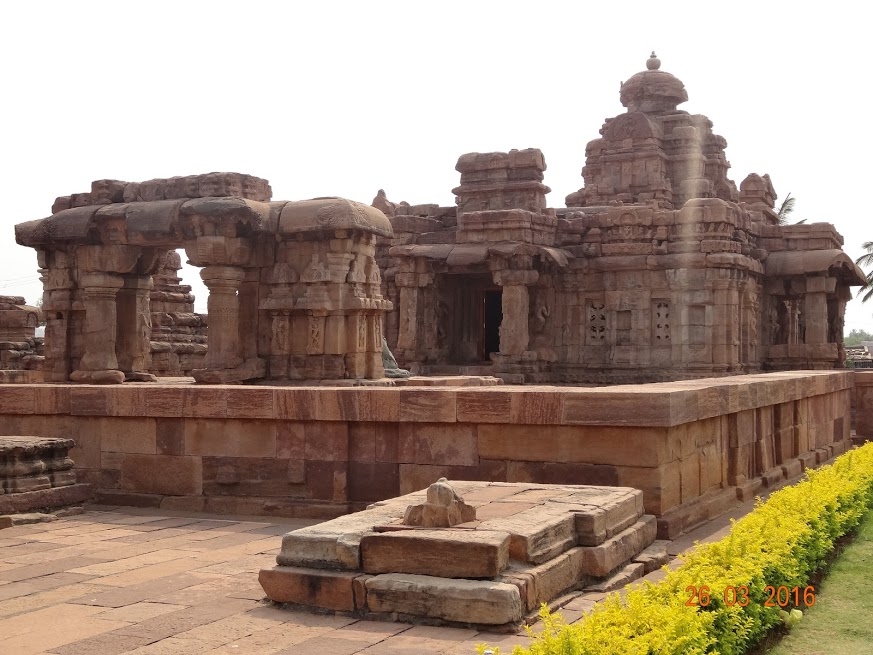
Mallikarjuna Temple
Standing right beside the Virupaksha and almost a twin of it, this Dravidian-style temple was commissioned by Queen Trilokamahadevi, the king's other queen, to mark the same Pallava victory. Slightly smaller, it features a four-storeyed vimana and exquisite carvings of dwarfs, couples and scenes from the Panchatantra and Krishna legends. Its pillars and ceiling medallions reward slow, close inspection.
Visitor Information
- Entry Fee: Included in complex ticket
- Hours: Sunrise to sunset, daily
- Best Time: Morning, alongside the Virupaksha
- Tip: Compare its proportions with the neighbouring Virupaksha to see how two queens built rival masterpieces.
Sangameshwara Temple
The oldest surviving temple at Pattadakal, begun under King Vijayaditya in the early 8th century and left partly unfinished. Built in solid Dravidian style with a sturdy, three-storeyed tower, it has a circumambulatory passage around the sanctum. Its relatively plain surfaces and massive blocks give it a powerful, archaic feel compared with the ornate temples nearby.
Visitor Information
- Entry Fee: Included in complex ticket
- Hours: Sunrise to sunset, daily
- Best Time: Anytime; quiet through the day
- Tip: Notice the unfinished carving work, a rare window into how these temples were actually built.
Papanatha Temple
Set a short walk south of the main cluster, this temple is the finest example of the Nagara, or North Indian, style at Pattadakal, with a curvilinear shikhara. Its long hall and outer walls are covered with some of the site's most detailed Ramayana and Mahabharata friezes, several inscribed with the names of the sculptors who carved them, a rare touch of personal pride in stone.
Visitor Information
- Entry Fee: Included in complex ticket
- Hours: Sunrise to sunset, daily
- Best Time: Late afternoon for warm light on the carvings
- Tip: Trace the Ramayana panels along the outer wall in sequence, like reading a comic strip in stone.
Kashi Vishwanatha & Galaganatha Temples
These two smaller temples showcase the Nagara style and the contrast it offers within one complex. The Kashi Vishwanatha has a finely carved ceiling and tower, while the Galaganatha, though partly ruined, retains a tall curvilinear shikhara and a striking panel of Shiva slaying the demon Andhaka. Together they round out Pattadakal's lesson in mixing architectural traditions.
Visitor Information
- Entry Fee: Included in complex ticket
- Hours: Sunrise to sunset, daily
- Best Time: Mid-morning
- Tip: Spot the Andhakasura panel on the Galaganatha, one of the most dramatic carvings on site.
Aihole (day-trip pairing)
About 15 km from Pattadakal, Aihole is an even older Chalukyan site often called the cradle of Indian temple architecture, with over a hundred temples scattered across the village. The Durga temple, with its unusual apsidal plan, and the Lad Khan temple are highlights. Visiting Pattadakal, Aihole and Badami together traces the full evolution of South Indian temple design.
Visitor Information
- Entry Fee: Separate ticket, around INR 25 (Indians), INR 300 (foreigners) for Durga temple
- Hours: Sunrise to sunset, daily
- Best Time: Combine as a half-day trip from Pattadakal
- Tip: Hire a single auto or taxi for the day to cover Pattadakal, Aihole and Badami efficiently.
Food & Local Flavours
Food near Pattadakal is simple, hearty North Karnataka fare, best sampled in nearby Badami where most travellers base themselves.
Jowar Roti (Jolada Rotti)
The staple of North Karnataka, a flat, slightly crisp unleavened bread made from sorghum flour. It is served with spicy curries, lentils and a fiery garlic-chilli chutney (chutney pudi). Filling and earthy, it is the dish that defines everyday eating across the Bagalkot region.
Price: INR 60 to 120 per thali
Try: Local dhabas and thali joints in Badami and Pattadakal village
North Karnataka Veg Thali
A generous platter built around jowar roti or rice, with seasonal vegetable curries, dal, sambar, palya (dry vegetable stir-fry), curd, papad and that signature chutney powder. It is the most reliable, satisfying meal in the area and excellent value for hungry temple-hoppers.
Price: INR 100 to 200
Try: Hotel Badami Court and small eateries near Badami bus stand
Girmit & Mirchi Bajji
A popular North Karnataka street snack, girmit is a tangy, spicy puffed-rice mixture tossed with onions, chutney and crunchy sev, usually paired with a deep-fried, batter-coated green chilli bajji. Light, zesty and ideal as an afternoon bite between temple visits.
Price: INR 30 to 70
Try: Street stalls and snack carts in Badami town
Filter Coffee & Local Chai
Strong South Indian filter coffee and milky, spiced chai are served at nearly every tea stall, offering a welcome break from the heat. Pair with a hot vada or bonda from a roadside cart for a classic, inexpensive pick-me-up while exploring the monuments.
Price: INR 15 to 40
Try: Tea stalls near the Pattadakal complex entrance and Badami
Practical Information
Getting Around
- Auto-rickshaw: INR 100 to 300 — short hops within the complex area and to nearby villages
- Taxi / hired car: INR 1,500 to 3,000 per day — best for the Pattadakal-Aihole-Badami circuit
- Local bus: INR 20 to 60 — KSRTC buses connect Badami, Pattadakal and Aihole frequently
- On foot: free — the temple complex itself is compact and easily walked
Budget Guide (Per Day)
- Budget: INR 1,200 to 2,000 (~$15 to 24): basic guesthouse in Badami, local thalis, bus and shared autos
- Mid-range: INR 3,000 to 5,500 (~$36 to 66): comfortable hotel, hired car for the temple circuit, sit-down restaurant meals
- Luxury: INR 8,000+ (~$96+): best available hotel or heritage stay, private guide, dedicated driver and unhurried touring
Best Time to Visit
- November to February: cool, dry weather ideal for walking the open-air complex
- October & March: pleasant shoulder months with fewer crowds and good light
- Avoid April to June: the Deccan summer is intensely hot with little shade on site
Interactive Map
Explore Pattadakal on the map.
Plan Your Trip
Build a personalised day-by-day itinerary for Pattadakal in 60 seconds.
Open Trip PlannerImage Credits
Pattadakal — MP Bharath Kumar, CC BY-SA 4.0 via Wikimedia Commons