
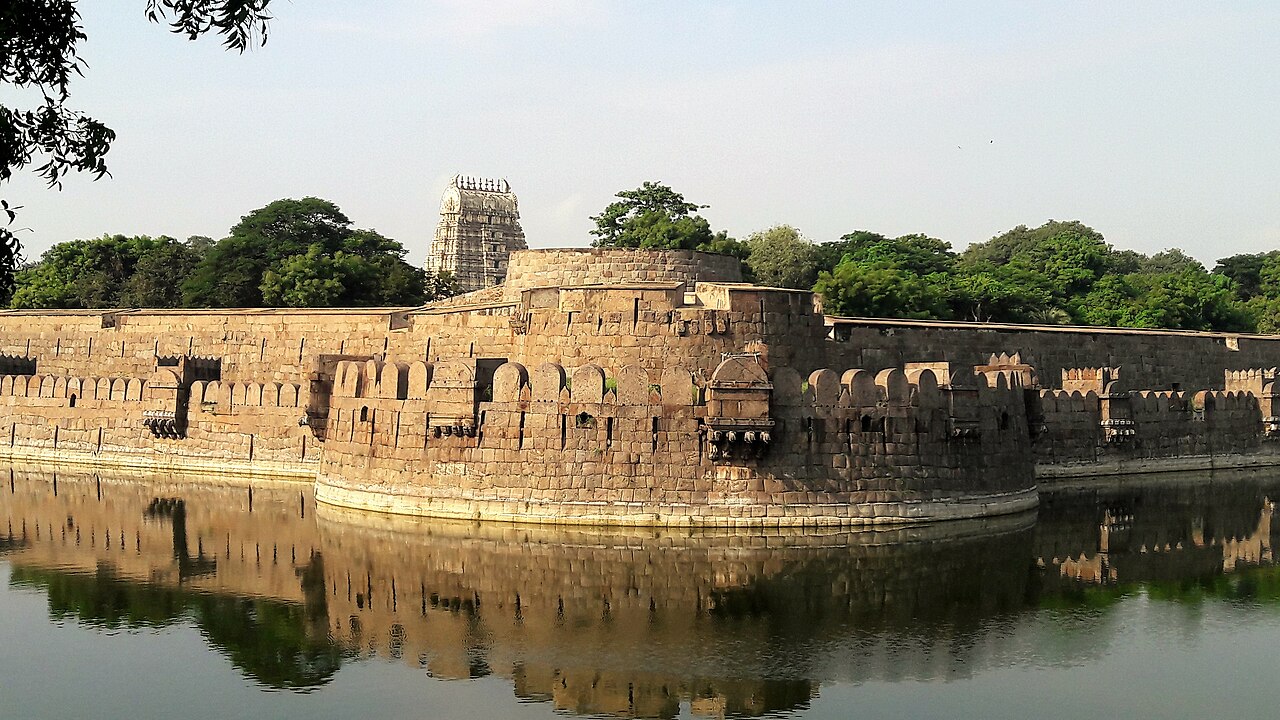
Rising from the heart of Vellore city in Tamil Nadu, Vellore Fort is one of South India's most impressive military monuments, built largely in the 16th century during the rule of the Vijayanagara Empire. Constructed entirely of solid granite and surrounded by a broad moat once stocked with crocodiles, the fort has changed hands many times over the centuries, passing through the Bijapur sultans, the Marathas, the Carnatic Nawabs and finally the British East India Company. Its ramparts witnessed a pivotal moment in colonial history: the Vellore Mutiny of 1806, India's first major uprising of Indian sepoys against the British, predating the better-known 1857 rebellion by half a century. Today the sprawling complex is remarkable for its religious harmony, sheltering a Hindu temple, a Christian church and a Muslim mosque within the same walls. Wandering inside, visitors encounter ornate Dravidian carvings, government offices, a museum and peaceful lawns. Designated a monument of national importance and maintained by the Archaeological Survey of India, the fort is also home to a temple managed separately by Tamil Nadu's HR&CE department. Compact, walkable and free to enter, Vellore Fort makes an absorbing half-day stop for history lovers and architecture enthusiasts alike.
Top Attractions
Jalakandeswarar Temple
This 16th-century Shiva temple is the architectural jewel within the fort, named for a deity once surrounded by water. Built in the Vijayanagara style, it dazzles with intricately carved granite pillars, mythological friezes and a sculpted gopuram. The mandapa with its ornate monolithic columns is a highlight. Used as an arsenal during British rule, it was reconsecrated in the 20th century and remains an active place of worship.
Visitor Information
- Entry Fee: Free
- Hours: Roughly 8:30 AM - 6:00 PM (worship timings vary)
- Best Time: Early morning for cooler temple courtyards and softer light
- Tip: Photography is often restricted inside the inner sanctum, so ask before raising your camera.
Government Museum, Vellore
Located inside the fort precincts, this museum showcases artefacts spanning the region's history, including prehistoric tools, sculptures, coins, weapons, hero stones and natural-history exhibits. It offers helpful context on the dynasties that ruled Vellore and the surrounding North Arcot district, making it a worthwhile stop to understand the fort's layered past before exploring the ramparts.
Visitor Information
- Entry Fee: Nominal, around INR 5-15
- Hours: Approximately 9:30 AM - 5:00 PM, closed Fridays
- Best Time: Mid-morning, after touring the temple
- Tip: Galleries can be quiet on weekdays, giving you an unhurried look at the displays.
St. John's Church
Built by the British East India Company in the early 19th century, this colonial-era Anglican church sits within the fort walls, a reminder of the British military presence. Its simple yet elegant architecture, arched windows and old graveyard reflect the era when Vellore served as a garrison town. The church stands as part of the fort's remarkable mix of three faiths sharing one enclosure.
Visitor Information
- Entry Fee: Free
- Hours: Exterior viewable during fort hours; interior access varies
- Best Time: Daytime, alongside the rest of the complex
- Tip: The adjacent old cemetery has weathered colonial tombstones worth a respectful look.
Fort Ramparts and Moat
The fort's defining feature is its massive granite curtain wall, set with round bastions and ringed by a wide moat that once held crocodiles to deter attackers. Walking the perimeter, you can appreciate the scale of the construction and the strategic double walls. The main gateway and drawbridge area give a real sense of the stronghold's formidable defences against centuries of sieges.
Visitor Information
- Entry Fee: Free
- Hours: Open daily, roughly 8:00 AM - 6:00 PM
- Best Time: Late afternoon for golden light on the granite
- Tip: Walk the full circuit of the lawns to see the moat from several angles.
Tipu Mahal and Hyder Mahal Ruins
Within the fort lie remnants associated with Tipu Sultan and Hyder Ali of Mysore, whose family was held here. After the fall of Srirangapatna, members of Tipu Sultan's family were detained at Vellore Fort, and these structures carry that poignant history. The surviving walls and chambers add a Mysore-era chapter to the fort's already crowded timeline of rulers.
Visitor Information
- Entry Fee: Free
- Hours: Daylight hours within the fort complex
- Best Time: Combine with a rampart walk
- Tip: Information boards are sparse, so read up beforehand to appreciate the significance.
Government Mosque
Completing the fort's trio of faiths, a mosque stands within the walls, dating from the period of Muslim rule under the Carnatic Nawabs and earlier sultanates. Modest in scale, it underlines the religious coexistence that makes Vellore Fort unusual among Indian forts, where a temple, church and mosque all share the same historic enclosure.
Visitor Information
- Entry Fee: Free
- Hours: Prayer timings vary; exterior viewable during fort hours
- Best Time: Daytime
- Tip: Dress modestly and remove footwear if entering during prayer times.
Food & Local Flavours
Vellore's food scene is hearty South Indian fare with strong Chettinad and Muslim culinary influences, best sampled at the eateries just outside the fort.
Chettinad Chicken
A fiery, aromatic curry rooted in the nearby Chettinad region, made with freshly ground spices like star anise, fennel, stone flower and black pepper. Rich, peppery and deeply flavourful, it is usually served with rice, dosa or parotta and is a regional must-try for anyone who enjoys bold, spicy cooking.
Price: INR 150-300
Try: Chettinad-style restaurants around Vellore town
Parotta with Salna
A Tamil Nadu street-food staple of flaky, layered flatbread served with salna, a thin spiced gravy. Flipped and slapped into shape by skilled cooks, parottas are best eaten hot, often paired with chicken or egg salna. Cheap, filling and ubiquitous, it is the classic quick meal near the fort.
Price: INR 40-120
Try: Roadside stalls and mess hotels near the fort
Filter Coffee and Tiffin
Start the day the Tamil way with idli, dosa, vada and pongal, washed down with strong South Indian filter coffee served in a steel tumbler and dabarah. Local tiffin centres serve these crisp, soft and steaming throughout the morning, offering a light, satisfying and inexpensive breakfast before fort-hopping.
Price: INR 30-120
Try: Tiffin centres and hotels across Vellore
Biryani, Vellore Style
Vellore and the wider Arcot region are known for fragrant seeraga samba rice biryani layered with marinated meat and spices, reflecting the Nawabi culinary legacy. Less heavy than Hyderabadi versions, it has a distinctive short-grain texture and is typically served with raita and a boiled egg.
Price: INR 120-300
Try: Local biryani hotels in Vellore
Practical Information
Getting Around
- On foot: Free — the fort is compact and entirely walkable; allow 2-3 hours to cover the temple, museum and ramparts
- Auto-rickshaw: INR 40-150 — handy for reaching the fort from Vellore bus stand or railway stations; agree the fare first
- City bus: INR 10-30 — frequent local buses connect the fort area with the bus stand and Katpadi junction
- Taxi or app cab: INR 200-500 — convenient for day trips combining the fort with nearby attractions
Budget Guide (Per Day)
- Budget: INR 800-1500 (~$10-18): A dorm or basic lodge, street-food meals, local buses and free fort entry
- Mid-range: INR 2500-5000 (~$30-60): A comfortable mid-range hotel, restaurant dining, autos and a guided walk
- Luxury: INR 7000+ (~$85+): A premium hotel, private cab, fine dining and curated heritage touring
Best Time to Visit
- November to February: Pleasant, cooler weather ideal for walking the open fort grounds
- Early morning or late afternoon: Avoids the harsh midday sun, which can be intense on the shadeless ramparts
- Avoid April to June: Vellore summers are very hot and uncomfortable for outdoor sightseeing
Interactive Map
Explore Vellore Fort on the map.
Plan Your Trip
Build a personalised day-by-day itinerary for Vellore Fort in 60 seconds.
Open Trip PlannerImage Credits
Vellore Fort — Ssriram mt, CC BY-SA 4.0 via Wikimedia Commons